

Every pharmaceutical drug undergoes a long and careful journey from discovery in the laboratory to being available in the medicine cabinet. At each critical checkpoint in this process, scientists depend on data from spectrophotometers. At the core of this essential instrument is a small yet powerful component: the quartz cuvette. This is not just ordinary lab glassware; it is a precision tool that ensures accuracy from the very first experiment to the final quality check. Let’s explore the journey of a quartz cuvette, which plays a crucial role in drug development.
Stage 1: Early Research – Where Sensitivity Is Everything
In early drug discovery, scientists work with tiny amounts of valuable material. The quartz cuvette’s job here is to provide precise, accurate readings from minimal samples.
- Key Tasks: Measuring DNA and RNA concentration (using UV light at 260 nm) and determining protein levels.
- Why Quartz Matters: Only high-grade quartz is transparent enough to deep UV light. Plastic or glass cuvettes would block the signal. Micro-volume cuvettes (using just 50 µL of sample) preserve precious compounds.
- The Risk: Using the wrong cuvette here could waste rare materials and lead researchers down the wrong path with faulty data.
Stage 2: Method Development – Building Reliable Tests
Once a promising drug candidate is found, scientists must design the exact tests that will be used to measure it for years to come. The cuvette becomes a standard for consistency.
- Key Tasks: Developing the official assay to measure the drug’s potency (potdrug) and studying its dissolution.
- Why Precision Cuvettes Are Critical: Analysts rely on the Beer-Lambert Law, which states that even a small error in the cuvette’s path length can significantly impact the calculated concentration. To ensure accurate results, certified cuvettes with guaranteed dimensions, such as Quartz’s suchQuartz’s0 mm ±0.01 mm, are essential. Additionally, the inert nature of quartz prevents solvents from reacting with the cuvette walls, which helps maintain the integrity of the results.
Stage 3: Stability & Process Testing – Handling Harsh Conditions
Can the drug survive heat, light, or time? Scientists push it to its limits to find out.
- Key Tasks: “Forced degradation” studies (stressing the drug with acid, heat, or light) and monitoring chemical reactions during manufacturing scale-up.
- Why Robust Quartz is Needed: These tests involve harsh chemicals, temperature changes, and repeated use. Quartz cuvettes are chemically inert and thermally stable. They can be used with strong acids without degrading, ensuring that one test doesn’t contaminate the next.
Stage 4: Quality Control – The Final Gatekeeper
Before any batch of drugs can be released, it must undergo rigorous testing to verify its strength and purity. Strict regulations now govern the role of the cuvette in this process.
- Key Tasks: The two main tasks are dissolution testing, which assesses whether the tablet releases the drug appropriately, and content uniformity testing, which ensures that each pill contains the same dose of the active ingredient.
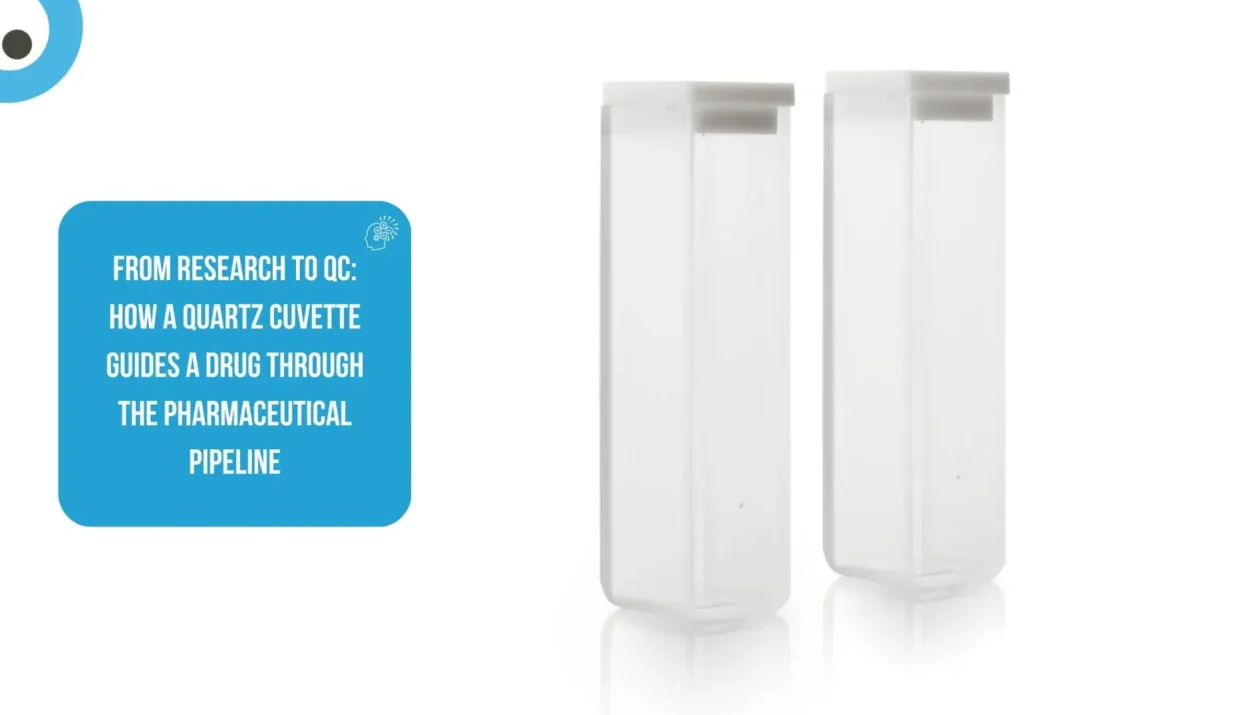
- Regulatory Standard: This stage utilizes matched pairs of quartz cuvettes—one containing the sample and the other containing the reference. Accompanying these cuvettes is a Certificate of Analysis, which is crucial for maintaining traceability and ensuring compliance with Good Manufacturing Practice (GMP) standards. Variations in the cuvette can determine whether a batch passes or fails, with significant financial and safety implications.
Conclusion
The journey of a drug is a story of increasing precision and regulatory scrutiny. The quartz cuvette evolves with this journey: from a sensitive micro-vessel in research to a certified, traceable component in QC. Choosing the right cuvette at each stage of the process is crucial. During research, prioritize UV purity; in development, focus on precise dimensions; for stability testing, emphasize durability; and in quality control, ensure certified performance. Selecting appropriate tools is crucial for maintaining the integrity of millions of dollars in research and, more importantly, for ensuring the safety and effectiveness of the final product. In the high-stakes pharmaceutical industry, reliable data depends on trustworthy tools.