

In the world of high-performance computing, we are hitting a physical wall. For decades, we have relied on electrons moving through copper wires to transport data. But as Artificial Intelligence (AI) and global data consumption explode in 2026, copper is becoming too slow, too hot, and too inefficient.
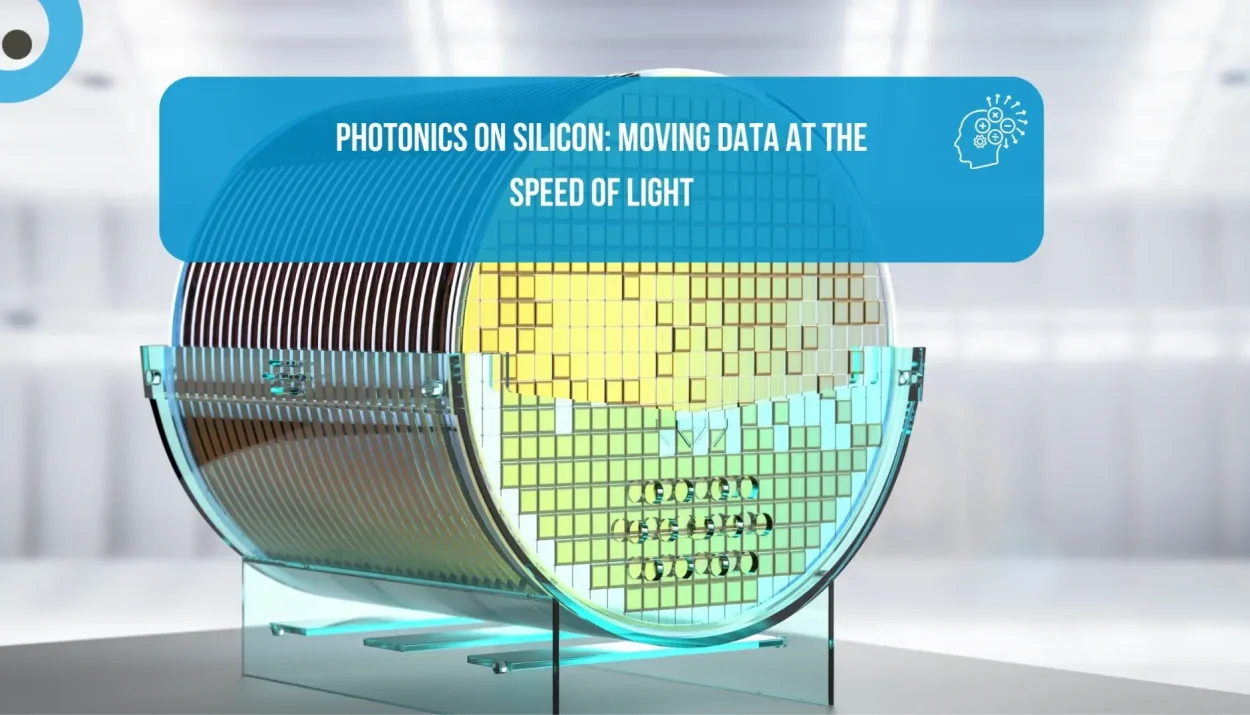
The solution? Silicon Photonics. By integrating lasers and optical signals directly onto a silicon wafer, we are literally moving data at the speed of light.
Why Copper is Reaching its Limit
As we push for faster processing speeds, copper wiring faces two massive hurdles: heat and latency. When electrons move through a metal, they generate resistance that converts to heat. In massive data centers, cooling these “copper bottlenecks” consumes nearly 40% of the total energy.
Furthermore, as data rates increase, signal integrity over copper drops off significantly over long distances. We need a medium that can carry more data with less “friction.”
Enter Silicon Photonics
Silicon photonics is the marriage of two worlds: silicon integrated circuits (the brains of our devices) and optical communications (the fiber-optic networks that power the internet).
By etching optical components—like waveguides, modulators, and photodetectors—directly onto a standard silicon wafer, manufacturers can create chips that “speak” in light.
The Core Benefits for 2026
- Massive Bandwidth: Light can carry vastly more data than electricity. A single fiber-optic stream can replace dozens of copper traces.
- Low Energy Consumption: Because light doesn’t generate heat through resistance, silicon photonics can reduce power consumption in data centers by up to 50%.
- Near-Zero Latency: For AI training models that require instantaneous communication between thousands of GPUs, the speed of light is the only way to prevent processing “lag.”
The 2026 Breakthrough: Co-Packaged Optics (CPO)
The biggest trend this year is Co-Packaged Optics. Previously, optical components were separate modules plugged into a board. In 2026, we are seeing the “optical engine” placed in the same package as the processor.
This proximity reduces the distance the signal has to travel, further reducing power loss and enabling more compact, powerful hardware designs. This is the technology currently enabling the next generation of AI “super-clusters.”
Conclusion
The transition from electronic data transfer to photonic data transfer marks one of the most significant shifts in semiconductor history. Silicon photonics isn’t just a marginal upgrade; it is the foundation for the future of the internet, autonomous vehicles, and artificial intelligence. By leveraging the same silicon manufacturing process that gave us the microprocessor, we are now able to scale the speed of light for the masses.