

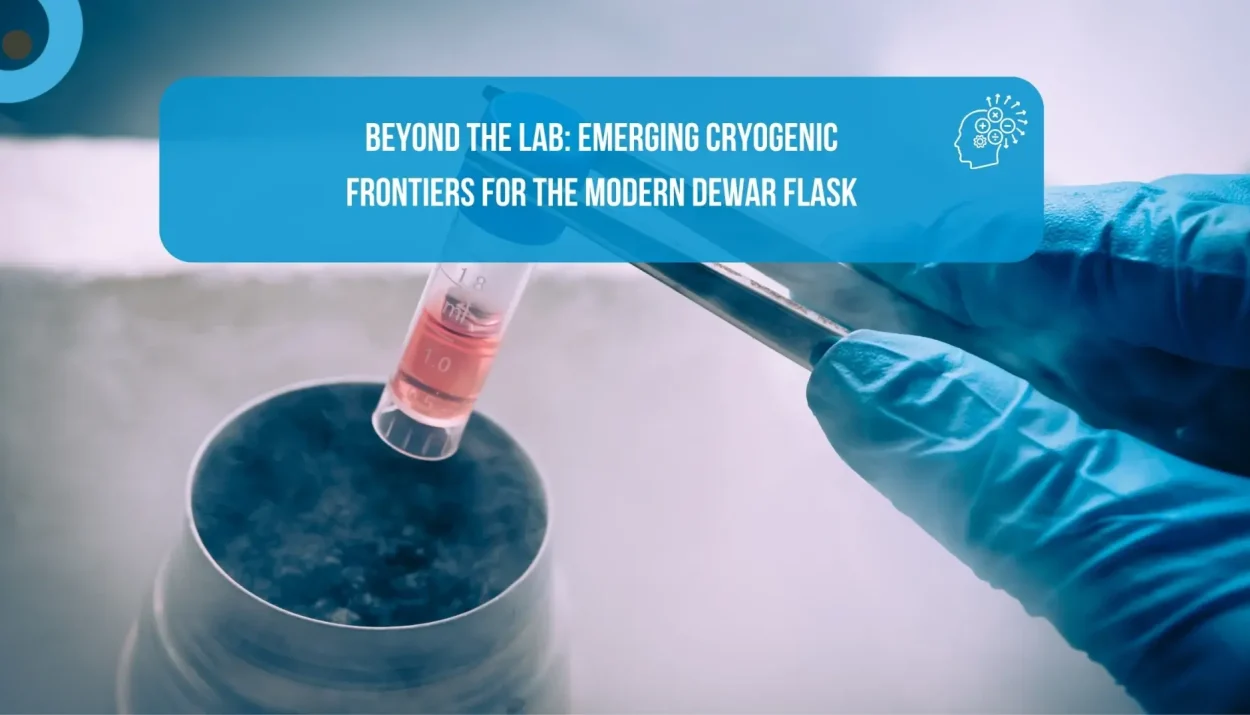
For over a century, the Dewar flask, an iconic, double-walled, vacuum-insulated vessel, has been synonymous with storing liquid nitrogen in laboratories. Its classic silvered silhouette is a fixture in biology and chemistry departments worldwide. Now, a quiet revolution is underway. The genius of Sir James Dewar’s invention is being scaled and re-engineered for transformative 21st-century technologies. Today’s modern Dewar flasks are more than storage containers. They enable breakthroughs ranging from the quantum realm to outer space.
The Core Evolution: From Static Storage to Dynamic Enabler
The classic lab Dewar was designed for preservation. The modern Dewar is engineered for performance under extreme conditions. Advances in materials science, vacuum technology, and precision engineering have created flasks that are smarter, tougher, and more efficient. This evolution is unlocking new applications in which maintaining ultra-low temperatures isn’t just convenient; it’s the very foundation of the technology.
Quantum Computing: Housing the Qubits of Tomorrow
The most promising quantum computers (using superconducting qubits) must operate within a fraction of a degree above absolute zero (-273°C). This extreme cold eliminates thermal noise, allowing fragile quantum states to persist.
- The Dewar’s Role: Modern cryostats are essentially highly sophisticated, multi-stage Dewar systems that create and maintain this deep cryogenic environment. They are complex, integrated vessels that house not just the coolant (often liquid helium), but also the quantum processor itself, along with intricate shielding and wiring.
- Advanced Dewar-based cryogenics are essential for scalable quantum computing. The flask serves as the foundational environment for quantum processors.
Aerospace & Green Energy: Powering the Future with Cold Fuels
The shift toward sustainable rocket propulsion and energy storage is a cryogenic challenge.
- Space Launch: Rockets like SpaceX’s Starship use liquid oxygen (LOX) and liquid methane. Others use liquid hydrogen. These fuels must be stored at cryogenic temperatures to achieve high density and efficiency. Modern, large-scale transport Dewar’s and fuel tanks are monumental applications of vacuum insulation. They are designed to withstand immense pressure and prevent ‘boil-off’ during the countdown.
- Hydrogen Economy: For green hydrogen to become a viable transport fuel, it must be liquefied at -253°C. Massive spherical Dewar tanks at production sites, specialized cryogenic trailers for transport, and station storage all use advanced vacuum-insulation technology. This technology is derived from the Dewar principle. Minimizing loss is key to economic viability.
Astrophysics & Sensing: Listening to the Universe’s Whispers
To detect the faintest signals from space, sensors must be incredibly cold to reduce their own thermal noise.
- Space Telescopes: Instruments on telescopes like the James Webb Space Shield use multi-layer sunshields. Ground-based detectors often sit inside liquid-helium-cooled Dewar cryostats. This cooling achieves the sensitivity needed to observe distant galaxies or search for exoplanets.
- SQUID Magnetometers: These ultra-sensitive devices are used in brain imaging (MEG) and mineral exploration. They need liquid-helium-cooled Dewar’s to work. The cooling lets them measure magnetic fields a billion times weaker than Earth’s.
High-Tech Manufacturing & Materials Science
- Cryogenic Treatment: “Super-cooling” metals and alloys in controlled Dewar-like chambers can enhance their wear resistance, durability, and performance, a process used for everything from aerospace components to high-end automotive parts.
- Superconducting Magnets: MRI machines and particle accelerators like the LHC use massive magnets. These only superconduct when cooled by liquid helium, which is circulated within a complex Dewar-based cryogenic system.
Conclusion: The Dewar as a Keystone of Modern Innovation
The Dewar flask’s journey from lab staple to cornerstone of advanced technology shows the enduring power of a brilliant idea: perfect thermal isolation. It is no longer just a container for cold liquids. It now serves as the critical chamber for the quantum age, powers green energy and space exploration, and astrophysics.
As these emerging fields accelerate, the demands on Dewar technology will grow, driving innovation toward even more efficient insulation, smarter monitoring systems, and more robust designs. The modern Dewar flask has successfully transcended its original purpose, proving that sometimes, the tools that enable the next great leap forward are those we have been perfecting all along. Its future looks as brilliantly cold and full of potential as the contents it was designed to hold.