

In the world of Electron Microscopy, the way you mount your sample is just as important as the microscope itself. Carbon-conductive tape (often referred to as SEM tape) is the standard adhesive used to secure specimens while keeping them electrically grounded.
Without proper grounding, samples can charge under the electron beam, leading to distorted images and data artifacts. This guide breaks down the variations and technical specs you need to know when sourcing high-quality carbon tape from providers.
What is Carbon Conductive Tape?
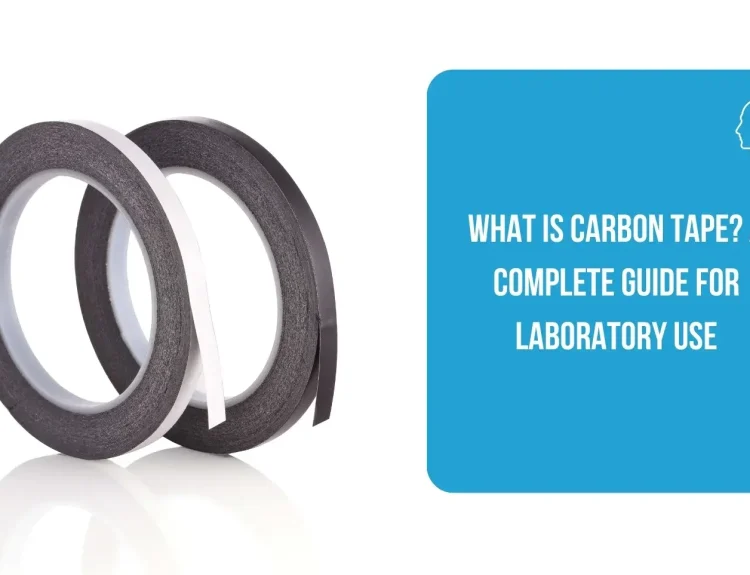
Carbon tape is a specialized adhesive, usually double-sided, composed of a thin carrier film coated with a carbon-filled acrylic adhesive. Unlike household tapes, it is designed to be:
- Conductive: It provides a low-resistance path (< 5 Ω/sq) for electrons to flow to the ground.
- Non-Porous: It won’t absorb your samples, making it ideal for powders and fibers.
- Low Outgassing: It won’t release gases that contaminate the high-vacuum environment of an SEM chamber.
Variations: Finding the Right Fit
While most carbon tape looks similar, different versions are optimized for specific research needs.
Standard Double-Sided Carbon Tape
The most common lab staple. It uses a non-woven liner coated on both sides with carbon adhesive.
Best for: General sample mounting on SEM stubs.
Thickness: Typically, around 160 microns.
High-Purity (Extra Pure) Tape
Engineered for sensitive EDS (Energy Dispersive Spectroscopy). This variation contains only trace amounts of aluminum (Al) and silicon (Si), ensuring that the background signal doesn’t interfere with your sample’s elemental analysis.
Ultra-Smooth / Aluminum-Backed Tape
Some variations use an aluminum foil core rather than a nonwoven fabric. This provides a much smoother surface.
Best for: Analyzing fine powders and small fibers at high magnification, where a rough background would be distracting.
Carbon Conductive Tabs (Pre-Cut)
If you don’t want to fumble with scissors, pre-cut circles (tabs) are available in diameters like 8mm, 12mm, and 25mm to match standard SEM stub sizes perfectly.
Technical Checklist
Before you add a roll to your cart, check these four critical specifications:
| Feature | What to Look For | Why it Matters |
| Purity | >99% Carbon | Minimizes background noise in EDS/X-ray analysis. |
| Operating Temp | -20°C to +60°C | Ensures the adhesive doesn’t melt or fail during imaging. |
| Width | 8mm, 12mm, 20mm | Should match your stub or sample holder size. |
| Resistance | < 5 Ω/sq | Essential for preventing sample charging artifacts. |
Conclusion
Carbon conductive tape connects your sample to your data. For routine SEM, standard double-sided 8mm tape suffices. Choose High-Purity tape for trace element analysis to ensure clean results.
We offer tapes up to 50mm wide for samples ranging from small grains to large wafers.