


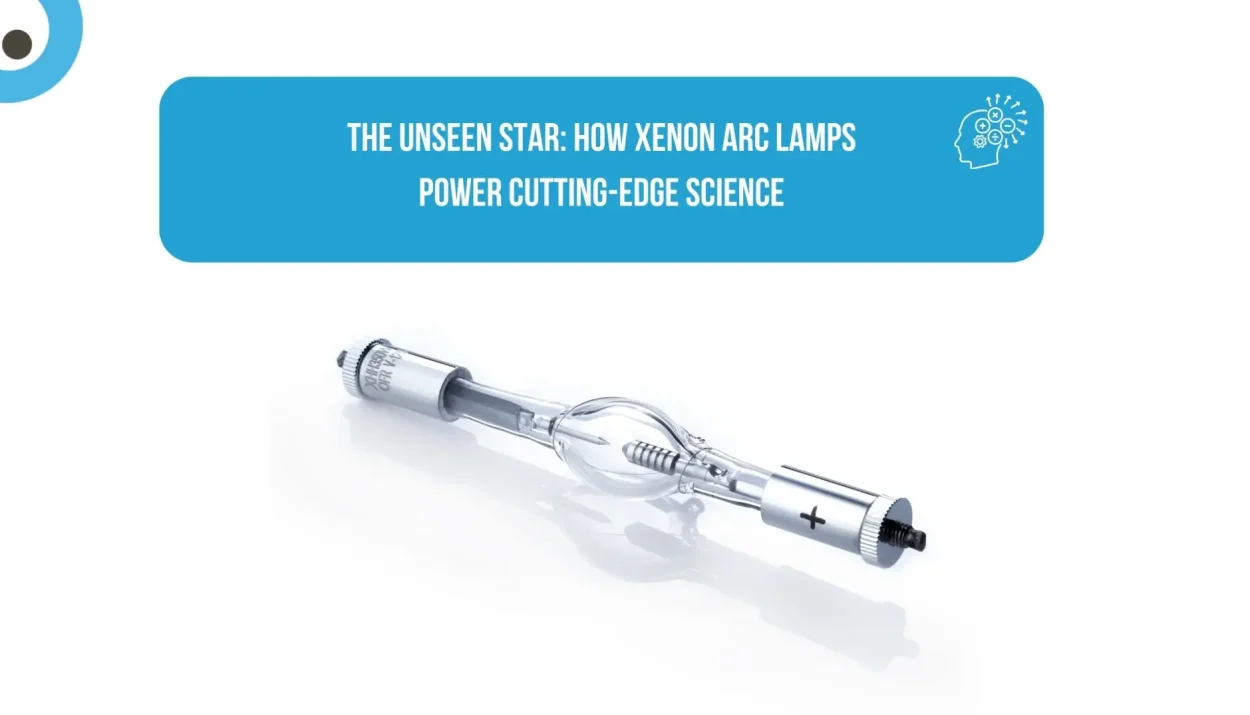
While famous for cinema projection, the xenon arc lamp’s true strength is its quiet, vital role in scientific discovery. In labs worldwide, from pharmaceuticals to satellite testing, these lamps serve as essential synthetic suns and spectroscopic tools. This blog explores why this decades-old technology still leads in science.
The Core Advantage: A Miniature Sun in a Quartz Bulb
Xenon lamps gain scientific value from their spectral output. Unlike lasers (single-wavelength) or LEDs (narrow-band), a high-pressure xenon arc emits a continuous, smooth spectrum from deep UV to visible and near-infrared light.
This output closely matches natural sunlight according to the CIE D55 standard (CIE stands for the International Commission on Illumination, and D55 is a standard daylight illuminant). This similarity is not just convenient but critical for many advanced scientific instruments.
Key Applications: Illuminating Discovery
Solar Simulation: Testing Under the Perfect Sun
How do you test satellite panels, new photovoltaic materials, or plastic’s weathering resistance without waiting years for sun exposure?
The Solution: Xenon-based solar simulators and weathering chambers.
Why Xenon Arc Lamp?
Their full-spectrum output lets researchers closely replicate solar radiation, accelerating material degradation studies and calibrating space equipment with confidence. Filters fine-tune the output for specific conditions, from AM0 (extraterrestrial sunlight) to AM1.5 (terrestrial sunlight).
Spectroscopy: The Fingerprint Reader for Molecules
Spectrometers identify materials by how they absorb or emit light. The brighter and broader the source, the clearer the fingerprint.
The Solution: Xenon lamps are the preferred light source for UV-Vis-NIR (ultraviolet-visible-near-infrared) spectrophotometers and fluorescence spectrometers.
Why Xenon? Their intense, continuous output provides a powerful “searchlight” for probing samples. It enables trace-element detection, chemical-bond analysis, and real-time reaction monitoring with high sensitivity and speed.
Stepper Lithography: Etching the Nano-World
Microchips are made using photolithography, where light etches patterns onto silicon. Legacy and critical fabrication still use DUV lithography with xenon-based lamps.
Why Xenon? With mercury, they produce intense UV lines (436nm “g-line,” 365nm “i-line”) to resolve microscopic features. They are a robust choice for specialized semiconductor production.
Other Critical Roles:
Flow Cytometry: Xenon lamps provide excitation light for rapid cell analysis and sorting.
Cinematography & Spectral Imaging: Used in microscopes for creating high-dynamic-range (HDR, which captures both very bright and very dark details) images of tissues or materials.
Calibration: Serves as a standard light source for calibrating (adjusting and confirming the accuracy of) other optical sensors and cameras, due to its stable, predictable output.
The Competitive Landscape: Why Not LED or Laser?
It’s a fair question. LEDs and lasers often win on efficiency, longevity, and low heat, but xenon stays essential in science for three reasons:
Spectral Breadth: No single LED matches xenon’s instant, continuous UV-to-IR spectrum.
High Intensity & Point-Source: The tiny, bright arc enables excellent collimation (making light rays parallel) and focusing, which are vital for spectrometers.
Proven Stability & Accuracy: Decades of data and calibration rely on xenon’s spectral reliability.
The trade-off: higher energy use, heat, and more bulb replacements. Still, for many, the light’s fidelity is essential.
Conclusion: A Legacy of Light with a Bright Future
The xenon arc lamp is not just old technology; its sun-like spectrum and intensity keep it the gold standard for light quality, shaping data quality.
As scientific needs evolve, ultrafast spectroscopy, single-molecule imaging, and exoplanet atmosphere simulation demand stable, broad-spectrum sources. While solid-state light sources may progress, xenon’s scientific role appears secure for the next generation of discovery, remaining a vital source at the forefront of scientific advancement.