

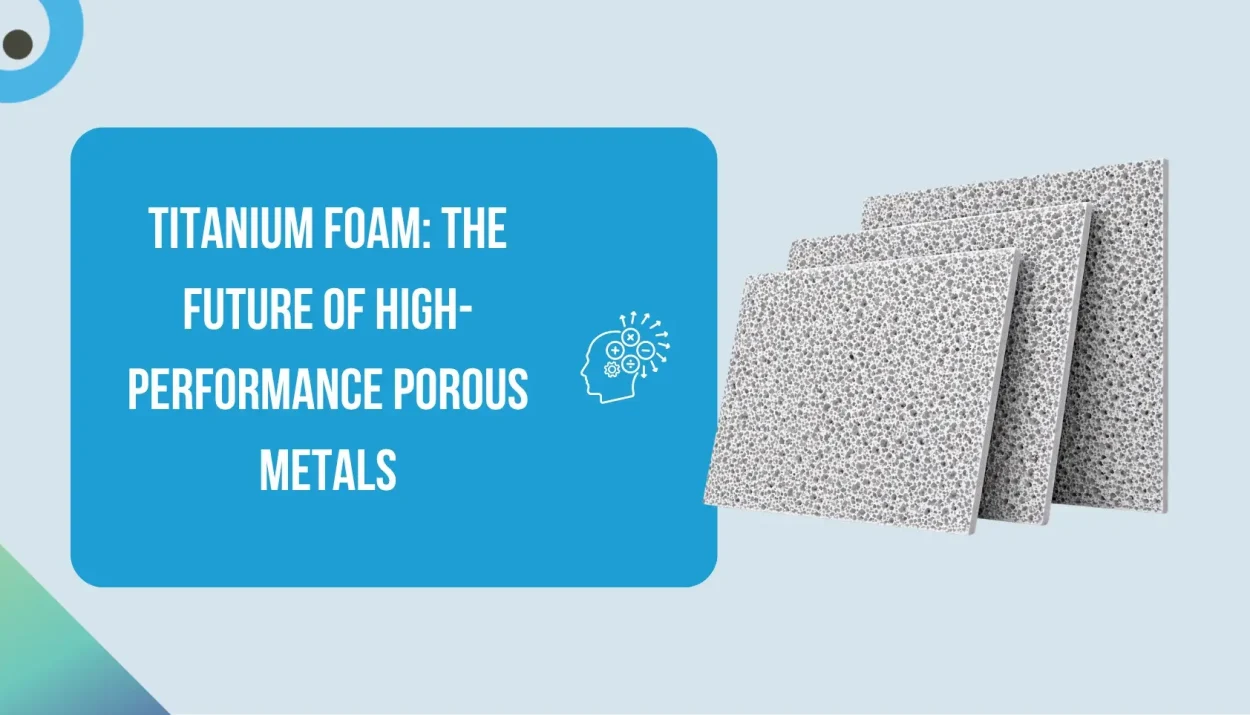
Titanium Foam, a super-material, combines titanium’s strength and corrosion resistance with its porous structure, making it lightweight yet robust.
Whether you are designing next-generation medical implants or high-efficiency hydrogen fuel cells, understanding the nuances of titanium foam is key to optimizing your project.
What is Titanium Foam?
Titanium foam is produced by powder metallurgy or space-holder techniques, yielding a metallic skeleton with adjustable, interconnected pores and a high surface area.
Key Performance Advantages:
- Biocompatibility: Titanium foam is suitable for medical use because its porous structure allows for osseointegration (the process where bone grows into the foam, bonding the material to the body).
- High Porosity: The foam usually has porosity between 50% and 90% (meaning that half to nearly all its volume is empty space), allowing gases and liquids to pass through easily.
- Corrosion Resistance: Highly resistant to seawater, acids, and bodily fluids, outperforming stainless steel foams.
- Thermal Management: The foam efficiently transfers heat because it has a high surface-area-to-volume ratio (a lot of outer surface area compared to its volume).
Variations: Choosing the Right Porosity
When buying from a manufacturer, specify the exact structural details (such as pore size and density) required for your intended use of the foam.
Sintered Titanium Foam Sheets
These are thin, flat substrates often used as Gas Diffusion Layers (GDL) in PEM electrolyzes. They provide the electrical conductivity needed while allowing hydrogen and oxygen to pass through freely.
High-Porosity Spherical Foam
Often used in aerospace and high-end filtration, this variation features uniform, spherical pores. This symmetry ensures predictable fluid flow and mechanical stress distribution.
Asymmetric Titanium Foam
This features a gradient of pore sizes, with larger pores (holes that let particles through) on one side and finer pores (smaller holes) on the other. This is ideal for multi-stage filtration, when you need to capture particles of different sizes in a single pass.
Essential Specifications
To ensure you get a high-quality product that meets industrial standards, keep this checklist handy during your procurement process:
| Feature | Technical Range | Why it Matters |
| Purity Grade | Grade 1 or Grade 2 (CP Ti) | Higher purity ensures better corrosion resistance and biocompatibility. |
| Pore Size | 10 µm 500 µm | Determines filtration efficiency and how easily bone/tissue can grow into it. |
| Relative Density | 10% to 40% of solid Ti | Affects the overall weight and the “stiffness” (Young’s Modulus) of the part. |
| Shape/Form | Sheets, Discs, Rods, Tubes | Choosing a near-net shape reduces expensive machining waste. |
Questions to Ask Your Supplier:
Is it Closed-Cell or Open-Cell? For filtration and medical use, you usually need Open-Cell foam, which has interconnected pores (holes that are connected to allow fluid flow). Closed-cell foam, in contrast, has isolated pores that block fluid flow.
What is the Oxygen Content? A high oxygen content can make titanium more brittle, or more likely to crack. Make sure your supplier provides a COA (Certificate of Analysis) listing the exact oxygen content of the foam.
Are Custom Dimensions Available? Titanium is very hard to cut without EDM (Electrical Discharge Machining), a specialized process that uses electrical sparks to shape metal. Ordering custom sizes helps you avoid extra cutting steps, saving time and expense.
Conclusion
Titanium foam bridges biology and engineering. It lightens aerospace components and improves the performance of bone implants, showcasing unmatched versatility. By prioritizing Grade purity and pore interconnectivity, you maximize the potential of this high-porosity metal.