
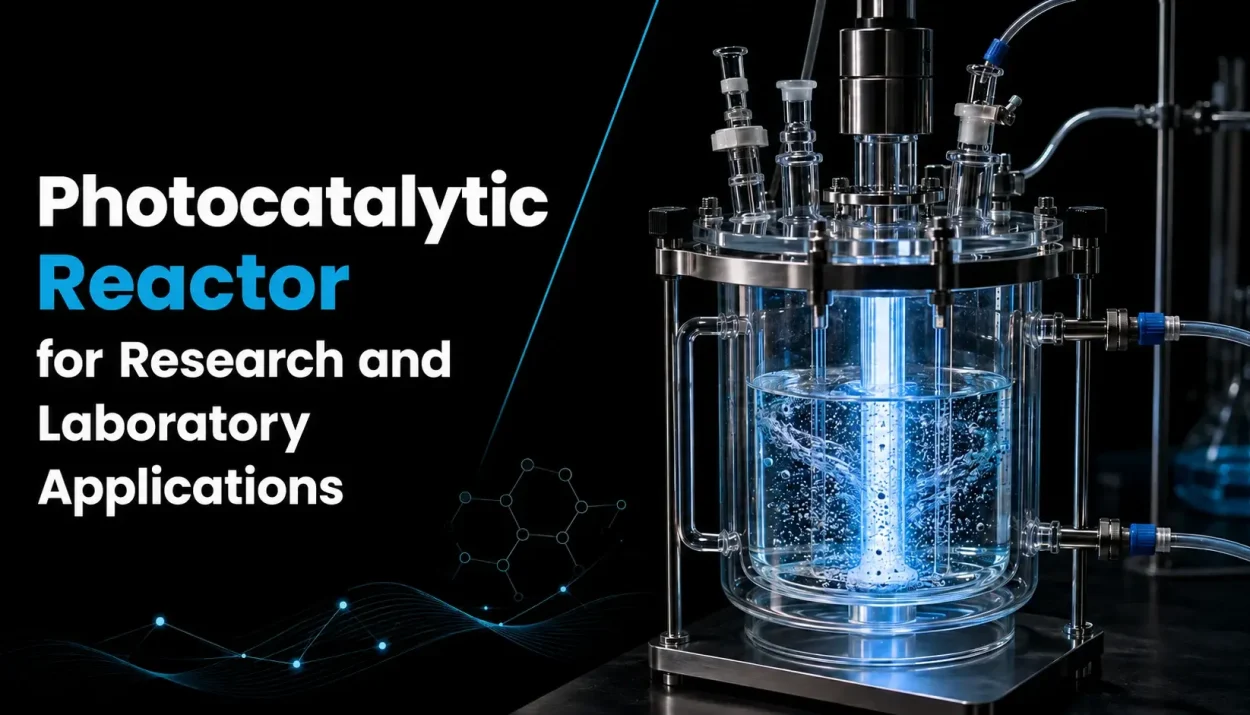
A photocatalytic reactor is a specialized laboratory system used to investigate chemical reactions that are accelerated by a photocatalyst in the presence of light. It provides researchers with a controlled environment for studying how light, catalysts, reactants, and reaction conditions interact.In research centers, photocatalytic reactors are particularly valuable because they allow experiments to be performed under controlled and repeatable conditions. Researchers can modify individual parameters and observe how those changes affect reaction efficiency, product formation, and catalyst performance.
What Is a Photocatalytic Reactor?
A photocatalytic reactor is designed to bring a photocatalyst, reactant, and light source together under controlled experimental conditions.
A typical research setup may include:
- Reaction vessel or reactor chamber
- UV, visible, or other selected light source
- Photocatalyst
- Stirring or mixing system
- Temperature control
- Sampling port
- Gas or liquid inlet and outlet
- Monitoring or measurement instruments
The exact configuration depends on whether the research involves liquid-phase reactions, gas-phase reactions, or specialized photocatalytic processes.
How Does a Photocatalytic Reactor Work?
The basic principle is relatively straightforward. When light with an appropriate wavelength reaches the photocatalyst, it can activate the catalyst and generate reactive charge carriers. These participate in reactions at the catalyst surface.
A simplified experimental sequence is:
Light source → Photocatalyst activation → Formation of reactive species → Reaction with target compounds → Products
The reactor’s role is to maintain suitable contact between the light, catalyst, and reactants while allowing researchers to control and measure the reaction.
Role in Research Centers
Photocatalytic reactors are commonly used as experimental platforms rather than simply as production equipment. They allow research teams to investigate fundamental reaction mechanisms and evaluate new photocatalytic materials.
For example, a research center may develop a new semiconductor-based photocatalyst. Instead of immediately scaling up the material, researchers can first test it in a controlled reactor and compare its performance with existing catalysts.
This makes the reactor an important link between material development, experimental validation, and process optimization.
Applications of Photocatalytic Reactors
1. Water Treatment Research
One important area of research is the photocatalytic degradation of organic contaminants in water.
Researchers can introduce a target compound into a controlled aqueous system and investigate how effectively a photocatalyst breaks it down under illumination.
Parameters such as catalyst concentration, light intensity, reaction time, pH, and initial contaminant concentration can be systematically varied.
2. Environmental Research
Photocatalytic reactors can be used to study pollutant removal or transformation in environmental systems.
Research may focus on compounds such as dyes, pharmaceutical residues, pesticides, or other model contaminants. The reactor enables researchers to examine degradation behavior and identify suitable operating conditions.
3. Hydrogen Generation Studies
Photocatalytic water splitting and related reactions are important areas of renewable-energy research.
Researchers can use specialized photocatalytic reactors to investigate hydrogen generation under controlled illumination. Gas collection and analytical techniques can then be used to evaluate the amount and composition of gases produced.
4. CO2 Conversion Research
Another developing field is photocatalytic carbon dioxide conversion. Researchers investigate whether photocatalysts can use light energy to transform CO2 into useful chemical products.
A controlled reactor allows systematic investigation of variables such as catalyst composition, light wavelength, gas flow, pressure, and reaction time.
5. Catalyst Development
Before a newly synthesized photocatalyst can be considered for practical applications, its performance needs to be evaluated.
A photocatalytic reactor allows researchers to compare materials under similar experimental conditions and study:
- Photocatalytic activity
- Reaction kinetics
- Catalyst stability
- Selectivity
- Reusability
- Light-response behavior
Importance of Light Source Selection
Light is one of the most important components of a photocatalytic experiment. Different photocatalysts respond to different wavelengths.
Depending on the research objective, a reactor may use UV, visible, or simulated solar illumination.
Researchers need to consider parameters such as:
- Wavelength
- Light intensity
- Irradiation distance
- Exposure time
- Light distribution
- Reactor geometry
Consistent illumination is especially important when comparing different photocatalysts because changes in light conditions can influence the experimental results.
Reactor Design Matters
The design of a photocatalytic reactor can significantly affect experimental performance. Light must reach the photocatalyst effectively, while the reactants must remain sufficiently mixed.
For laboratory research, reactor designs may include:
- Batch reactors
- Continuous-flow reactors
- Slurry reactors
- Immobilized-catalyst reactors
- Gas-phase reactors
A batch reactor is often convenient for laboratory studies because researchers can easily control reaction time and collect samples at different intervals. Continuous-flow configurations, on the other hand, can be useful when studying longer-term operation and process stability.
Parameters Researchers Can Study
A major advantage of using a controlled photocatalytic reactor is the ability to change one experimental parameter at a time.
Researchers may investigate the influence of:
Experimental parameters studied in a photocatalytic reactor
| Parameter | Research Significance |
|---|---|
| Catalyst loading | Determines available active material |
| Light wavelength | Influences catalyst activation |
| Light intensity | Affects photon availability |
| Reaction time | Helps determine reaction kinetics |
| pH | Can influence surface chemistry |
| Temperature | May affect reaction behavior |
| Reactant concentration | Helps evaluate reaction kinetics |
| Mixing rate | Influences catalyst-reactant contact |
| Catalyst particle size | Can affect surface area and activity |
Systematically controlling these factors helps research teams develop reproducible experimental data.
Photocatalytic Reactor for Scale-Up Research
Laboratory experiments are often the first step toward larger-scale photocatalytic systems. A research center may begin with a small reactor to understand catalyst behavior and reaction kinetics before moving toward a pilot-scale design.
However, scaling up is not simply a matter of increasing reactor volume. Researchers must also consider light penetration, photon distribution, mass transfer, mixing, catalyst recovery, and energy consumption.
This is why laboratory-scale photocatalytic reactors are important in process-development research: they provide experimental data that can guide the design of larger systems.
What Makes a Research-Grade Reactor Useful?
For research applications, flexibility is often more important than simply achieving a high reaction rate. A useful laboratory reactor should allow researchers to adjust experimental parameters and collect reliable data.
Features that may be valuable include:
- Controlled illumination
- Temperature regulation
- Efficient mixing
- Easy catalyst loading and recovery
- Sampling access
- Gas or liquid connections
- Compatibility with analytical instruments
- Replaceable light sources
- Adjustable experimental conditions
These features make the reactor adaptable to different research projects, rather than limiting it to a single reaction.
Safety Considerations
Photocatalytic experiments may involve UV radiation, reactive chemicals, gases, pressurized components, or elevated temperatures depending on the research setup.
Research laboratories should therefore use suitable shielding, ventilation, personal protective equipment, and chemical-handling procedures. UV sources should be properly enclosed or shielded to prevent unnecessary exposure.
Researchers should also follow the reactor manufacturer’s operating instructions and the laboratory’s applicable safety procedures.
Conclusion
A photocatalytic reactor provides research centers with a controlled platform for exploring the interaction between light, catalysts, and chemical reactions. Its applications extend across environmental remediation, water treatment, hydrogen generation, CO2 conversion, catalyst development, and advanced materials research.
More importantly, the reactor enables researchers to move beyond simply asking whether a photocatalyst works. They can investigate why it works, under which conditions it performs best, how stable it remains, and whether the process can eventually be scaled.
For modern research laboratories, a well-designed photocatalytic reactor can therefore serve as both an experimental tool and a foundation for developing the next generation of light-driven chemical processes.