

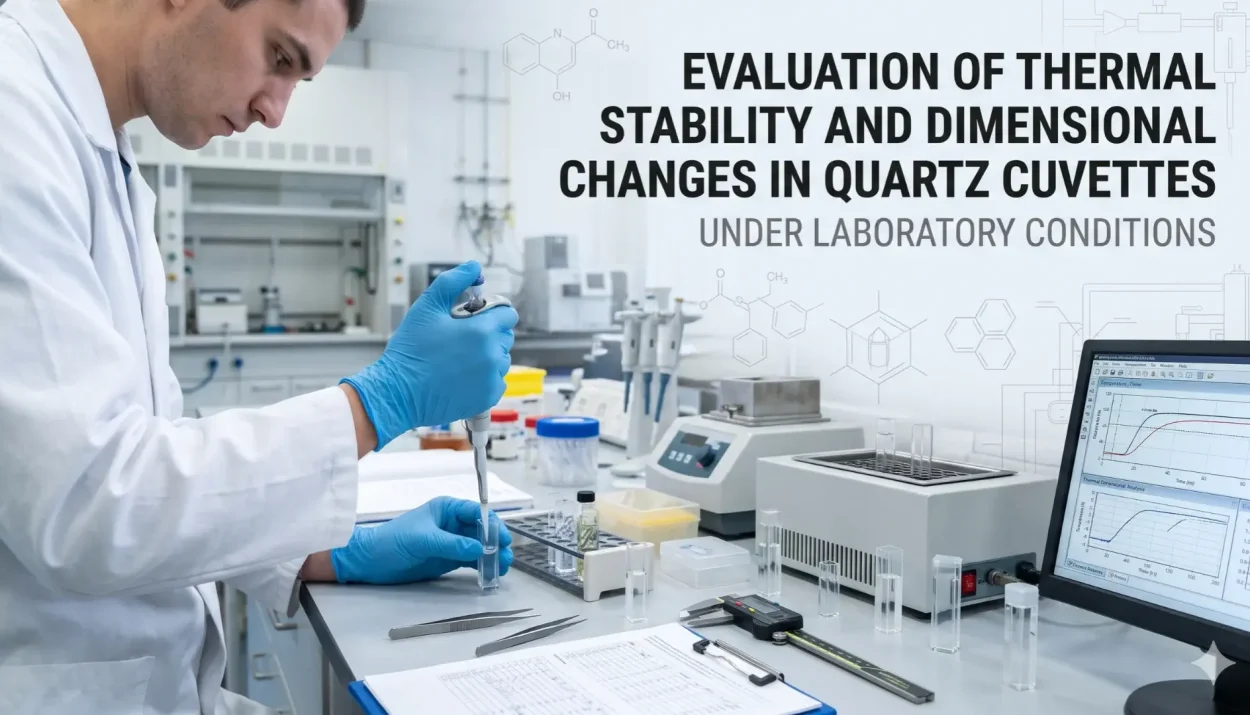
Quartz cuvettes are important optical components used in spectroscopic investigations, material characterization, and laboratory experiments. Their transparent structure allows light to pass through a sample while maintaining a defined optical path. The cuvette’s quality and dimensional accuracy can directly affect measurement consistency.
Fused quartz is particularly valuable in optical applications because it exhibits very low thermal expansion compared with many conventional glass materials. This characteristic reduces dimensional changes as the surrounding temperature varies. Research on fused quartz has demonstrated its suitability for precision dimensional and optical applications, including studies involving highly sensitive measurements of thermal expansion.
Despite these advantages, quartz cuvettes are not immune to temperature effects. Sudden temperature changes, uneven heating, repeated thermal cycling, surface defects, and differences in material composition may affect long-term performance. Understanding these factors is essential when using quartz cuvettes in experiments involving heated samples, temperature-controlled environments, or repeated laboratory testing.
Material Characteristics of Quartz Cuvettes
Quartz cuvettes are generally manufactured from optical-grade fused quartz or fused silica. Their performance depends on the quality of the starting material and the manufacturing process.
Important material characteristics include:
- Optical transparency: Allows light transmission across the intended wavelength range.
- Low thermal expansion: Helps maintain dimensional stability during temperature changes.
- Thermal resistance: Supports use in controlled heating environments, depending on the cuvette’s construction and the manufacturer’s specifications.
- Chemical durability: Resists many laboratory liquids and solutions.
- Structural uniformity: Helps maintain consistent wall thickness and optical path geometry.
- Surface quality: Reduces unwanted scattering and optical distortion.
The internal composition and thermal history of fused quartz can influence its physical properties. Research has shown that hydroxyl content and fictive temperature can affect thermal expansion behavior.
Thermal Stability of Quartz Cuvettes
Thermal stability refers to a material’s ability to retain its physical structure and functional characteristics under temperature changes.
For quartz cuvettes, thermal stability involves several important properties.
Resistance to Temperature Variation
Quartz has low thermal expansion, which helps limit dimensional changes during gradual heating and cooling. This is beneficial in laboratory environments where sample temperatures may change during an experiment.
However, the actual performance depends on the material grade, manufacturing quality, cuvette design, and temperature distribution.
Behavior During Repeated Heating
Repeated heating and cooling may change an optical component’s internal stress distribution. Although fused quartz generally offers good thermal stability, uneven temperature distribution can create localized stress.
The effect may become more significant when a cuvette is heated rapidly or when different parts of its structure experience different temperatures.
Thermal Shock Resistance
Thermal shock occurs when a material experiences a rapid temperature difference between its surfaces or between different sections of its structure.
For quartz cuvettes, sudden exposure to a hot environment followed by rapid cooling may increase the possibility of cracking or structural damage. Gradual temperature adjustment is therefore preferable when working with temperature-sensitive optical components.
Influence of Material Quality
The thermal response of fused quartz can vary according to its composition and manufacturing history. Impurities and differences in material processing may influence its thermal and optical behavior.
Research investigating fused quartz has identified relationships between material composition, thermal history, and thermal expansion.
Dimensional Changes Under Laboratory Conditions
Dimensional stability describes a quartz cuvette’s ability to maintain its original shape and measurements during temperature exposure.
Even small dimensional variations can affect the optical path and the sample’s position inside the cuvette.
Changes in Length and Width
Temperature variations may cause slight expansion or contraction of the cuvette. These changes are generally small in high-quality fused quartz, but they can become relevant in precision optical experiments.
Measuring external dimensions before and after temperature exposure can help identify any permanent dimensional change.
Changes in Wall Thickness
Wall thickness is important for maintaining structural strength and optical consistency.
Uneven manufacturing or localized thermal stress may contribute to variations in wall geometry. Such variations can influence light transmission and the consistency of optical measurements.
Changes in Optical Path Length
The optical path length is the distance light travels through the sample inside the cuvette.
If the cuvette dimensions change, even slightly, the optical path may also be affected. This can introduce differences between measurements taken before and after temperature exposure.
Surface Deformation and Structural Defects
High-quality quartz generally maintains good structural stability under suitable operating conditions. However, manufacturing defects, scratches, uneven heating, and mechanical stress may contribute to surface damage.
Inspection of the cuvette before and after thermal exposure can help identify cracks, deformation, surface irregularities, and other visible changes.
Factors Affecting Thermal Stability and Dimensional Behavior
Several factors may influence the performance of quartz cuvettes during laboratory temperature exposure.
| Factor | Possible influence |
| Quartz purity | May influence thermal and optical properties |
| Manufacturing quality | Affects dimensional accuracy and structural uniformity |
| Wall thickness | Influences mechanical strength and heat distribution |
| Heating rate | Rapid heating may increase thermal stress |
| Cooling conditions | Uneven cooling may contribute to internal stress |
| Surface defects | May increase the possibility of damage |
| Thermal cycling | Repeated exposure may reveal changes in structural performance |
| Cuvette construction | Bonded joints and assembled sections may have different temperature limits |
One important consideration is that a cuvette made from a single piece of fused quartz may behave differently from one assembled from bonded sections. The joining material can have a lower temperature tolerance than the quartz itself. Therefore, consider the construction method when selecting a cuvette for heated experiments.
Research Challenges and Limitations
Although quartz offers several advantages for optical applications, evaluating its thermal stability involves certain challenges.
- Measurement sensitivity: Very small dimensional changes require suitable precision instruments.
- Temperature uniformity: Uneven heating can introduce errors into experimental observations.
- Sample variation: Differences in manufacturing batches may influence the results.
- Surface contamination: Residues can affect optical transmission measurements.
- Thermal history: Previous heating or processing conditions may influence the material’s behavior.
- Construction differences: Bonded and single-piece cuvettes may have different temperature limitations.
- Measurement repeatability: Reliable comparisons require consistent positioning and environmental conditions.
Another important limitation is that results obtained from flat fused quartz specimens cannot automatically be applied to complete quartz cuvettes. Cuvette geometry, corners, joints, and manufacturing processes must also be considered.
Applications of Thermal Stability Research
Understanding the thermal behavior of quartz cuvettes is useful in several scientific and industrial research areas.
- UV–Visible spectroscopy: Helps maintain consistent optical measurement conditions.
- Temperature-dependent experiments: Supports investigations involving controlled sample heating.
- Material characterization: Provides insight into optical component performance under changing temperatures.
- Optical instrument development: Helps improve dimensional consistency across components.
- High-temperature research: Supports the selection of suitable cuvette designs for controlled thermal environments.
- Quality control: Helps evaluate the consistency of quartz cuvette manufacturing.
Conclusion
Evaluating thermal stability and dimensional changes in quartz cuvettes is an important area of research in optical materials and laboratory instrumentation. Fused quartz offers valuable characteristics, particularly low thermal expansion, good optical transparency, and structural stability under suitable operating conditions.
However, several factors influence the performance of a quartz cuvette, including material purity, manufacturing quality, wall thickness, surface condition, heating rate, and cooling conditions. A systematic experimental approach combining controlled temperature exposure, dimensional measurement, optical transmission analysis, and surface inspection can provide useful information about the long-term performance of quartz cuvettes.
The investigation also highlights the importance of evaluating complete cuvette assemblies rather than considering only the properties of the raw quartz material. This research can improve quality control, material selection, and optical consistency in laboratory applications.