
Developing advanced composite materials with improved thermal properties is an important research area in materials science and engineering. Modern industrial and research applications increasingly require materials that maintain structural integrity under varying temperature conditions while providing predictable heat-transfer characteristics.
Silicon dioxide nanoparticles are widely investigated as functional nanofillers because of their chemical stability, adjustable surface chemistry, high specific surface area, and availability in different particle sizes and morphologies.
When incorporated into a suitable matrix, SiO₂ nanoparticles can influence the thermal response of the resulting composite. Their distribution within the matrix, interaction with surrounding materials, and concentration can significantly affect heat transfer, thermal expansion, and resistance to temperature-induced degradation.
However, improved thermal performance is not automatic. Poor particle dispersion, particle aggregation, and weak interfacial bonding may limit the expected benefits. Therefore, understanding the relationship between nanoparticle characteristics and composite structure is essential for developing reliable thermal materials.
Thermal Stability of Silicon Dioxide Nanoparticles
Thermal stability refers to a material’s ability to retain its structural and functional properties when exposed to elevated temperatures over a defined period. Silicon dioxide is particularly interesting in this area because of its strong silicon–oxygen bonding network and resistance to many environmental conditions. Its thermal behavior depends on its structure, particle characteristics, surface chemistry, and preparation method.
In nanoparticle-based composites, silica can contribute to the overall thermal response through several mechanisms:
- Structural reinforcement: Silica particles can improve the dimensional stability of certain composite matrices.
- Resistance to thermal deformation: Properly distributed nanoparticles may help restrict matrix movement under temperature variations.
- Interfacial interactions: Strong interactions between silica surfaces and the matrix can influence the composite’s resistance to temperature-induced structural changes.
- Thermal degradation behavior: Incorporating inorganic silica may change the decomposition characteristics of polymer-based composites.
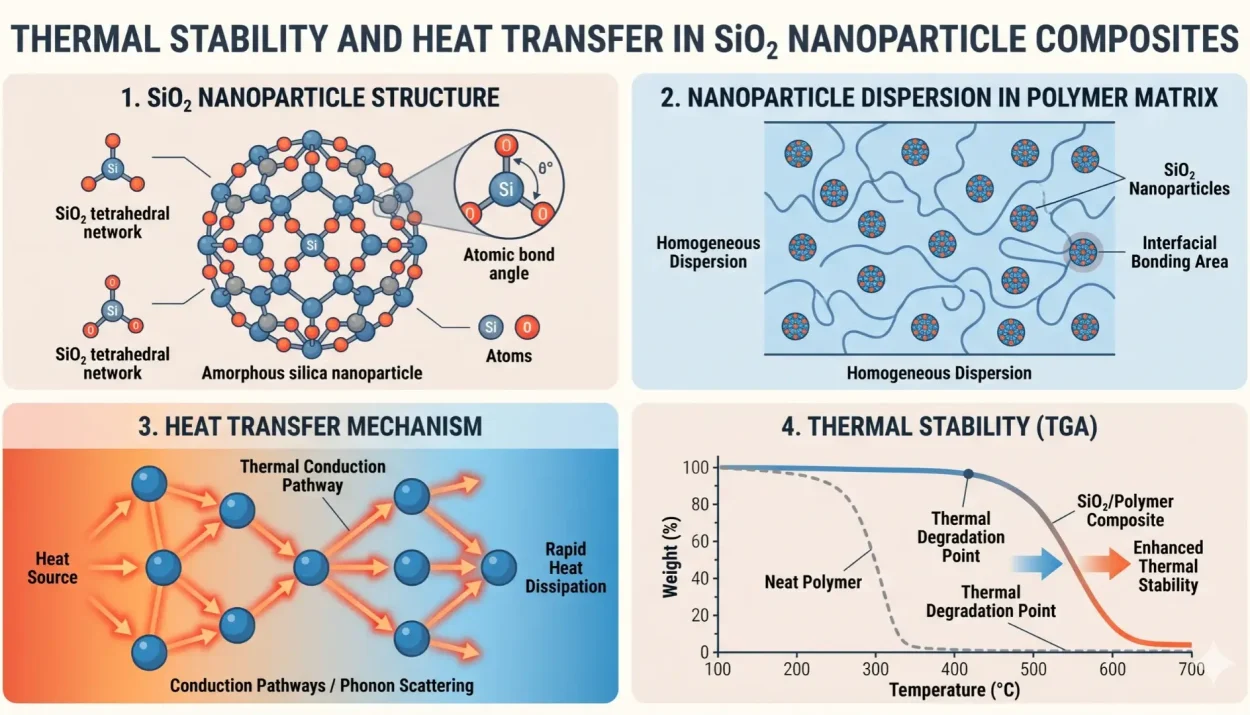
It is important to distinguish the inherent thermal stability of silica from the thermal stability of the complete composite. The surrounding matrix may begin to degrade at temperatures significantly lower than those tolerated by the silica particles.
Heat Transfer Characteristics of Silica-Based Nanocomposites
Heat transfer behavior is an important factor in evaluating the performance of advanced composite materials. The addition of SiO₂ nanoparticles can modify heat movement through a material by changing its internal structure and the interactions between different phases.
Three major mechanisms are relevant to understanding thermal behavior.
Particle Distribution and Heat Transfer Pathways
The distribution of nanoparticles within the matrix influences the uniformity of thermal properties. A homogeneous distribution can provide more consistent material characteristics throughout the composite.
However, excessive particle aggregation can create regions with different thermal responses. Such non-uniformity may affect heat distribution and reduce the predictability of composite performance.
Interfacial Thermal Resistance
The interface between silicon dioxide nanoparticles and the surrounding matrix plays an important role in heat transfer.
Differences in material properties between the inorganic particles and the matrix can create interfacial thermal resistance. This resistance influences the movement of thermal energy across particle–matrix boundaries.
Surface modification techniques can be investigated to improve interfacial compatibility and control the composite’s thermal behavior.
Influence of Nanoparticle Concentration
Nanoparticle loading is another important research parameter. Increasing silica concentration may change the composite’s thermal response, mechanical structure, and density.
Nevertheless, higher nanoparticle concentration does not necessarily produce better heat transfer. At excessive loading levels, particle aggregation and processing difficulties may reduce the nanofiller’s effectiveness.
Therefore, identifying an appropriate concentration range is essential for achieving balanced composite properties.
Influence of Particle Size and Surface Characteristics
Particle size and surface characteristics are fundamental parameters in silica nanoparticle research.
Smaller particles generally provide a larger surface area relative to their volume, creating more opportunities for interaction with the surrounding matrix.
The major characteristics influencing composite performance include:
- Particle size: Influences particle distribution, surface interaction, and composite structure.
- Specific surface area: Determines the available surface for interaction with the matrix.
- Surface functional groups: Influence compatibility, dispersion, and interfacial bonding.
- Particle morphology: Spherical, porous, and irregular particles may produce different composite structures.
- Surface porosity: Can influence the interaction between nanoparticles and surrounding materials.
A systematic investigation of these parameters helps researchers understand how nanoscale characteristics influence the thermal properties of larger composite structures.
Effect of Silica Nanoparticles on Polymer Composite Materials
Polymer-based composites are an important area of investigation for applications of silicon dioxide nanoparticles.
Incorporating silica nanoparticles can influence the mechanical, dimensional, and thermal characteristics of polymer matrices. Depending on the polymer type and processing conditions, silica may improve stiffness, reduce thermal expansion, and alter thermal degradation behavior.
The effectiveness of silica as a nanofiller depends on achieving good compatibility between the nanoparticle surface and the polymer matrix.
Poor compatibility can result in particle agglomeration, non-uniform distribution, and weak interfacial interactions. Surface functionalization and controlled mixing techniques are therefore important considerations during composite preparation.
Researchers can investigate different polymer systems to understand how silica nanoparticle concentration and surface characteristics influence the final material performance.
Characterization Techniques for Thermal Investigation
Reliable characterization is necessary to establish the relationship between silica nanoparticle properties and composite thermal performance.
Several analytical techniques are particularly useful.
Thermogravimetric Analysis (TGA)
TGA is used to investigate changes in sample mass during controlled heating. It helps researchers evaluate thermal degradation behavior, residual material content, and the influence of silica incorporation on composite decomposition characteristics.
Differential Scanning Calorimetry (DSC)
DSC provides information about thermal transitions within a material. It can be used to investigate glass transition behavior, melting characteristics, and other thermal events in composite systems.
Thermal Conductivity Measurement
Thermal conductivity testing helps determine how effectively heat moves through a composite material. Comparing the thermal conductivity of unfilled and silica-filled samples provides useful information about the influence of nanoparticle incorporation.
Scanning Electron Microscopy (SEM)
SEM is useful for examining the surface morphology and particle distribution within composite materials. It can reveal aggregation, structural irregularities, and differences in fracture surfaces.
Fourier Transform Infrared Spectroscopy (FTIR)
FTIR helps identify chemical bonds and functional groups present in silica nanoparticles and composite materials. It can provide information about possible interactions between the nanoparticle surface and the matrix.
X-Ray Diffraction (XRD)
XRD is used to investigate structural characteristics and phase composition. It is particularly useful for distinguishing amorphous and crystalline material characteristics.
Combining these techniques provides a more complete understanding of the relationship between composite structure and thermal performance.
Research Challenges and Future Perspectives
Despite the considerable research interest in silica nanoparticle-based composites, several challenges remain.
One major challenge is achieving consistent nanoparticle dispersion. The tendency of nanoparticles to form aggregates can create non-uniform structures and affect the reliability of thermal measurements.
Another important consideration is interfacial thermal resistance. Even when silica particles are distributed throughout the matrix, poor interfacial compatibility may limit the desired thermal response.
Future research can focus on developing improved surface modification methods, optimizing nanoparticle concentration, and investigating how particle morphology affects composite performance.
Researchers should also conduct comparative studies using different particle sizes, surface treatments, and matrix compositions under identical experimental conditions.
Advanced microscopy, thermal analysis, and controlled temperature testing can provide valuable insights into the relationship between nanoscale structure and macroscopic thermal behavior.
Long-term thermal cycling studies are another promising research direction because they can help evaluate changes in material structure and performance following repeated heating and cooling.
Conclusion
Silicon dioxide nanoparticles represent an important class of inorganic nanofillers for developing advanced composite materials with controlled thermal characteristics. Incorporating them into polymeric, ceramic, and other material systems can influence thermal stability, dimensional behavior, heat transfer, and structural performance.
The resulting properties depend strongly on particle size, surface area, concentration, dispersion quality, interfacial interactions, and matrix composition. Characterization methods such as TGA, DSC, SEM, FTIR, XRD, and thermal conductivity measurement provide essential information for understanding these relationships.
Future investigations should prioritize controlled nanoparticle dispersion, improved interfacial compatibility, and systematic evaluation of thermal behavior under practical operating conditions.
A deeper understanding of these factors can support the development of more reliable silica-based composite materials for advanced engineering, thermal management, protective coatings, and high-performance material systems.