


Multi-Walled Carbon Nanotubes (MWCNTs) are important nanostructured materials widely investigated in advanced materials science because of their distinctive tubular architecture, high aspect ratio, excellent mechanical strength, and electrical conductivity. Their unique structure makes them suitable for developing conductive polymer composites, functional coatings, flexible electronic materials, and advanced conductive networks.
Despite these advantages, achieving uniform dispersion of MWCNTs remains a significant challenge in material processing. Strong van der Waals interactions between individual nanotubes encourage aggregation and bundling, which can influence the distribution of conductive pathways within a material.
The relationship between nanotube bundling, dispersion quality, and electrical conductivity is therefore an important area of research. Understanding how nanotubes interact, distribute, and form interconnected networks can help researchers optimize the electrical performance of MWCNT-based materials.
This article explores the physical mechanisms behind nanotube aggregation, how dispersion quality influences conductive network formation, and the characterization techniques used to investigate these properties.
Understanding Nanotube Bundling in MWCNT Materials
Nanotube bundling refers to the association of multiple carbon nanotubes into interconnected groups or rope-like structures.
MWCNTs have relatively large surface areas and elongated geometries. Their neighboring nanotubes can interact through van der Waals forces, encouraging them to form bundles during manufacturing, storage, or processing.
Several factors contribute to nanotube bundling.
Van der Waals Interactions: Attractive forces between neighboring nanotube surfaces encourage aggregation, particularly at higher concentrations.
High Aspect Ratio: The elongated geometry of MWCNTs increases the possibility of physical entanglement and interaction between neighboring nanotubes.
Surface Characteristics: Surface chemistry, defect distribution, and functional groups influence interactions between individual nanotubes.
Processing Conditions: Mixing intensity, solvent selection, sonication, and drying conditions can influence nanotube bundle formation and distribution.
Material Concentration: Increasing nanotube concentration can increase the frequency of nanotube interactions and the likelihood of network formation and aggregation.
Understanding these factors is essential for controlling the microstructure of MWCNT-based materials.
Dispersion Quality and Its Importance in Nanotube Systems
Dispersion quality describes how uniformly MWCNTs are distributed within a selected liquid medium or solid material matrix.
A well-dispersed system generally contains a more uniform distribution of individual nanotubes and smaller aggregates, while poorly dispersed systems contain larger bundles and localized regions of high nanotube concentration.
Dispersion quality influences several important material characteristics.
Uniform Distribution
Uniform distribution allows nanotubes to participate more consistently in forming conductive networks throughout the material.
In polymer composites, this can help reduce localized concentration differences and improve the consistency of electrical properties.
Reduction of Large Agglomerates
Large nanotube agglomerates may create non-uniform regions within a composite structure.
Controlling their formation can improve material homogeneity and provide more predictable electrical behavior.
Interfacial Compatibility
The interaction between MWCNTs and the surrounding matrix influences their distribution and structural integration.
Surface functionalization and appropriate matrix selection can improve compatibility and support more uniform nanotube incorporation.
Long-Term Dispersion Stability
A dispersion may initially appear uniform but gradually sediment or aggregate during storage.
Therefore, dispersion quality should be evaluated over time rather than only immediately after preparation.
Relationship Between Nanotube Bundling and Electrical Conductivity
Electrical conductivity in MWCNT-based materials depends strongly on the formation of interconnected conductive pathways.
Individual nanotubes can contribute to electrical transport, while nanotube-to-nanotube contacts enable the formation of larger conductive networks.
However, the relationship between bundling and electrical conductivity is complex.
Formation of Conductive Networks
When MWCNTs are distributed throughout a material, they can establish interconnected pathways that support electron transport.
The number, distribution, and connectivity of these pathways influence the overall electrical performance.
A sufficiently connected nanotube network can produce conductive behavior even when the nanotube concentration is relatively low.
Influence of Excessive Bundling
Large bundles may create localized conductive regions while leaving other parts of the material with insufficient nanotube coverage.
This non-uniform distribution can produce variations in electrical conductivity across the sample.
Excessive bundling may also reduce the effective interaction between nanotubes and the surrounding matrix.
Inter-Nanotube Contact Resistance
Electrical transport between individual nanotubes depends partly on the quality of their contact.
Contact resistance can arise at junctions where electrons move from one nanotube to another.
The number of junctions, contact geometry, surface conditions, and separation between nanotubes can influence the electrical characteristics of the complete network.
Role of Nanotube Connectivity
A material may contain a relatively high concentration of MWCNTs but still exhibit inconsistent electrical performance if the nanotubes are not sufficiently interconnected.
The spatial arrangement of nanotubes is therefore as important as their overall concentration.
Research into conductive network formation helps explain why two materials containing similar quantities of MWCNTs may demonstrate different electrical characteristics.
Influence of Dispersion Techniques on Nanotube Structure
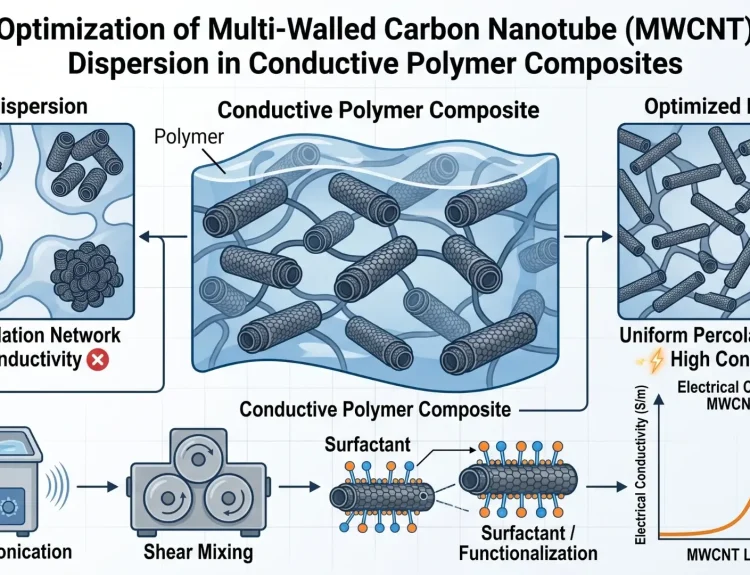
Different dispersion methods are used to separate MWCNT bundles and improve their distribution within liquid media or composite materials.
However, selecting an appropriate technique requires balancing dispersion efficiency with the need to preserve nanotube structure.
Ultrasonication
Ultrasonication is commonly used to separate nanotube aggregates through cavitation and mechanical forces generated within a liquid medium.
It can improve MWCNT dispersion and reduce the size of larger bundles.
However, excessive sonication intensity or prolonged treatment may shorten nanotubes, introduce structural defects, or affect their original morphology.
Mechanical Stirring
Mechanical stirring provides controlled mixing and is often used as an initial dispersion step.
It can help distribute MWCNTs throughout a liquid medium, although it may not completely separate strongly associated nanotube bundles.
High-Shear Mixing
High-shear mixing applies mechanical forces to break down aggregates and improve material distribution.
It can be useful for preparing larger quantities of MWCNT dispersions and polymer-based composites.
Surfactant-Assisted Dispersion
Surfactants can help stabilize nanotube dispersions by interacting with their surfaces and reducing aggregation tendencies.
Surfactant selection depends on the solvent system, nanotube characteristics, and intended application.
However, residual surfactants may influence electrical contact between nanotubes and should be considered during material processing.
Chemical Functionalization
Functionalization introduces selected chemical groups onto nanotube surfaces to modify their interactions with solvents and surrounding materials.
This approach can improve dispersion in suitable systems and enhance compatibility with selected polymer matrices.
Nevertheless, excessive functionalization may introduce structural defects and influence the electrical properties of MWCNTs.
Experimental Characterization of Nanotube Dispersion and Bundling
Scientific characterization is necessary to understand the relationship between nanotube morphology, dispersion quality, and electrical behavior.
Several analytical techniques can provide complementary information.
Transmission Electron Microscopy (TEM)
TEM is useful for investigating the internal and external structural characteristics of MWCNTs. It can help researchers examine nanotube diameter, wall structure, aggregation, and the arrangement of individual nanotubes within bundles. TEM images can provide direct evidence of nanotube bundling and structural changes following dispersion treatment.
Scanning Electron Microscopy (SEM)
SEM provides information about the surface morphology and distribution of nanotubes within a material. It is particularly useful for examining nanotube networks, aggregate distribution, and the microstructure of composite surfaces and fracture sections.
Raman Spectroscopy
Raman spectroscopy is widely used to evaluate the structural characteristics of carbon nanotubes. It provides information about graphitic ordering, defect-related features, and structural changes following different processing conditions. Comparative Raman analysis can help researchers investigate whether intensive dispersion treatments have affected nanotube structure.
Dynamic Light Scattering (DLS)
DLS can provide information about the apparent size distribution of dispersed particles and aggregates in suitable liquid systems.
However, MWCNTs have elongated structures rather than spherical geometries. Their measurements can therefore be influenced by particle orientation, aggregation, and instrument assumptions.
DLS results should be interpreted alongside microscopic observations rather than treated as a direct measurement of individual nanotube length.
Zeta Potential Analysis
Zeta potential measurements can help researchers understand the electrokinetic behavior and relative colloidal stability of MWCNT dispersions.
The results can provide insights into how surface modification, solvent conditions, and pH influence dispersion behavior.
Four-Point Probe Measurement
Four-point probe measurements are useful for evaluating the electrical characteristics of conductive films and selected MWCNT-based structures.
Comparing electrical measurements across samples prepared under different dispersion conditions can help establish relationships between nanotube distribution and electrical performance.
Effect of MWCNT Concentration on Conductive Network Formation
MWCNT concentration is an important parameter influencing conductive network development.
At relatively low concentrations, nanotubes may remain separated by larger distances, limiting the formation of continuous conductive pathways.
As concentration increases, the probability of nanotube contact and network formation generally increases.
At a certain concentration range, a connected conductive network may develop. This phenomenon is commonly associated with electrical percolation.
However, higher MWCNT loading does not automatically guarantee better electrical performance.
Excessive nanotube concentration can encourage aggregation, increase processing difficulty, and produce non-uniform structures.
Consequently, identifying an appropriate concentration range is important to balance dispersion quality and conductive network connectivity.
Role of MWCNT Dispersion in Polymer-Based Composite Materials
MWCNTs are frequently incorporated into polymer matrices to develop materials with enhanced electrical and functional properties.
The distribution of nanotubes within the polymer matrix influences the formation of conductive networks and the resulting material performance.
Improved Electrical Uniformity
A relatively uniform nanotube distribution can help establish conductive pathways throughout the polymer matrix.
This may reduce localized variations in electrical performance.
Interfacial Interaction
The interaction between nanotubes and polymer chains influences how well MWCNTs integrate into the composite structure.
Appropriate surface modification may improve interfacial compatibility and reduce the tendency of nanotubes to aggregate.
Mechanical and Structural Performance
The distribution and interfacial bonding of nanotubes can influence the mechanical behavior of composite materials.
Well-integrated nanotube structures may improve stress transfer, while large agglomerates can act as structural imperfections.
Functional Conductive Materials
MWCNT-based polymer composites are investigated for conductive coatings, antistatic structures, flexible electronic components, and electromagnetic shielding materials.
Their performance depends on nanotube loading, network connectivity, matrix compatibility, and processing conditions.
Challenges in Optimizing MWCNT Dispersion
Achieving an ideal balance between dispersion quality and electrical conductivity remains an important challenge.
Several considerations require attention during material development.
Structural Preservation: Dispersion processes should separate aggregates without significantly damaging or shortening the nanotubes.
Uniform Distribution: Nanotubes should be distributed consistently throughout the selected medium or matrix.
Interfacial Resistance: Consider the electrical resistance at nanotube junctions when evaluating conductive performance.
Dispersion Stability: The prepared dispersion should maintain acceptable uniformity during processing and storage.
Surface Functionalization: Chemical modification should improve compatibility without unnecessarily compromising the conductive carbon framework.
Processing Reproducibility: Mixing time, energy input, temperature, concentration, and solvent composition should be controlled to obtain comparable results.
These factors demonstrate why MWCNT dispersion requires a systematic approach rather than relying on a single processing technique.
Future Research Directions
Further research into MWCNT dispersion can help clarify the relationship between nanotube arrangement and electrical network development. Promising research directions include investigating how different sonication energies affect nanotube length and aggregation behavior, examining the role of functionalization in improving dispersion stability, and studying how nanotube concentration affects electrical percolation.
Advanced microscopic techniques combined with electrical characterization can provide a more detailed understanding of conductive network formation. Another important research area involves evaluating the long-term stability of MWCNT-based dispersions and their influence on the electrical performance of finished composite materials.
Developing reproducible dispersion methods that preserve nanotube structure while supporting effective conductive pathways will remain an important objective in advanced nanomaterial engineering.
Conclusion
The relationship between nanotube bundling, dispersion quality, and electrical conductivity is fundamental to understanding the performance of MWCNT-based materials. Nanotube bundling primarily results from interactions between neighboring carbon nanotubes and can influence their distribution in liquid media and solid matrices.
Effective dispersion can improve material uniformity and support the formation of interconnected conductive networks. However, excessive dispersion treatment may damage nanotube structures, while insufficient dispersion can leave large aggregates and localized conductive regions.
Several interconnected parameters, including nanotube concentration, aspect ratio, network connectivity, inter-nanotube contact resistance, and matrix compatibility, therefore influence electrical conductivity.
Techniques such as TEM, SEM, Raman spectroscopy, zeta potential analysis, and four-point probe measurements provide valuable information for investigating these relationships. A systematic understanding of nanotube dispersion and conductive network formation can help develop more reliable MWCNT-based composites, functional coatings, and advanced conductive materials.