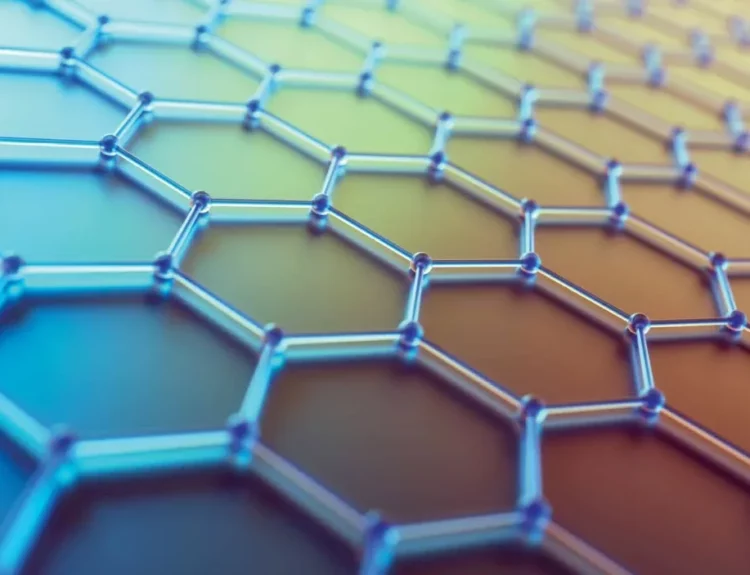

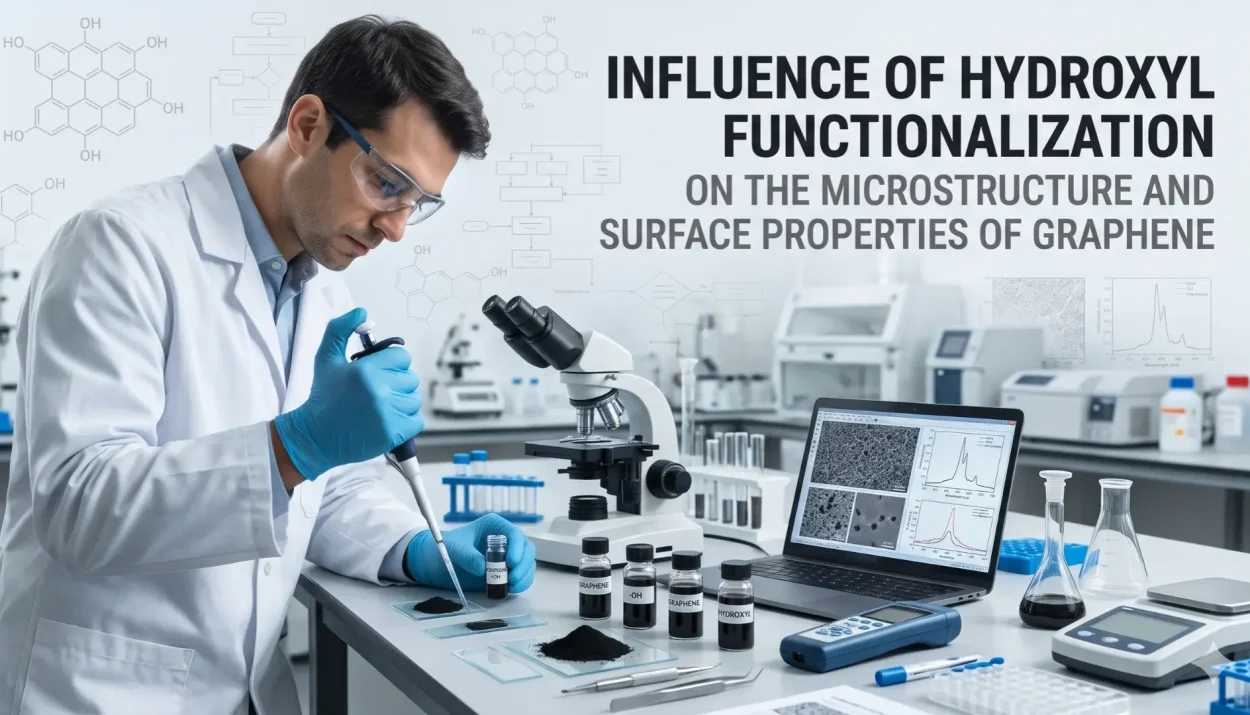
Graphene has attracted considerable scientific interest because of its unique two-dimensional structure and exceptional material characteristics. It consists of carbon atoms arranged in a hexagonal honeycomb lattice, forming an extremely thin and highly connected carbon network. Its distinctive structure contributes to several important properties, including high mechanical strength, electrical conductivity, thermal conductivity, and a large specific surface area.
Despite these advantages, pristine graphene has certain surface-related limitations. Its relatively non-polar surface and strong interactions between neighboring graphene sheets can lead to aggregation and reduced compatibility with some polar solvents and polymer materials. Surface functionalization offers an effective way to modify these characteristics without changing the fundamental graphene framework.
Hydroxyl functionalization involves introducing hydroxyl groups onto the graphene surface or at structurally reactive locations, depending on the functionalization method. These groups can alter the carbon network’s chemical environment and influence surface polarity, wettability, dispersion behavior, and interactions with surrounding materials.
However, functionalization must be carefully controlled because excessive chemical modification can disrupt the interconnected carbon structure and affect graphene’s intrinsic electrical and thermal properties. Therefore, understanding the relationship between hydroxyl functionalization and graphene microstructure is important for developing functionalized graphene materials with balanced surface and structural properties.
Structural Characteristics of Graphene
Graphene’s fundamental structure consists of a single atomic layer of carbon atoms arranged in a hexagonal lattice.
Two-Dimensional Carbon Network
Graphene has a highly ordered carbon framework that provides excellent electrical and mechanical characteristics.
The interconnected arrangement of carbon atoms supports electron transport and contributes to its distinctive physical properties.
Maintaining this structural arrangement is important when modifying graphene through chemical functionalization.
Layered Structure and Sheet Morphology
Graphene-based powders may contain individual sheets, partially stacked layers, and aggregated nanosheets.
The degree of stacking and sheet arrangement influences accessible surface area, dispersion behavior, and interactions with surrounding materials.
Hydroxyl functionalization can modify the interactions between neighboring sheets, potentially influencing their aggregation and separation behavior.
Surface Defects and Reactive Sites
Graphene surfaces and edges may contain defects, vacancies, and structurally irregular regions.
These sites can serve as reactive sites for chemical modification.
The distribution of functional groups across the graphene surface depends on the starting material, functionalization technique, and processing conditions.
Understanding these structural features is necessary when evaluating the effects of hydroxyl functionalization.
Hydroxyl Functionalization of Graphene
Hydroxyl functionalization is a surface modification approach in which hydroxyl groups are introduced onto graphene-based structures.
Adding hydroxyl groups changes the chemical environment of the graphene surface and can influence its interaction with solvents, polymers, and other materials.
Role of Hydroxyl Groups
Hydroxyl groups contain oxygen and hydrogen atoms attached to the graphene structure.
Their presence can introduce polar characteristics to an otherwise relatively non-polar carbon surface.
This modification can influence:
- Surface polarity.
- Solvent compatibility.
- Hydrogen bonding interactions.
- Interfacial adhesion.
- Dispersion behavior.
The extent of these changes depends on the number, distribution, and chemical environment of the introduced functional groups.
Functional Group Distribution
The distribution of hydroxyl groups is an important parameter influencing the final characteristics of functionalized graphene.
Functional groups may be located at different positions depending on the starting graphene material and modification process.
A relatively uniform distribution can produce more consistent surface characteristics, while localized functionalization can cause variations in surface chemistry.
Influence on Carbon Structure
Chemical functionalization can alter the local bonding environment of carbon atoms.
Introducing oxygen-containing groups may disrupt parts of the original graphene lattice, changing structural ordering and defect characteristics.
The extent of these changes depends on the functionalization technique and processing intensity.
Consequently, researchers must evaluate both the surface chemistry and structural integrity of functionalized graphene.
Influence of Hydroxyl Functionalization on Microstructure
Graphene microstructure determines how its nanosheets are arranged and how they interact with neighboring sheets and surrounding materials. Hydroxyl functionalization can influence several microstructural characteristics.
Changes in Surface Morphology
Introducing hydroxyl groups can alter the surface characteristics of graphene nanosheets.
Depending on the functionalization method, the modified material may demonstrate changes in surface texture, sheet arrangement, and aggregation behavior.
SEM and TEM are useful for investigating these variations.
However, imaging alone cannot confirm the presence of hydroxyl groups. Chemical characterization is necessary to establish the functional group composition.
Interlayer Interaction
Pristine graphene sheets tend to interact through relatively strong interlayer attraction, which can promote aggregation and stacking.
Hydroxyl functionalization can introduce additional interactions between neighboring sheets.
These may include hydrogen bonding and interactions with surrounding polar materials.
Depending on functional group distribution and environmental conditions, these interactions can influence the spacing and arrangement of graphene layers.
Defect Formation
Chemical modification may introduce structural defects or alter existing defects within the graphene framework.
These changes can influence the material’s mechanical, electrical, and thermal characteristics.
The degree of structural modification depends on the functionalization process, reaction conditions, and starting graphene quality.
Sheet Aggregation and Separation
Hydroxyl groups may improve graphene compatibility with certain polar environments.
This can help reduce aggregation under suitable dispersion conditions.
However, hydroxyl groups can also promote hydrogen bonding between graphene sheets. Therefore, functionalization does not always guarantee improved dispersion.
The final behavior depends on solvent selection, functional group density, surface chemistry, and processing conditions.
Influence on Surface Properties of Graphene
Surface properties are among the most significantly affected characteristics of hydroxyl-functionalized graphene.
Introducing polar functional groups can change how graphene interacts with liquids, polymers, and other materials.
Surface Polarity
Pristine graphene has a relatively non-polar surface.
Introducing hydroxyl groups increases the surface’s polar character, potentially improving its interaction with polar solvents and polymer systems.
This change can be important when developing graphene-based composite materials.
Wettability
Wettability describes a liquid’s ability to spread across a material’s surface.
Hydroxyl-functionalized graphene may interact more strongly with water and certain polar liquids than pristine graphene.
Wettability depends on functional group concentration, surface roughness, sheet aggregation, and testing conditions.
Contact angle measurements can provide useful information about these changes.
Surface Energy
Surface energy influences the interaction between graphene and surrounding materials.
Hydroxyl functionalization can modify the polar component of surface energy and influence interfacial interactions.
This can be useful when incorporating graphene into polymer matrices, surface coatings, and other composite systems.
Dispersion Stability
One important reason for functionalizing graphene is to improve its compatibility with selected dispersion media.
Hydroxyl groups may improve dispersion in suitable polar solvents by changing interactions between graphene and the surrounding liquid.
However, dispersion stability must be evaluated experimentally because excessive aggregation may still occur through intersheet interactions.
Interfacial Bonding
Hydroxyl functionalization can improve interactions between graphene and surrounding materials through hydrogen bonding and other surface interactions.
These interactions may improve compatibility within selected polymer matrices and composite structures.
The resulting performance depends on polymer chemistry, functional group distribution, processing conditions, and interface quality.
Characterization Techniques for Hydroxyl-Functionalized Graphene
Advanced characterization techniques are essential to confirm the presence of hydroxyl groups and understand their influence on graphene structure and surface properties.
| Characterization technique | Research objective |
| FTIR Spectroscopy | Identifies hydroxyl and other oxygen-containing functional groups |
| Raman Spectroscopy | Evaluates structural defects and changes in graphene ordering |
| XPS Analysis | Determines surface chemical composition and bonding characteristics |
| SEM | Examines surface morphology and sheet aggregation |
| TEM | Investigates nanosheet structure and layer arrangement |
| AFM | Measures surface topography and nanosheet thickness |
| TGA | Evaluates thermal stability and changes associated with functional groups |
| Contact Angle Analysis | Determines surface wettability |
| BET Analysis | Evaluates specific surface area and pore characteristics |
Fourier Transform Infrared Spectroscopy (FTIR)
FTIR is an important technique for identifying chemical functional groups present on graphene surfaces.
Hydroxyl functionalization can be investigated through characteristic infrared absorption associated with O–H and C–O bonding.
The presence and relative intensity of these absorption features can indicate changes in surface chemistry.
Interpret FTIR analysis alongside other characterization methods because overlapping absorption bands can make individual functional groups difficult to distinguish.
Raman Spectroscopy
Raman spectroscopy provides information about graphene’s structural characteristics.
Researchers commonly examine the D, G, and 2D bands to assess structural ordering, defects, and graphitic characteristics.
Hydroxyl functionalization may affect the relative intensity and shape of these bands by altering the carbon network.
Comparative Raman analysis of pristine and functionalized graphene can therefore help researchers understand the structural effects of surface modification.
Comparative Analysis of Pristine and Hydroxyl-Functionalized Graphene
Introducing hydroxyl groups can significantly alter graphene’s surface characteristics.
The following comparison presents general material trends rather than guaranteed experimental outcomes.
| Property | Pristine Graphene | Hydroxyl-Functionalized Graphene |
| Surface chemistry | Predominantly carbon-based | Contains additional oxygen-containing groups |
| Surface polarity | Relatively low | Generally increased |
| Wettability | Often lower with polar liquids | Often improved with polar liquids |
| Dispersion behaviour | Can show aggregation | May show improved dispersion in suitable polar media |
| Hydrogen bonding interactions | Limited | Increased potential |
| Surface energy | Depends on surface condition | Polar contribution may increase |
| Structural defects | Depends on starting material | May increase with functionalization |
| Electrical conductivity | Generally high | May decrease depending on structural modification |
| Interfacial compatibility | Limited with some polar materials | Can improve with suitable materials |
| Surface reactivity | Relatively limited | Increased availability of reactive surface groups |
An important consideration is that hydroxyl functionalization does not improve every property simultaneously.
For example, increasing the concentration of oxygen-containing groups may improve surface polarity and compatibility with polar materials. At the same time, excessive modification can disrupt the conjugated carbon network and reduce electrical conductivity.
Therefore, balancing surface functionalization with structural preservation is important.
Factors Influencing Hydroxyl Functionalization
The final characteristics of hydroxyl-functionalized graphene depend on several processing and material-related parameters.
Functionalization Method
Different modification techniques can vary the type, quantity, and distribution of hydroxyl groups.
Chemical treatment, plasma processing, and mechanically assisted functionalization are among the approaches investigated for modifying graphene surfaces.
Each technique may produce different structural and chemical characteristics.
Functional Group Concentration
The concentration of hydroxyl groups influences surface polarity, wettability, and interactions with surrounding materials.
A higher functional group concentration may improve compatibility with selected polar environments, but excessive modification can introduce structural defects.
Processing Conditions
Temperature, treatment duration, chemical environment, and processing intensity influence the extent of functionalization.
Careful control of these conditions is necessary to obtain consistent surface properties while maintaining the desired graphene structure.
Initial Graphene Quality
The starting material plays an important role in determining the final properties of functionalized graphene.
Initial defect concentration, layer thickness, surface cleanliness, and particle morphology can influence functional group attachment and distribution.
Storage and Environmental Exposure
Hydroxyl-functionalized graphene may interact with moisture and environmental contaminants because of its increased surface polarity.
Therefore, control storage conditions, moisture exposure, and sample handling during characterization and material evaluation.
Conclusion
Hydroxyl functionalization is an important surface modification approach for tailoring the microstructural and surface characteristics of graphene. Introducing hydroxyl groups changes the chemical environment of the carbon network and can influence surface polarity, wettability, dispersion behavior, and interactions with surrounding materials.
The investigation shows that functionalization can improve graphene’s compatibility with selected polar solvents and polymer systems. It can also modify interlayer interactions and influence the arrangement of graphene nanosheets. However, introducing oxygen-containing functional groups may also affect graphene’s structural ordering and electrical characteristics. Excessive functionalization can introduce additional defects and disrupt portions of the interconnected carbon network.
Advanced characterization techniques, including FTIR, Raman spectroscopy, XPS, SEM, TEM, and AFM, are essential for understanding these changes. Overall, successful hydroxyl functionalization requires a balanced approach that considers surface modification, structural preservation, and the desired application.
Further research into controlled functionalization, surface chemistry, and microstructural optimization can support the development of advanced graphene-based materials for composite engineering, coatings, and specialized conductive systems.