
What Is Nickel Conductive Paste?
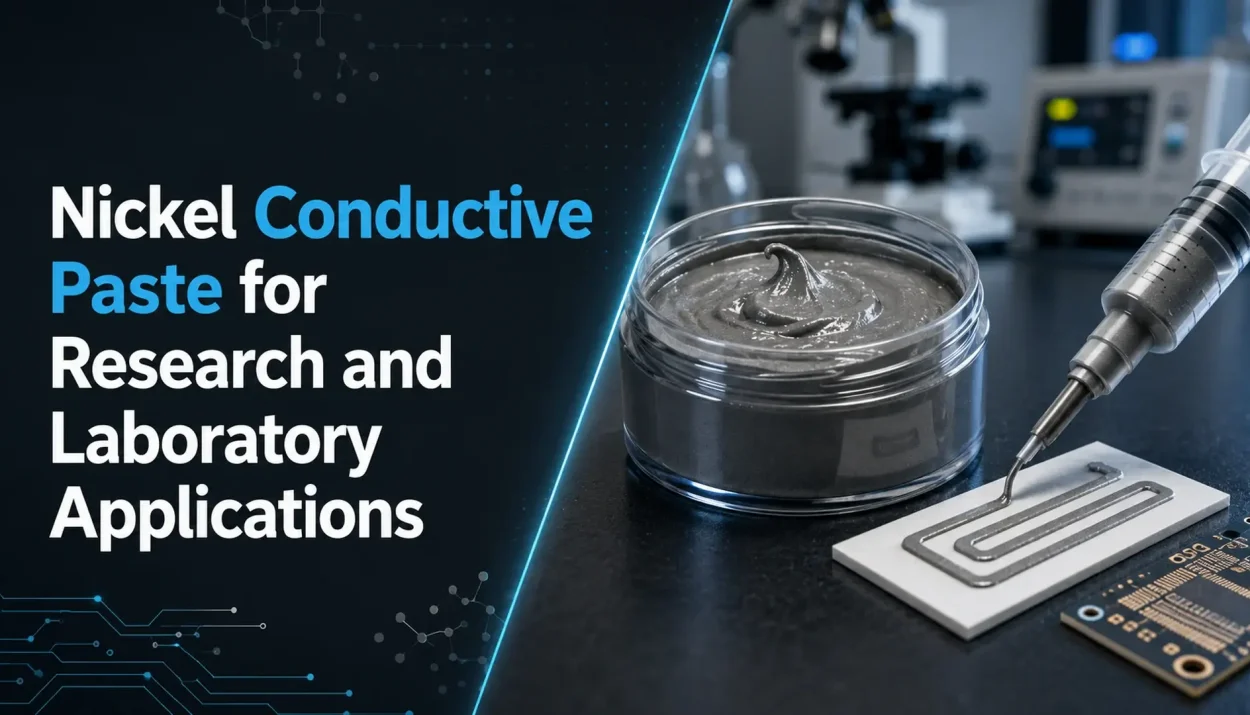
Nickel conductive paste is typically formulated by combining fine nickel particles with an organic or inorganic binder and a suitable carrier. The nickel particles form the conductive network, while the binder helps the deposited material adhere to the selected substrate after drying or curing.
Depending on its formulation, the paste may be used for:
- Electrical contact formation
- Conductive coatings
- Prototype electrodes
- Printed conductive tracks and patterns
- Sensor development
- Materials-science studies
- Laboratory-scale electronics experiments
Final performance depends on nickel particle size and shape, metal loading, binder chemistry, viscosity, deposited thickness, curing conditions and substrate preparation. Researchers should evaluate the cured deposit rather than judging performance from nickel content alone.
Why Is Nickel Used in Conductive Paste?
Nickel combines useful electrical conductivity with mechanical strength and corrosion resistance in many environments. It can provide a practical, lower-cost alternative to noble-metal fillers for selected conductive-paste applications.
Nickel is not immune to oxidation. Surface oxide can raise contact resistance or change processing behaviour, so formulation, particle condition, curing atmosphere and storage history may influence the electrical properties of the finished track or coating.
Researchers can also compare nickel with silver, copper, carbon and other conductive fillers to investigate how composition, particle morphology and processing conditions affect conductivity, adhesion and durability.
Applications of Nickel Conductive Paste in Research Laboratories
1. Sensor Research
Nickel conductive paste can form conductive tracks, contact pads or electrode structures during laboratory sensor development. Subject to material compatibility, researchers may apply it to ceramic, glass, polymer and composite substrates and then evaluate electrical response under different experimental conditions.
This approach is particularly useful during early-stage development, when electrode geometry or contact location may need to change frequently.
2. Prototype Electrode Fabrication
Research projects often require small quantities of electrodes for testing. Instead of fabricating a separate solid-metal electrode for every experiment, researchers can deposit experimental electrode patterns directly on a compatible substrate.
This can shorten prototype cycles and make it easier to compare electrode dimensions, shapes, spacing and deposition methods before selecting a more advanced manufacturing process.
3. Conductive Coatings
Nickel paste can be evaluated as a coating for creating electrically conductive surfaces. Researchers may study how dry-film thickness, curing temperature, substrate preparation and filler concentration affect conductivity, adhesion and coating stability.
4. Printed Electronics Research
Conductive pastes are widely investigated for printed and flexible electronics. Nickel-based formulations can be explored for producing conductive lines and patterns on suitable substrates.
Printing variables—including line width, screen or stencil design, dispensing pressure, paste viscosity, drying temperature and curing time—can be adjusted to study their effect on geometry and electrical performance.
5. Materials-Science Experiments
Nickel conductive paste can serve as a practical model system for investigating the relationship between microstructure and electrical conductivity. Researchers may compare particle sizes, shapes, concentrations or binder systems to examine how particle-to-particle contact influences the resistance of the cured material.
6. Electrical Contacts and Repairs
In suitable low-volume experiments, the paste may help establish temporary or semi-permanent conductive contacts, bridge selected conductive regions or support prototype repair work. Suitability depends on required resistance, operating temperature, mechanical stress and compatibility with the device materials.
How Particle Size Influences Conductive Paste
Nickel particle size and morphology affect packing, surface area, rheology and the conductive network formed during drying or curing. Fine particles can create numerous contact points, but their higher surface area can also increase binder demand and sensitivity to surface oxidation or agglomeration.
Researchers may compare micro- and nano-scale nickel fillers by examining:
- Electrical resistance
- Particle distribution and agglomeration
- Surface coverage
- Adhesion to the substrate
- Film uniformity and roughness
- Viscosity and printability
- Drying or curing behaviour
No single particle size is ideal for every experiment. The appropriate specification depends on the application method, target feature size, desired conductivity, substrate and curing limits.
How Nickel Conductive Paste Is Typically Used
The exact method depends on the formulation and experimental objective, but a general laboratory workflow includes the following stages.
1. Review the Product Documentation
Before use, review the current technical data sheet and safety data sheet. Confirm substrate compatibility, mixing requirements, application method, curing schedule, ventilation, personal protective equipment and waste-disposal requirements.
2. Prepare the Substrate
Prepare the surface using the method specified for the paste and substrate. Dust, oils, moisture and residues can reduce wetting, adhesion and electrical consistency.
3. Condition and Apply the Paste
If the manufacturer requires mixing or conditioning, follow the stated procedure. Apply the paste with a brush, dispenser, stencil, screen-printing process or another compatible technique.
4. Form the Conductive Pattern
Deposit the required track, electrode or contact geometry. Control wet-film dimensions where repeatability is important.
5. Dry or Cure the Deposit
Process the coated substrate using the time and temperature conditions specified for the formulation. This stage removes the carrier, cures the binder or completes both processes. Verify that the substrate can tolerate the required conditions.
6. Test the Finished Structure
After conditioning, measure resistance, conductivity, adhesion or contact performance using an appropriate and documented test method. For meaningful comparisons, record pattern geometry, dry-film thickness, cure history and environmental conditions.
Factors Researchers Should Evaluate
When selecting nickel conductive paste for laboratory work, researchers should consider more than simply its nickel content. Important parameters can include:
| Parameter | Why It Matters |
| Nickel purity | Can affect experimental consistency |
| Particle size | Influences particle packing and conductivity |
| Nickel loading | Affects the conductive network |
| Viscosity | Determines application and printing behavior |
| Binder system | Influences adhesion and curing |
| Curing temperature | Important for substrate compatibility |
| Film thickness | Can affect electrical resistance |
| Adhesion | Determines coating durability |
Understanding Resistance and Conductivity Results
Electrical performance is influenced by more than the paste formulation. A longer or narrower printed track normally has greater resistance than a shorter or wider track made from the same cured material. Dry-film thickness, curing completeness, contact geometry and probe method also affect the measured result.
Researchers should distinguish between track resistance, sheet resistance, volume resistivity and contact resistance. Reporting the measurement method and specimen dimensions makes results easier to reproduce and compare.
Nickel Conductive Paste in Experimental Prototyping
One major advantage of conductive paste in research is experimental flexibility. Researchers can modify electrode dimensions, conductive paths and contact locations without requiring complex metal-patterning equipment for every design iteration.
This makes nickel paste useful in university laboratories, R&D centers, materials-testing facilities, electronics laboratories and prototype-development teams. For example, a team developing a sensing material may test several electrode configurations at laboratory scale before progressing to a more controlled fabrication process.
A paste-based prototype is not automatically equivalent to a production conductor. Long-term stability, tolerance, environmental resistance and manufacturing repeatability should be validated before scaling a design.
Storage and Laboratory Handling
Store nickel conductive paste in accordance with the supplier’s stated temperature, shelf-life and container-orientation requirements. Keep the container properly closed when not in use to reduce contamination, solvent loss and unintended changes in consistency.
Before beginning an experiment, review the product’s technical data sheet and safety data sheet. Nickel-containing particles and formulation solvents or binders may present inhalation, skin-sensitization, flammability or other hazards depending on the exact product.
- Use the ventilation and personal protective equipment specified by the safety data sheet and laboratory risk assessment.
- Avoid generating or inhaling aerosols, dust or vapours.
- Prevent skin and eye contact.
- Keep the paste away from incompatible materials and ignition sources when applicable.
- Label containers clearly and observe the supplier’s shelf-life guidance.
- Dispose of residues, wipes and contaminated packaging through an approved hazardous-waste process.
Product-specific instructions and local institutional requirements always take precedence over general guidance.
Frequently Asked Questions
What is nickel conductive paste used for?
It is used to create conductive tracks, coatings, contacts and prototype electrodes on compatible substrates. Common research areas include sensors, printed electronics, functional coatings and materials-science experiments.
How does nickel paste become conductive?
During drying or curing, nickel particles form an interconnected network within the binder. When enough particle-to-particle conductive paths develop, electrical current can pass through the deposited material.
Does nickel conductive paste require curing?
Most formulations require drying, curing or both, but the correct time, temperature and atmosphere are product-specific. Always use the conditions stated in the manufacturer’s technical data sheet.
Which substrates are compatible with nickel conductive paste?
Potential substrates include selected ceramics, glass, polymers, composites and metals. Compatibility depends on surface chemistry, adhesion, curing temperature and the paste’s binder and carrier system, so application-specific testing is necessary.
Is nickel conductive paste as conductive as solid nickel?
Generally, no. A cured paste contains binder, pores and particle interfaces, so its electrical resistivity is typically higher than that of bulk nickel. Actual performance depends on formulation, processing and deposited geometry.
Conclusion
Nickel conductive paste is more than a conductive coating. In research environments, it is a flexible tool for electrode fabrication, sensor development, printed electronics, functional coatings and materials-science experiments.
Its usefulness comes from the ability to deposit conductive structures directly on compatible substrates while allowing researchers to vary pattern geometry, thickness and processing conditions. By studying nickel particle characteristics, filler loading, binder chemistry and curing conditions, research teams can better understand how formulation and processing influence electrical performance.
For laboratory and research applications, nickel conductive paste provides a practical bridge between materials experimentation and functional device prototyping.