

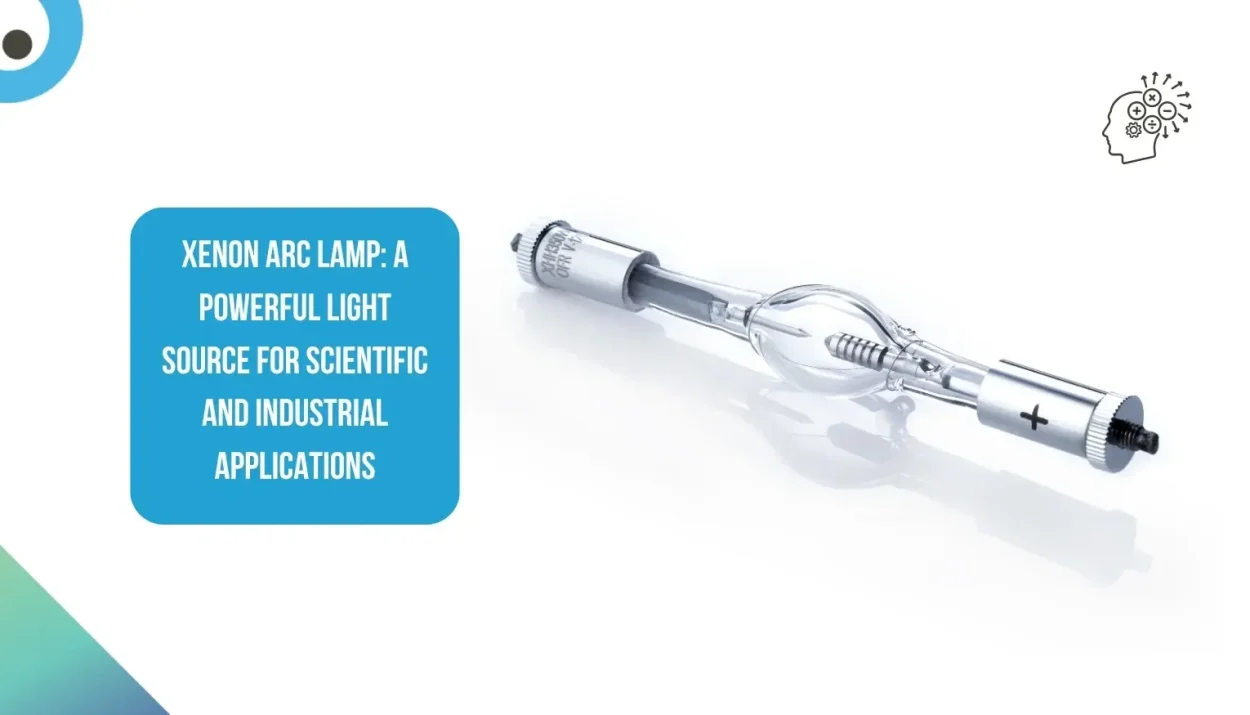
Xenon Arc Lamp is a high-intensity light source that produces bright white light closely resembling natural sunlight. Due to their excellent spectral output, high brightness, and stable performance, xenon arc lamps are widely used in scientific research, solar simulation, spectroscopy, microscopy, material testing, and industrial inspection systems.
Unlike conventional lamps, a xenon arc lamp produces light via an electric arc between two tungsten electrodes, enclosed within a quartz bulb filled with high-pressure xenon gas. This unique operating principle enables the lamp to emit a continuous spectrum from ultraviolet (UV) to visible and infrared (IR) wavelengths.
How Does a Xenon Arc Lamp Work?
A xenon arc lamp operates by applying a high-voltage pulse between two tungsten electrodes. Once the arc is initiated, electrical current passes through the ionized xenon gas, producing an extremely bright plasma discharge.
The plasma emits intense light across a broad wavelength range, creating a spectrum that closely matches natural daylight. This characteristic makes xenon arc lamps ideal for applications requiring realistic sunlight simulation and precise optical measurements.
Key Features of Xenon Arc Lamps
Broad Spectral Output
Xenon arc lamps provide continuous emission from ultraviolet to infrared regions, making them suitable for diverse optical and analytical applications.
Sunlight-Like Illumination
The spectral distribution closely resembles natural sunlight, which is particularly beneficial for solar cell testing and weathering studies.
High Brightness
These lamps generate extremely intense light with excellent luminance, enabling precise illumination in demanding scientific instruments.
Stable Light Performance
Modern xenon lamp systems offer stable output and consistent performance over extended operating periods.
Fast Start-Up
Unlike some other high-intensity discharge lamps, xenon arc lamps achieve full brightness almost immediately after ignition.
Compact Light Source
The small arc size enables efficient focusing and coupling into optical, monochromator, and fiber-optic systems.
Types of Xenon Arc Lamps
Short Arc Xenon Lamps
Short-arc lamps have a very small gap between the electrodes, producing highly concentrated, intense light. These are commonly used in microscopy, projection systems, and spectroscopy.
Long Arc Xenon Lamps
Long arc lamps feature a larger electrode separation and are often used in industrial processing and large-area illumination systems.
Continuous Xenon Lamps
Designed for constant operation, these lamps provide stable illumination for research laboratories and testing facilities.
Pulsed Xenon Lamps
These lamps generate high-energy light pulses and are commonly used in photography, laser pumping, and flash applications.
Applications of Xenon Arc Lamps
Solar Simulation
Xenon arc lamps are extensively used in solar simulators for photovoltaic cell testing and solar energy research.
Spectroscopy
Researchers use xenon lamps as broadband light sources for UV-Vis spectroscopy and optical characterization.
Material Testing
Manufacturers use xenon arc weathering chambers to evaluate the long-term durability of materials exposed to sunlight.
Microscopy
High-intensity illumination improves image quality and observation accuracy in advanced microscopy systems.
Semiconductor Research
The broad spectral range makes xenon lamps valuable for semiconductor characterization and photonic device testing.
Medical and Biomedical Research
Xenon light sources are employed in fluorescence imaging, phototherapy research, and optical diagnostic systems.
Optical Instrumentation
Many scientific instruments rely on xenon arc lamps for calibration, measurement, and analytical applications.
Advantages of Xenon Arc Lamps
- Produces sunlight-like illumination
- Wide spectral coverage from UV to IR
- High optical intensity
- Excellent color rendering properties
- Suitable for precision scientific measurements
- Rapid ignition and stable operation
- Compatible with various optical systems
- High efficiency for laboratory applications
Factors to Consider When Selecting a Xenon Arc Lamp
When choosing a xenon arc lamp, consider the following parameters:
- Power rating (typically 75 W to several kilowatts)
- Spectral requirements
- Lamp lifetime
- Arc size
- Optical coupling requirements
- Cooling method (air or water cooled)
- Stability and intensity specifications
- Application-specific certification requirements
- Selecting the correct lamp ensures optimal performance and accurate experimental results.
Maintenance and Safety
Since xenon arc lamps operate under high pressure and temperature, proper safety precautions are essential. Users should:
- Wear appropriate eye protection.
- Follow the manufacturer’s operating guidelines.
- Inspect lamps regularly for damage.
- Replace lamps at recommended intervals.
- Use proper cooling systems.
- Handle lamps carefully to prevent breakage.
Routine maintenance helps maximize lamp lifespan and maintain consistent light output.
Future Trends in Xenon Arc Lamp Technology
Advancements in power supplies, optical engineering, and lamp design continue to improve the performance of xenon arc lamps. Modern systems offer enhanced stability, longer service life, better energy efficiency, and improved spectral consistency. As research in renewable energy, photonics, and advanced materials expands, the demand for high-performance xenon light sources is expected to grow.
Conclusion
Xenon Arc Lamps remain one of the most versatile and powerful light sources available for scientific, industrial, and research applications. Their ability to produce intense sunlight-like illumination across a broad spectral range makes them indispensable for solar simulation, spectroscopy, microscopy, material testing, and optical analysis. With their exceptional brightness, stability, and spectral accuracy, xenon arc lamps continue to play a critical role in advancing modern technology and scientific innovation.