

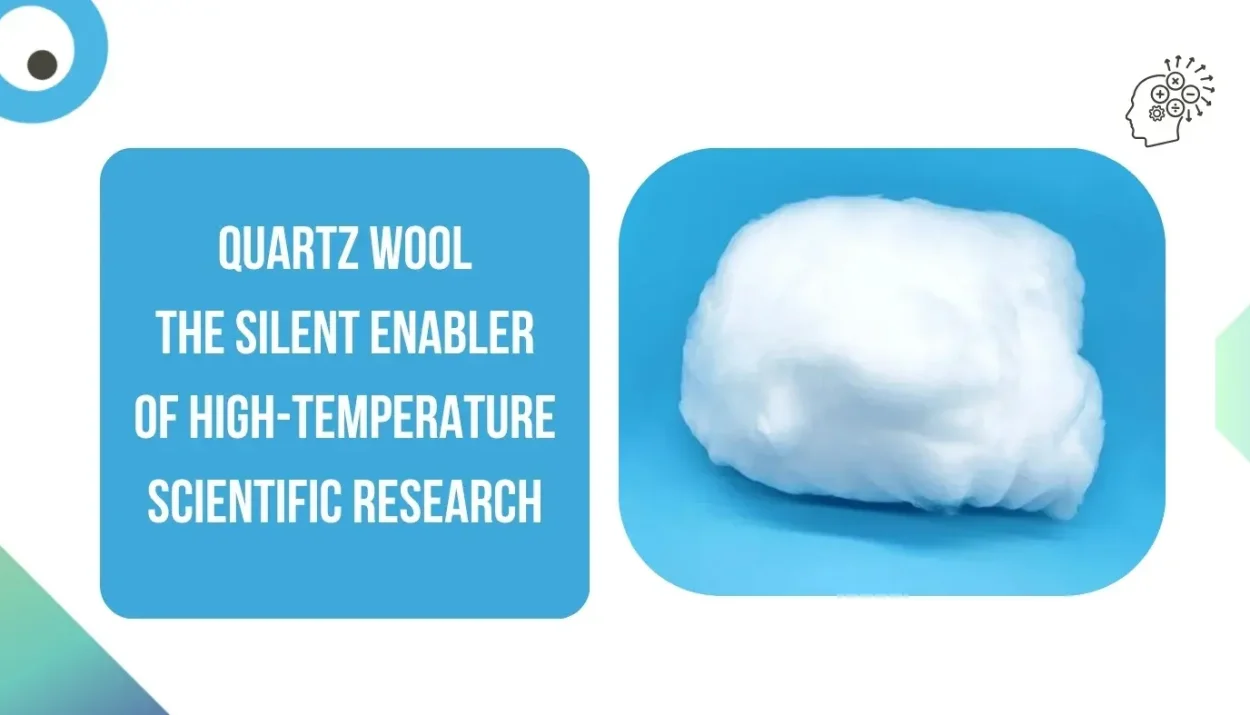
In every research laboratory, there are materials that attract immediate attention—advanced catalysts, nanomaterials, sophisticated analytical instruments, and high-performance reactors. Yet, many successful experiments depend on laboratory components that rarely receive recognition. Quartz Wool is one such material. Though modest in appearance, it performs a vital role in ensuring the accuracy, safety, and reliability of countless scientific investigations.
From catalyst testing and gas chromatography to thermal analysis and reactor design, quartz wool serves as a dependable support material that withstands conditions where ordinary materials fail.
Why Quartz Wool Matters in Research
Scientific experiments involving elevated temperatures demand materials that remain chemically stable, mechanically reliable, and thermally resistant. Conventional fibers often degrade, contaminate samples, or react with chemicals under extreme conditions, introducing uncertainty into experimental results.
Quartz wool addresses these challenges through its exceptional purity and resistance to thermal shock. Manufactured from high-purity fused silica fibers, it maintains structural integrity even at temperatures encountered in advanced laboratory processes.
For researchers, this means experiments can be conducted with greater confidence, knowing that the supporting material is unlikely to influence the outcome.
Supporting High-Temperature Experimental Systems
Many laboratory investigations require components that securely hold catalysts, powders, or reaction media within heated zones. Quartz wool acts as a stable support inside quartz tubes and reaction chambers, allowing gases to flow freely while preventing materials from shifting during experiments.
Its fibrous structure creates an effective barrier that retains samples without significantly restricting gas flow, making it particularly useful in continuous-flow reactor systems.
A Trusted Material in Catalyst Research
Catalysis research forms the foundation of many industrial processes, including hydrogen production, environmental remediation, petrochemical refining, and renewable energy technologies.
Researchers frequently use quartz wool to:
- Support catalyst beds inside tubular reactors
- Separate different catalyst layers
- Secure catalyst pellets during gas flow experiments
- Maintain consistent reaction zones.
- Prevent sample displacement during thermal cycling.
Because quartz wool remains chemically inert under many reaction conditions, it helps ensure that observed catalytic activity originates from the catalyst itself rather than the support material.
Essential in Gas Chromatography
Gas Chromatography (GC) laboratories often rely on quartz wool during sample injection and analytical procedures. It improves sample vaporization and reduces contamination of sensitive analytical components.
Its use contributes to consistent analytical performance, particularly when handling complex organic compounds or trace-level chemical analysis.
Advancing Materials Science
Researchers studying advanced ceramics, nanomaterials, semiconductor materials, and functional coatings frequently conduct experiments at elevated temperatures. Quartz wool provides thermal insulation and sample support without introducing impurities that could interfere with material characterization.
Its high purity is especially valuable in experiments where contamination at even trace levels could influence results.
Applications Across Research Disciplines
The versatility of quartz wool makes it useful across numerous scientific fields.
Chemical Engineering
Supporting catalysts during reaction studies and process optimization.
Environmental Science
Investigating emission control technologies and catalytic treatment of pollutants.
Renewable Energy
Evaluating catalysts for hydrogen generation, fuel cells, and biomass conversion.
Nanotechnology
Supporting nanomaterials during thermal treatment and controlled atmosphere processing.
Analytical Chemistry
Enhancing sample preparation for gas chromatography and laboratory analytical systems.
Academic Research
Serving as a standard laboratory material in universities, national research laboratories, and industrial R&D facilities.
Why Research Laboratories Choose Quartz Wool
Research institutions require laboratory materials that deliver consistency across repeated experiments. Quartz wool offers several characteristics that make it particularly suitable for scientific applications:
- Excellent thermal resistance
- High chemical purity
- Low risk of contamination
- Resistance to thermal shock
- Good mechanical stability
- Compatibility with quartz reactors and laboratory glassware
- Suitable for oxidizing and inert atmospheres
- Easy integration into experimental setups
These qualities help researchers maintain experimental reproducibility while reducing unwanted variables.
Compatible with Modern Laboratory Equipment
Quartz wool is commonly used in conjunction with a wide range of laboratory instruments and research systems, including:
- Fixed-bed reactors
- Tubular furnaces
- Gas chromatography systems
- Quartz reaction tubes
- Catalyst testing units
- Thermal decomposition systems
- Pyrolysis equipment
- Laboratory-scale chemical reactors
Its compatibility with these systems has made it a standard consumable in many research laboratories.
Enabling Reliable Scientific Discoveries
Scientific progress depends on careful control of every aspect of an experiment, including the materials that support the process itself. Quartz wool provides researchers with a dependable solution for high-temperature sample support, allowing them to focus on investigating reaction mechanisms, material properties, and innovative technologies.
Although it is rarely highlighted in published research, quartz wool contributes quietly to experiments that advance renewable energy, environmental protection, chemical manufacturing, and materials science.
Conclusion
Quartz wool is far more than a laboratory accessory. It is an essential research material that enables accurate, reproducible, and contamination-free experimentation in high-temperature environments. Its combination of thermal stability, chemical inertness, and mechanical reliability has made it indispensable in catalyst research, analytical chemistry, materials science, and chemical engineering.
As research continues to push the boundaries of temperature, precision, and performance, quartz wool will remain a trusted partner in laboratories where reliable experimental conditions are the foundation of scientific discovery.