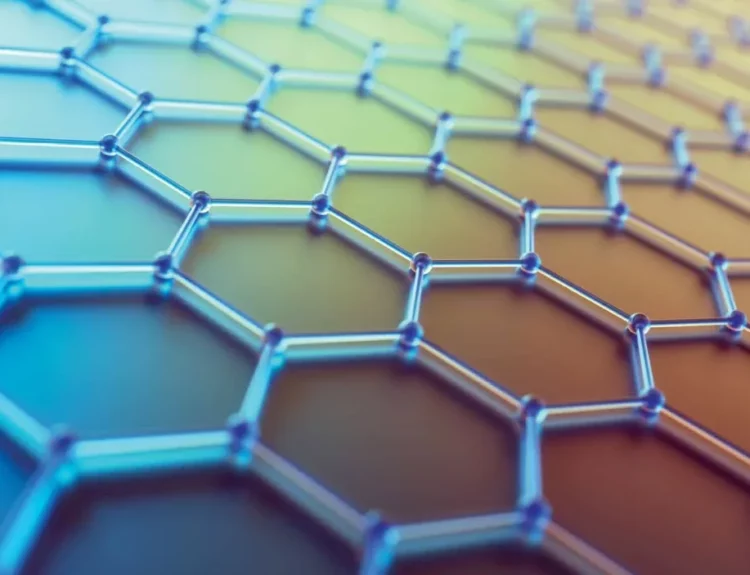

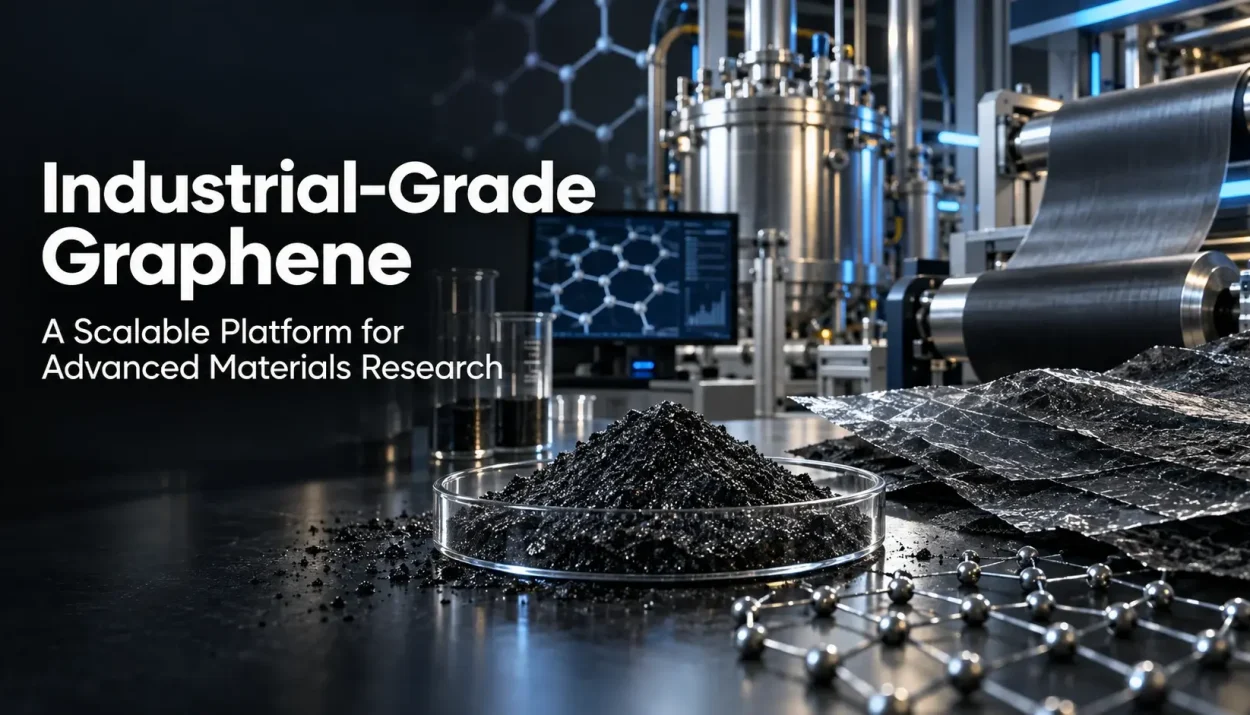
Graphene has emerged as one of the most extensively investigated carbon-based materials in modern materials science. Its distinctive combination of electrical conductivity, thermal transport, mechanical strength, large surface area, and exceptionally thin structure has encouraged researchers to integrate it into a wide range of functional materials.
While highly refined graphene materials are frequently used for fundamental studies, industrial-grade graphene offers a different and equally important research perspective. It gives researchers a platform to investigate how graphene behaves when produced, processed, dispersed, and incorporated at larger scales. This makes industrial-grade graphene particularly relevant to research that connects nanoscale material characteristics with practical materials engineering.
Rather than focusing only on the properties of individual graphene layers, research involving industrial-grade graphene examines the broader relationship between flake structure, processing, dispersion, interfaces, and final material performance.
Industrial-Grade Graphene as a Research Material
Industrial-grade graphene is generally produced with scalability and practical processing in mind. Depending on the manufacturing route, it may contain a distribution of flake dimensions, layer structures, surface characteristics, and defect populations. These characteristics make industrial-grade graphene particularly interesting for applied materials research. Researchers can investigate how variations in the starting material influence the performance of coatings, composites, conductive structures, and other functional systems.
This approach reflects an important transition in materials science: moving from demonstrating a material’s properties under highly controlled laboratory conditions to understanding how those properties are retained when the material is processed at larger scales.
The Importance of Graphene Morphology
Graphene morphology plays an important role in determining its behavior within a composite or coating. Flake dimensions, thickness distribution, surface condition, and defect characteristics can influence how graphene interacts with neighboring particles or a surrounding matrix.
Larger flakes may create longer conductive pathways, while smaller flakes can sometimes provide more uniform distribution within certain formulations. Consequently, researchers studying industrial-grade graphene often treat morphology as a central experimental variable rather than assuming graphene is uniform. Understanding this relationship can help researchers optimize graphene-based formulations according to the desired application.
Dispersion as a Key Research Challenge
One of the most important factors influencing the performance of industrial-grade graphene is its distribution within a host material. Graphene flakes can interact strongly with one another and form agglomerated structures. If these structures remain poorly distributed, the resulting material may not fully benefit from graphene’s characteristics.
Research therefore focuses on methods for improving dispersion through controlled mixing, mechanical processing, ultrasonic treatment, solvent selection, surface modification, and formulation optimization. Industrial-grade graphene is especially useful for this type of research because dispersion behavior becomes increasingly important as the quantity of material increases.
Building Conductive Networks
When graphene flakes become sufficiently interconnected within a material, they can create pathways for electrical transport. This phenomenon has made industrial-grade graphene interesting for research involving conductive coatings, printable materials, composite structures, and functional surfaces.
Researchers can study how conductivity changes with graphene concentration, flake size, orientation, dispersion quality, processing conditions, and matrix characteristics. The objective is not simply to add more graphene, but to understand how to form an efficient interconnected network using the smallest practical material loading. This approach can be particularly important for scalable material development.
Industrial-Grade Graphene in Composite Research
Composite materials provide one of the broadest research areas for industrial-grade graphene. Researchers can incorporate graphene into polymeric and other matrix systems to investigate changes in electrical behavior, thermal transport, mechanical response, surface properties, and structural stability. The interface between graphene and the surrounding matrix is particularly important.
The effectiveness of a graphene-containing composite depends not only on the quantity of graphene present but also on how well the flakes are distributed and how effectively they interact with the surrounding material. This creates opportunities for researchers to study the connection between microscopic interfaces and large-scale material properties.
Thermal Transport and Heat Management
Graphene’s thermal characteristics have generated considerable interest in advanced thermal-management research. Industrial -grade graphene can be incorporated into composite systems to investigate how conductive pathways influence heat distribution throughout a material.
However, numerous factors affect the thermal behavior of a graphene composite, including flake orientation, contact between neighboring flakes, dispersion, interface quality, matrix properties, and processing history.Research in this area therefore provides an opportunity to explore how nanoscale carbon structures can contribute to macroscopic thermal performance.
Graphene-Based Coatings
Industrial-grade graphene can also serve as a functional component in coatings. A graphene-containing coating can be engineered to modify electrical behavior, thermal response, surface characteristics, mechanical performance, or environmental stability.
Researchers can investigate parameters such as coating thickness, graphene loading, dispersion quality, surface preparation, adhesion, and drying or curing conditions. The scalability of industrial-grade graphene makes it particularly relevant to research involving larger coating areas and practical deposition techniques.
Surface and Interface Engineering
Graphene’s surface offers a highly interesting research interface. Researchers can modify graphene surfaces to influence their compatibility with surrounding materials. Surface treatment can affect dispersion, adhesion, interfacial interactions, and the resulting composite structure.
This research area is particularly important because graphene’s behavior within a material system is often determined by what happens at the interface between the graphene and its surroundings. Industrial-grade graphene can therefore provide a practical platform for investigating scalable interface-engineering approaches.
Importance of Flake Distribution
Uniform distribution is another important factor in graphene-based material development. A material containing the same overall amount of graphene can exhibit very different properties depending on whether the flakes are evenly distributed or concentrated into localized agglomerates.
Researchers can investigate this behavior through microscopy, electrical measurements, surface analysis, and other characterization techniques.Understanding flake distribution can help explain why two apparently similar graphene formulations may produce different experimental results.
Characterization of Industrial-Grade Graphene
Comprehensive characterization is essential when using industrial-grade graphene for scientific research.
Researchers may investigate:
- Flake dimensions
- Layer distribution
- Surface morphology
- Defect characteristics
- Carbon purity
- Thermal behavior
- Electrical properties
- Dispersion stability
- Surface characteristics
- Moisture and residual material content
Microscopic techniques can provide information about morphology and distribution, while spectroscopic methods can help examine structural characteristics. Thermal and electrical measurements can provide additional information about functional performance. Combining multiple characterization methods allows researchers to establish stronger connections between material structure and observed performance.
Reproducibility and Material Consistency
An important consideration when working with industrial-grade graphene is batch-to-batch consistency. Industrial-scale production may involve broader distributions of flake dimensions or other material characteristics than highly specialized research materials. For scientific investigations, documenting these variations helps establish reproducible results.
Researchers can improve reproducibility by recording material specifications, processing conditions, dispersion procedures, environmental conditions, and characterization results.This approach can make experimental findings more useful for subsequent scale-up and manufacturing studies.
Bridging Laboratory Research and Scalable Processing
One of the greatest advantages of industrial-grade graphene is its relevance to scale-up research. A formulation that performs well at a very small laboratory scale may behave differently when processing larger quantities. Mixing efficiency, viscosity, dispersion time, drying behavior, coating uniformity, and material handling can all change with scale.
Industrial-grade graphene enables researchers to investigate these challenges earlier in the development process. It can therefore bridge fundamental materials research and practical manufacturing development.
Industrial-Grade Graphene in Functional Inks
Another important research direction involves graphene-based conductive inks and printable materials. Researchers can incorporate graphene into formulations designed for deposition onto different substrates. Researchers can study how particle distribution, formulation characteristics, printing parameters, drying conditions, and substrate properties affect the resulting conductive structures. These investigations help explain how graphene can transition from a powder or dispersion into a patterned functional material.
Research on Flexible Material Systems
Graphene’s thin, lightweight nature makes it attractive for flexible-material research. When incorporated into suitable matrices or deposited as functional layers, graphene can contribute to electrically or thermally active flexible structures.
Industrial-grade graphene provides a practical material source for investigating scalable processing techniques for such systems. Researchers can examine how bending, repeated deformation, substrate flexibility, and processing conditions influence the performance and durability of graphene-containing structures.
Sustainability and Scalable Material Development
As graphene research moves toward larger-scale production, sustainability and efficient material utilization are becoming increasingly relevant. Research can examine how processing methods influence material yield, energy consumption, waste generation, and overall manufacturing efficiency.
Industrial-grade graphene offers an opportunity to evaluate whether useful functional properties can be achieved without relying exclusively on highly refined or resource-intensive material grades. This perspective can contribute to the development of more practical graphene-based technologies.
Future Research Directions
Future research on industrial-grade graphene is likely to move toward greater control over material architecture rather than simply increasing graphene content. Researchers may investigate how flake dimensions, orientation, surface characteristics, defect distribution, and interfacial interactions can be deliberately controlled to create specific functional properties.
Another promising direction is developing standardized relationships between graphene specifications and final product performance. Such approaches could make it easier to select appropriate industrial-grade graphene for specific research and engineering requirements. The development of scalable dispersion methods, improved coating processes, and controlled composite architectures will also remain important areas of investigation.
Conclusion
Industrial-grade graphene represents an important link between advanced nanomaterial research and scalable materials engineering. Its value extends beyond the intrinsic characteristics of individual graphene flakes; the greater research opportunity lies in understanding how those characteristics translate into functional performance when graphene is processed in realistic material systems. Through research into morphology, dispersion, conductive networks, thermal transport, surface interactions, composite structures, and scalable processing, industrial-grade graphene can provide a versatile platform for developing advanced functional materials.
Its growing importance reflects a broader evolution in materials science—from studying what a material can achieve under ideal laboratory conditions to understanding how to translate its properties into practical, scalable material technologies reliably. For this reason, industrial-grade graphene should not be viewed merely as a lower-cost alternative to highly refined graphene. Instead, it can be considered a distinct research platform for exploring the engineering, processing, and scale-up challenges that determine how graphene-based materials perform beyond the laboratory.