
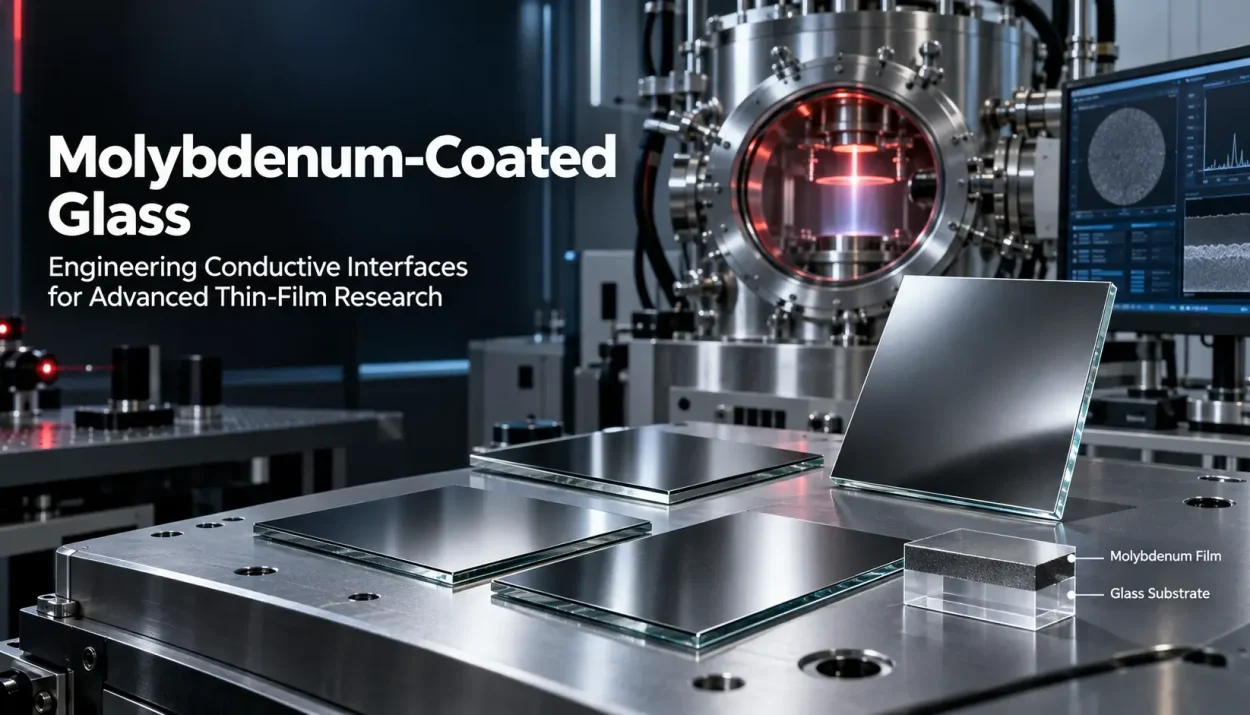
Advancing thin-film technology depends heavily on controlling surfaces and interfaces at very small scales. In many research applications, the material beneath an active layer can significantly influence how that layer develops and performs. Molybdenum coated glass is a key example, combining the stability of a glass substrate with the electrical and thermal characteristics of a molybdenum thin film.
Molybdenum coated glass is produced by depositing a controlled molybdenum layer onto a glass surface, commonly through vacuum-based deposition techniques such as magnetron sputtering. The resulting conductive substrate is particularly relevant to photovoltaic research, semiconductor development, electrochemical studies, thin-film electronics, and surface science.
This material is scientifically interesting because it allows control and investigation of the molybdenum layer at the thin-film level. Researchers can study and optimize film thickness, crystallinity, surface morphology, adhesion, electrical characteristics, and thermal behavior to meet the needs of a specific research application.
The Role of Molybdenum in Thin-Film Research
Molybdenum is a refractory transition metal known for its high-temperature stability and useful electrical conductivity. These characteristics make it suitable for applications where a conductive layer must remain stable during demanding fabrication processes.
When molybdenum is deposited as a thin film, its behavior is influenced by its microstructure. Grain formation, crystallographic orientation, surface roughness, defects, and internal stress can all affect the coating’s final properties.
This is why researchers generally do not evaluate a molybdenum film solely by its electrical conductivity. A scientifically useful coating must also be considered in terms of its adhesion, morphology, structural stability, and compatibility with other materials. Studying these characteristics makes Mo-coated glass a valuable platform for materials research.
Engineering the Molybdenum–Glass Interface
The interface between molybdenum and glass is central to the coated substrate’s performance.Before deposition, the glass surface may be cleaned and prepared to promote uniform film formation. During deposition, molybdenum atoms interact with the substrate and gradually develop into a continuous film. The conditions during this growth process determine many of the characteristics observed after deposition. Surface preparation, substrate temperature, sputtering conditions, deposition rate, and coating thickness can all influence the resulting interface. Researchers can therefore use Mo-coated glass to investigate how changes in deposition conditions affect film structure and performance. This makes it useful not only as a finished conductive substrate but also as an experimental material for studying thin-film growth.
Magnetron Sputtering for Molybdenum Deposition
Magnetron sputtering is a commonly investigated method for depositing molybdenum films onto glass.During sputtering, a molybdenum target sits in a vacuum chamber and is exposed to an argon plasma. Energetic ions interact with the target, releasing molybdenum atoms that travel toward the glass substrate and form a thin coating. The characteristics of the deposited film can be adjusted by controlling parameters such as sputtering power, working pressure, substrate temperature, deposition time, and substrate condition.
Scientific studies have demonstrated that these parameters can influence the crystallinity, morphology, electrical characteristics, and adhesion of Mo films. This level of process control is one of the main reasons sputtering is attractive for research and industrial thin-film development.
Film Thickness and Microstructural Development
The thickness of a molybdenum film can strongly influence its structure and properties.During the initial stages of deposition, the coating begins with the formation of small nuclei on the glass surface. As deposition continues, these regions develop and eventually form a continuous metallic film. Continued growth can modify grain size, surface roughness, crystallographic characteristics, and electrical behavior.
Researchers can therefore prepare Mo-coated glass with different coating thicknesses and compare their characteristics. Such controlled experiments can provide insight into thin-film evolution during deposition.
Thickness studies are especially useful when designing coatings for multilayer devices, where the Mo layer must provide adequate conductivity while maintaining suitable morphology and mechanical stability.
Surface Morphology and Nanoscale Characterization
The surface of a molybdenum coating can contain features that are not visible to the naked eye but may influence the performance of subsequently deposited materials.
Atomic Force Microscopy can be used to study nanoscale surface topography and roughness. Scanning Electron Microscopy provides information about surface morphology, grain structure, and cross-sectional characteristics.
These techniques allow researchers to assess coating uniformity and identify microscopic features such as grain boundaries, irregularities, defects, and film-thickness variations.
Understanding surface morphology becomes particularly important when another semiconductor, oxide, or metallic layer will be deposited over the molybdenum.
Crystallographic Characteristics
The internal crystal structure of molybdenum films is another important area of investigation.Molybdenum has a body-centered cubic crystal structure, and deposited films can develop preferred crystallographic orientations depending on the deposition conditions.
X-ray diffraction is commonly used to examine the structure of Mo coatings. Researchers can use this information to determine how deposition parameters, substrate temperature, film thickness, or thermal treatment influence crystallinity and preferred orientation.
By considering XRD results alongside electrical and morphological measurements, researchers can develop a more complete understanding of the relationship between film structure and functional properties.
Molybdenum Coated Glass in CIGS Photovoltaic Research
One of the most significant applications of molybdenum-coated glass is in CIGS thin-film photovoltaic research. CIGS stands for copper indium gallium selenide, a semiconductor material used as an absorber in thin-film solar cells. In a conventional CIGS architecture, molybdenum is used as the conductive back-contact layer on the glass substrate.
The Mo layer has to perform several functions during fabrication. It must conduct electricity, maintain adhesion to the glass, withstand elevated processing temperatures, and provide a suitable surface for CIGS absorber growth.
Because of these requirements, molybdenum film characteristics can strongly influence photovoltaic device performance and reproducibility.Researchers therefore investigate Mo thickness, surface morphology, crystallinity, adhesion, and thermal stability when developing CIGS structures.
The Mo/CIGS Interface
The interaction between the molybdenum back contact and the CIGS absorber is an important subject in photovoltaic materials research.During CIGS processing, the Mo layer can be exposed to high temperatures and selenium-containing environments. Under suitable conditions, molybdenum selenide can develop at the interface.
The formation and characteristics of this interfacial region can influence the device’s electrical and structural behavior. This illustrates why the quality of the original Mo coating is important even though it may be several processing steps away from the final active device.Studying these interfacial reactions helps researchers understand how fabrication conditions influence the final photovoltaic structure.
Electrical Characterization
Electrical characterization provides important information about the molybdenum layer’s effectiveness as a conductive substrate.Four-point probe measurements commonly evaluate sheet resistance while reducing the influence of contact resistance.Comparing electrical measurements with structural and morphological observations helps explain how deposition conditions influence conductivity.
For example, changes in grain structure, film continuity, thickness, and crystallinity may be associated with changes in electrical behavior.This combined approach provides more useful information than relying on electrical measurements alone.
Adhesion and Mechanical Stability
The Mo coating’s ability to remain attached to the glass is essential for many research applications.Adhesion can be influenced by the condition of the glass surface, deposition parameters, substrate temperature, film thickness, and residual stress within the coating.
Poor adhesion can result in peeling or delamination, particularly during heating, cooling, or subsequent processing.For this reason, adhesion testing and stress analysis can be valuable components of a research program involving Mo-coated glass.A well-engineered coating must balance electrical performance and mechanical stability.
Thermal Stability
Many thin-film fabrication processes involve elevated temperatures. Consequently, the thermal behavior of the Mo-coated glass system can be an important consideration.Thermal treatment may alter the crystallinity, grain structure, surface morphology, stress state, and electrical characteristics of the molybdenum layer.
Researchers can use controlled annealing experiments to investigate these changes and determine whether a particular coating remains stable under the conditions required for subsequent processing.This is particularly relevant to photovoltaic and semiconductor research, where several layers may be deposited and processed at different temperatures.
Why Mo-Coated Glass Matters in Modern Materials Science
The significance of molybdenum-coated glass lies in its ability to connect several areas of materials research within one relatively simple structure.Researchers can investigate the deposition process, observe microstructural changes, measure electrical behavior, examine surface morphology, and study interactions with subsequently deposited materials.
This makes the material particularly useful for laboratories interested in understanding the complete lifecycle of a thin film—from deposition and nucleation to processing and final device integration.
The glass substrate provides a stable foundation, while the molybdenum layer creates a controllable conductive interface. Together, they provide a practical platform for studying how engineered surfaces influence advanced materials.
Future Research Potential
The development of increasingly sophisticated thin-film devices is creating a growing need for precisely controlled conductive interfaces.Future research involving Mo-coated glass may focus on highly uniform large-area coatings, ultra-thin molybdenum layers, low-stress films, multilayer Mo structures, Mo/MoOx interfaces, and improved photovoltaic back contacts.
Advanced sputtering techniques can also be combined with real-time monitoring and high-resolution characterization. Such approaches could provide researchers with greater control over film growth and help establish more precise relationships between deposition conditions and material performan
Conclusion
Molybdenum-coated glass is an engineered research platform, not simply a conductive glass substrate. Its value comes from the ability to control and investigate the molybdenum layer and its interface with glass and other functional materials.
Its established role in CIGS photovoltaic research demonstrates the importance of a carefully engineered conductive back contact. At the same time, its potential in semiconductor research, electrochemistry, surface science, and multilayer thin-film development makes it relevant to a much broader scientific community.
The study of Mo-coated glass brings together several important areas of materials science, including thin-film deposition, crystallography, surface morphology, electrical characterization, adhesion, thermal stability, and interface chemistry.
As researchers continue to develop smaller, more complex, and more efficient thin-film devices, interface quality will become increasingly important. Molybdenum-coated glass provides a practical, versatile foundation for investigating these interfaces and developing the next generation of functional thin-film materials.