
Multi-Walled Carbon Nanotubes (MWCNTs) are widely studied nanomaterials for developing conductive polymer composites because of their high aspect ratio, electrical conductivity, mechanical strength, and distinctive nanoscale structure. Incorporating MWCNTs into polymer matrices can improve electrical charge transport and enhance selected mechanical and functional properties. However, achieving consistent performance depends strongly on the quality of nanotube dispersion throughout the polymer matrix.
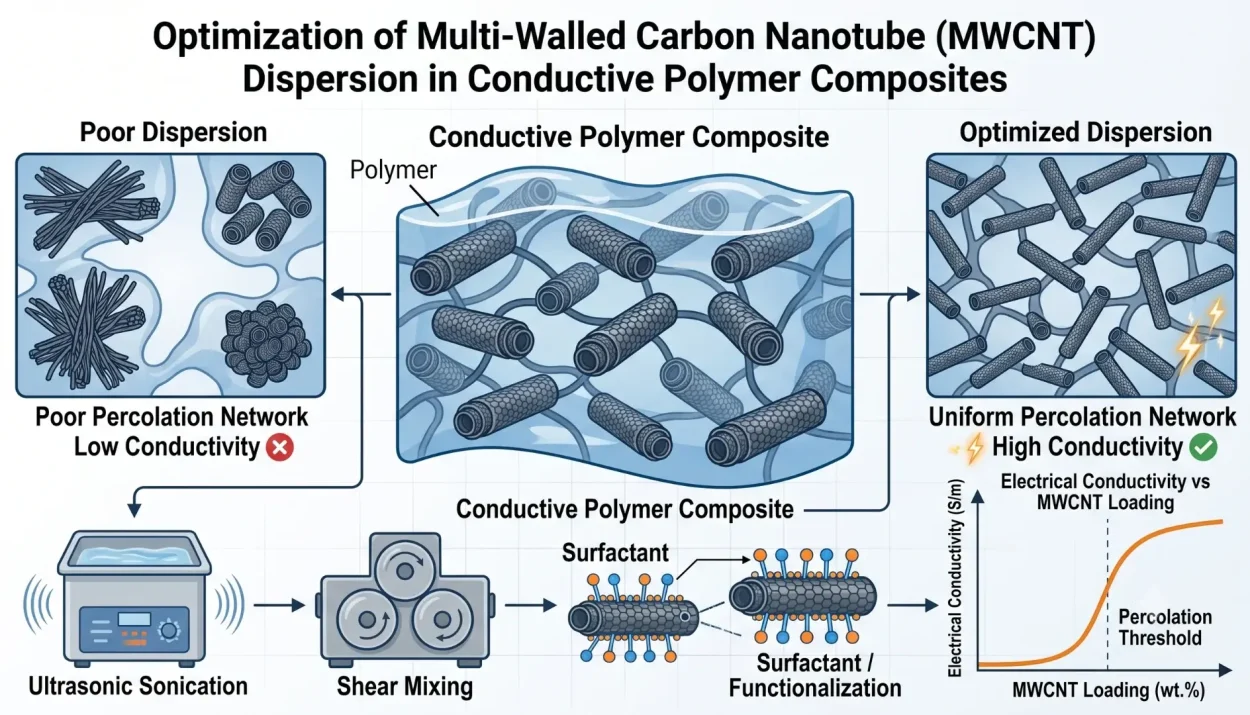
MWCNTs tend to form agglomerates because of attractive interactions between adjacent nanotubes. Poor dispersion can create non-uniform conductive pathways, localized defects, and variations in electrical resistance. Therefore, optimizing dispersion is a key step in fabricating conductive polymer composites for flexible electronics, antistatic coatings, conductive films, and advanced functional materials.
Importance of MWCNT Dispersion in Polymer Composites
The performance of a conductive polymer composite depends on how effectively MWCNTs are distributed within the polymer matrix. A uniform distribution increases the probability of forming interconnected conductive networks, while excessive agglomeration can reduce the efficiency of the incorporated nanotubes.
Several factors determine dispersion quality, including nanotube concentration, surface chemistry, polymer compatibility, mixing conditions, and processing temperature.
Effective dispersion can provide the following benefits:
- Improved uniformity of electrical conductivity.
- More consistent formation of conductive pathways.
- Better distribution of nanotubes throughout the polymer matrix.
- Reduced formation of large agglomerates and structural defects.
- Improved reproducibility between composite batches.
- Greater control over the electrical and mechanical properties of the final material.
Nevertheless, the best dispersion method depends on the target polymer and intended application. Excessive processing may shorten nanotubes or damage their structure, potentially affecting their ability to form conductive networks.
Challenges in Dispersing Multi-Walled Carbon Nanotubes
MWCNTs have a high aspect ratio and a strong tendency to associate with neighboring nanotubes. Their cylindrical structures can entangle, forming bundles that conventional mixing techniques struggle to separate.
The main challenges include:
Agglomeration: Attractive interactions between nanotubes encourage bundle formation, limiting uniform distribution.
Poor polymer compatibility: Differences in surface energy and chemical characteristics between MWCNTs and the polymer can restrict effective wetting and mixing.
High mixture viscosity: Higher nanotube loading can increase mixture viscosity, reducing mixing efficiency and complicating processing.
Sedimentation: In liquid dispersions, larger bundles may settle over time, resulting in non-uniform nanotube concentrations.
Structural damage: Excessive mechanical energy during processing can shorten nanotubes or introduce structural defects.
Addressing these challenges requires balancing effective bundle separation, nanotube preservation, and compatibility with the selected polymer system.
Methods for Optimizing MWCNT Dispersion
Ultrasonication
Ultrasonication is commonly used to separate nanotube bundles in liquid media. Acoustic energy generates localized forces that help break apart agglomerates and distribute nanotubes throughout the suspension.
The effectiveness of ultrasonication depends on processing time, power, solvent properties, nanotube concentration, and temperature. Insufficient treatment may leave large bundles, whereas excessive treatment can shorten nanotubes or alter their structural characteristics.
For reproducible research, record sonication conditions carefully. Temperature control is particularly important because prolonged processing can heat the suspension and influence solvent behavior.
Mechanical Stirring and High-Shear Mixing
Mechanical stirring and high-shear mixing provide alternative methods for incorporating MWCNTs into liquid formulations and polymer matrices. These methods can improve bulk mixing and help distribute nanotubes throughout the material.
High-shear mixing is useful for processing relatively large volumes. However, the selected shear rate and mixing duration should be optimized to avoid excessive energy input and unnecessary structural damage.
Combining preliminary stirring with controlled high-shear mixing may improve dispersion consistency before the polymer composite forms.
Surfactant-Assisted Dispersion
Surfactants can improve the interaction between MWCNT surfaces and the surrounding liquid by reducing interfacial tension and helping stabilize separated nanotubes.
Surfactant selection depends on the solvent, polymer chemistry, nanotube surface characteristics, and final application. The concentration must be optimized because insufficient surfactant may not provide adequate stabilization, while excessive amounts may interfere with electrical contact between nanotubes or alter composite properties.
Where electrical conductivity is the primary objective, researchers should evaluate whether the surfactant remains in the final material and whether its presence affects the formation of conductive pathways.
Solvent Selection
Solvent choice influences nanotube wetting, dispersion stability, and compatibility with the polymer matrix. A suitable solvent can facilitate bundle separation and improve MWCNT distribution before incorporation into the polymer.
Important selection criteria include solvent polarity, viscosity, evaporation rate, polymer solubility, and compatibility with subsequent processing conditions.
A solvent that produces a stable nanotube suspension may not necessarily be suitable for the final composite. Researchers should therefore evaluate both dispersion quality and the behavior of the complete polymer formulation.
Surface Functionalization
Chemical or non-covalent surface modification can improve MWCNT compatibility with selected polymer matrices. Functional groups may increase interactions between nanotubes and the surrounding material, reducing the tendency for agglomeration.
Covalent functionalization can improve compatibility in certain systems but may introduce defects into the nanotube structure. Non-covalent approaches can preserve more of the original structure, although their effectiveness depends on the modifying agent and the surrounding medium.
Select the appropriate approach by considering dispersion stability, electrical performance, mechanical properties, and the requirements of the intended application.
Influence of MWCNT Concentration on Conductivity
MWCNT concentration is a critical variable in developing conductive polymer composites. At low concentrations, nanotubes may remain isolated or form incomplete conductive pathways. As concentration increases, the probability of creating interconnected networks generally increases.
The concentration at which a continuous conductive network first develops is known as the electrical percolation threshold. Above this threshold, conductivity can increase substantially with additional nanotube loading, although the exact behavior depends on nanotube characteristics, dispersion quality, polymer structure, and processing conditions.
Excessive nanotube loading can increase viscosity, complicate processing, and encourage agglomeration. It may also reduce flexibility or affect the composite’s surface quality.
Consequently, optimization should identify a concentration that provides the required electrical performance while maintaining acceptable processability and mechanical properties.
Experimental Approach for Dispersion Optimization
A systematic experimental design can help determine how individual processing parameters affect dispersion quality and composite performance.
A practical research procedure may include the following stages:
- Material selection: Select the MWCNT grade, polymer matrix, dispersion medium, and any surfactant or modifying agent.
- Sample preparation: Prepare suspensions or polymer mixtures with controlled nanotube concentrations.
- Dispersion treatment: Apply selected ultrasonication, mechanical stirring, or high-shear mixing conditions.
- Composite fabrication: Incorporate the dispersion into the polymer matrix and produce films, coatings, or test specimens using a consistent procedure.
- Controlled processing: Maintain defined drying, curing, or solidification conditions appropriate to the polymer system.
- Characterization: Evaluate dispersion quality, electrical resistance, morphology, and relevant mechanical properties.
- Data analysis: Compare results to identify the processing conditions that best balance conductivity, stability, and material integrity.
Researchers should include repeat measurements and, where possible, appropriate control samples to determine whether observed changes are reproducible.
Characterization Techniques for MWCNT Dispersion
Accurate characterization is necessary to understand how dispersion quality influences composite performance.
Microscopy
Optical microscopy can help identify larger agglomerates and visible non-uniformities. Scanning electron microscopy (SEM) can provide information about nanotube distribution, bundle formation, fracture surfaces, and the structure of conductive networks.
Transmission electron microscopy (TEM) may be used when detailed nanoscale examination is required.
UV–Visible Spectroscopy
For suitable liquid dispersions, UV–visible spectroscopy can monitor optical changes associated with nanotube concentration and dispersion behavior. Interpret results alongside other techniques because absorbance alone does not confirm complete dispersion or long-term stability.
Electrical Resistance Measurements
Four-point probe measurements can determine sheet resistance in suitable conductive films. Conduct electrical measurements using consistent sample dimensions, electrode arrangements, and environmental conditions.
Comparing resistance across different dispersion conditions helps reveal the relationship between nanotube distribution and conductive network formation.
Rheological Analysis
Rheological measurements provide information about viscosity and flow behavior. These properties are important for evaluating processability during coating, printing, casting, and other fabrication operations.
Sedimentation and Stability Testing
The stability of liquid dispersions can be investigated by monitoring sediment formation or changes in optical properties over a defined period. Consistent sampling and storage conditions are necessary for meaningful comparisons.
Combining these methods provides a more reliable assessment than using a single characterization technique.
Relationship Between Dispersion Quality and Composite Performance
Dispersion quality influences both electrical and mechanical behavior. A relatively uniform nanotube distribution can support conductive pathways throughout the polymer matrix. In contrast, large agglomerates may create regions with different electrical properties and increase variability between samples.
The effect on mechanical performance depends on the interaction between the nanotubes and the polymer. Improved distribution and effective interfacial interactions can contribute to reinforcement, while poorly bonded agglomerates may act as stress-concentration points.
The relationship is not always linear. Very aggressive dispersion treatment can improve the apparent uniformity of the suspension but shorten nanotubes, potentially reducing their effectiveness in forming interconnected networks.
For this reason, the optimization process should consider electrical conductivity, mechanical performance, processing behavior, and stability together rather than treating dispersion uniformity as the only objective.
Applications of Conductive MWCNT–Polymer Composites
Optimized MWCNT dispersions support research and development in several advanced material systems:
Flexible electronics: Conductive layers and flexible circuit structures.
Antistatic materials: Polymer coatings and components designed to dissipate accumulated electrical charge.
Conductive coatings: Functional surface layers for selected industrial and laboratory applications.
Electromagnetic shielding: Composite structures investigated for attenuation of electromagnetic interference.
Strain-responsive materials: Conductive networks whose resistance changes under mechanical deformation.
Conductive films: Thin polymer-based layers for electrical and materials research.
Structural composites: Polymer materials in which nanotubes contribute to selected electrical and mechanical functions.
Performance varies with polymer type, nanotube loading, dispersion method, and the architecture of the resulting conductive network. Each application therefore requires appropriate testing under its intended operating conditions.
Future Research Directions
Future investigations can focus on developing low-energy dispersion methods, improving compatibility between MWCNTs and different polymer matrices, and establishing reproducible processing protocols.
Additional research opportunities include comparing surfactant-free formulations, evaluating the influence of nanotube length and surface chemistry, and investigating how processing affects conductivity during repeated mechanical deformation.
Researchers may also explore combined optimization strategies involving solvent selection, controlled ultrasonication, high-shear mixing, and polymer-specific surface modification. The goal is to improve dispersion without compromising nanotube structure or introducing unnecessary formulation components.
Standardized reporting of material properties, mixing conditions, sample preparation, and characterization procedures will be important for comparing findings across different research studies.
Conclusion
Optimizing multi-walled carbon nanotube dispersion is a fundamental step in developing conductive polymer composites with consistent electrical and mechanical properties. Dispersion quality depends on nanotube concentration, surface chemistry, solvent compatibility, mixing energy, and polymer characteristics.
Controlled ultrasonication, mechanical mixing, surfactant-assisted stabilization, and appropriate surface modification can improve nanotube distribution when selected to meet formulation requirements. Electrical measurements, microscopy, rheological analysis, and stability testing provide complementary information for evaluating the resulting material.
A balanced optimization strategy should aim to establish effective conductive networks while preserving nanotube structure, maintaining processability, and achieving reproducible composite properties. Such an approach supports ongoing research into advanced conductive materials, flexible electronic structures, functional coatings, and polymer-based nanocomposites.