
Graphene-based inks have attracted significant scientific interest for developing conductive coatings, printed electronic structures, flexible circuits, and advanced functional surfaces. Among graphene-derived materials, Graphene Oxide (GO) and Reduced Graphene Oxide (rGO) are widely studied because they offer different combinations of surface chemistry, electrical properties, dispersion behavior, and processing characteristics.
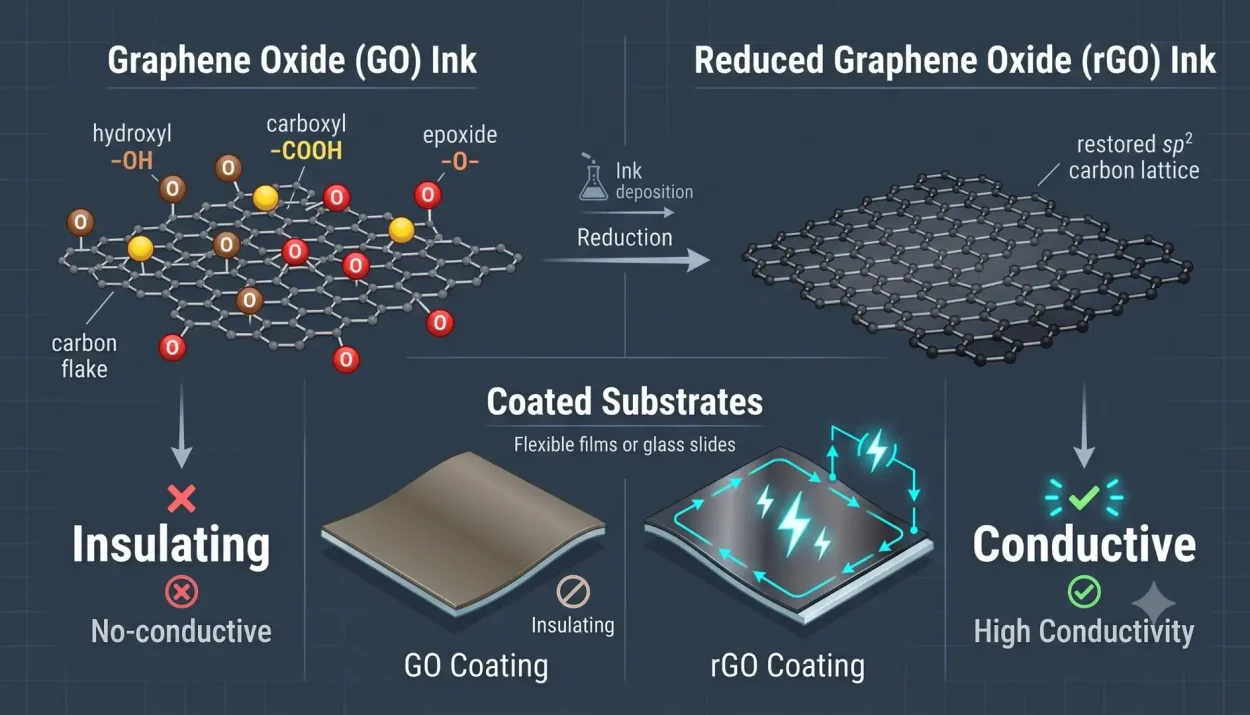
Graphene Oxide contains oxygen-bearing functional groups, including hydroxyl, epoxy, and carboxyl groups. These groups influence its interaction with solvents and other materials, making GO suitable for preparing dispersions in selected liquid media. Reduced Graphene Oxide is produced by removing some of these oxygen-containing groups through chemical, thermal, or other reduction processes. This treatment generally improves electrical conductivity, although the resulting material retains structural defects and residual oxygen groups.
Understanding the differences between GO and rGO inks is essential for selecting suitable formulations for conductive coatings. Comparative evaluation includes dispersion stability, film formation, electrical resistance, substrate adhesion, and the effects of post-deposition processing.
Structural and Chemical Differences Between GO and rGO
The properties of graphene-based inks depend strongly on the chemical structure and surface characteristics of the dispersed material.
Graphene Oxide (GO)
Graphene Oxide is a graphene-derived material containing oxygen functional groups distributed across its basal planes and edges. These groups modify its surface chemistry and can improve its compatibility with water and other suitable polar media.
Important characteristics include:
- Relatively high oxygen content compared with rGO.
- Hydrophilic surface characteristics in suitable formulations.
- Potential for stable aqueous dispersions under appropriate conditions.
- Functional groups that can interact with selected polymers and substrate surfaces.
- Electrical conductivity that is generally lower than that of well-reduced graphene-derived materials.
GO is particularly useful when dispersion stability, surface functionalization, and chemical interactions are important research parameters.
Reduced Graphene Oxide (rGO)
Reduced Graphene Oxide is obtained by partially removing oxygen-containing functional groups from GO. The reduction process can restore portions of the conjugated carbon network, improving electrical charge transport.
Its important characteristics include:
- Generally higher electrical conductivity than GO.
- Lower oxygen content, depending on the reduction method.
- Greater difficulty in dispersing in some polar media.
- Potential for forming conductive networks in deposited films.
- Residual structural defects and oxygen groups that depend on the starting material and reduction conditions.
The extent of reduction significantly influences the final properties of rGO. Consequently, not all rGO inks exhibit the same conductivity, stability, or film quality.
Comparison of GO and rGO Ink Properties
GO and rGO inks differ in several important parameters that affect their suitability for conductive coating applications.
| Parameter | Graphene Oxide Ink | Reduced Graphene Oxide Ink |
| Oxygen content | Relatively high | Generally lower |
| Electrical conductivity | Usually low before reduction | Generally higher |
| Water dispersibility | Often favorable with suitable formulation | May require additional formulation strategies |
| Surface chemistry | Rich in oxygen-containing functional groups | Partially restored carbon network with residual functional groups |
| Film formation | Can support uniform coatings under suitable conditions | Can form conductive coatings after appropriate deposition and processing |
| Post-deposition treatment | May require reduction for improved conductivity | May require drying or further treatment to improve film performance |
| Interfacial interactions | Functional groups can support surface interactions | Depends on residual functionality and surface characteristics |
| Main research focus | Dispersion, functionalization, and film uniformity | Conductivity, conductive network formation, and stability |
These are general trends, not absolute properties. Each ink’s actual performance depends on material grade, flake dimensions, concentration, formulation additives, substrate characteristics, and processing conditions.
Electrical Conductivity and Charge Transport
Electrical conductivity is a key difference between GO and rGO coatings.
In GO, oxygen functional groups interrupt portions of the interconnected carbon network. These changes restrict charge-carrier movement, resulting in comparatively low electrical conductivity.
During reduction, some oxygen-containing groups are removed, and portions of the carbon network regain greater electronic connectivity. This typically improves conductivity. However, reduction does not completely restore the original graphene structure because structural defects may remain.
The conductivity of a deposited coating also depends on how effectively individual sheets connect. Even when rGO has favorable intrinsic properties, poor flake contact or non-uniform deposition can increase the overall film resistance.
Researchers can investigate these relationships by measuring sheet resistance, estimating electrical conductivity where film thickness is known, and comparing samples prepared under controlled conditions.
Important variables include:
- Degree of reduction.
- Graphene sheet dimensions and distribution.
- Film thickness and packing density.
- Contact resistance between adjacent sheets.
- Residual binders and other formulation additives.
- Drying, annealing, or reduction conditions.
A useful comparative study should therefore evaluate both the starting-material properties and the electrical performance of the final coating.
Dispersion Stability and Ink Formulation
Dispersion stability is essential for reproducible coating formation. Aggregation or sedimentation can cause variations in deposited thickness, surface coverage, and electrical resistance.
GO often disperses more readily in water because its oxygen-containing groups interact with the surrounding liquid. This behavior can simplify aqueous formulation preparation, although stability still depends on pH, ionic strength, concentration, and other components.
rGO generally has fewer oxygen-containing groups and may aggregate more strongly in some polar media. Formulation strategies such as solvent selection, surfactants, polymeric stabilizers, or controlled surface modification may improve dispersion.
However, formulation additives can affect the dried film’s electrical properties. Excessive stabilizer content may introduce barriers between adjacent sheets and reduce electrical contact.
Researchers should consider the following factors when optimizing either ink:
- Material concentration and flake size.
- Solvent compatibility and surface interactions.
- Mixing and ultrasonication conditions.
- Viscosity and flow behavior.
- Sedimentation over time.
- Effects of additives on the final film’s conductivity.
The objective is to achieve adequate dispersion stability without compromising the formation of an interconnected conductive network.
Conductive Coating Formation on Different Substrates
GO and rGO inks can be deposited onto glass, polymer films, paper, and other suitable surfaces. The substrate choice influences wetting, adhesion, drying behavior, and the final coating structure.
Glass Substrates
Glass provides a relatively rigid platform for studying film uniformity, electrical properties, and surface morphology. GO may interact with properly prepared glass surfaces through its functional groups, while rGO coatings can be evaluated for conductive-layer formation.
Surface cleanliness, coating thickness, drying conditions, and the degree of material aggregation influence the quality of the resulting film.
Polymer Substrates
Polymer films are relevant to research involving lightweight and flexible electronic structures. However, researchers must consider their thermal stability, surface energy, and solvent compatibility during coating preparation.
GO may offer advantages where aqueous processing and surface interactions are important. rGO may be preferred when higher electrical conductivity is required, provided that the formulation and processing method are compatible with the polymer.
Paper and Porous Substrates
Porous substrates can absorb the liquid medium, affecting coating penetration, thickness, and surface uniformity. Both GO and rGO formulations may require adjustment to control liquid absorption and obtain reproducible conductive layers.
The most suitable material depends on the required electrical performance, substrate properties, and fabrication method.
Printing and Deposition Techniques
Different deposition methods can prepare GO and rGO coatings, depending on ink rheology and the desired coating architecture.
Screen printing: Suitable for patterned coatings and relatively thick deposited layers. Optimize viscosity and flow behavior to maintain pattern definition.
Inkjet printing: Supports digitally controlled deposition and fine pattern formation. The formulation must meet the requirements for viscosity, surface tension, dispersion stability, and nozzle compatibility.
Spray coating: Useful for covering larger areas and producing coatings with adjustable thickness through repeated deposition.
Drop casting: A straightforward laboratory technique for comparative material studies, although uniformity may be more difficult to control over large areas.
Spin coating: Can produce relatively uniform thin films on suitable substrates, depending on ink properties and processing parameters.
GO and rGO inks may require different formulation conditions for the same deposition method. For a scientifically valid comparison, researchers should document the deposition parameters and account for differences in solids concentration, viscosity, and drying behavior.
Influence of Drying and Reduction Conditions
Post-deposition processing can significantly alter the structure and electrical properties of graphene-based coatings.
GO coatings may undergo reduction to improve electrical conductivity. Chemical, thermal, or other reduction methods can remove some oxygen-containing groups. The effectiveness of each method depends on the initial GO material and the processing conditions.
Temperature, treatment duration, atmosphere, and reduction chemistry can affect the degree of reduction, structural integrity, and film morphology. Excessive thermal treatment may damage temperature-sensitive substrates, while incomplete reduction may leave the coating with relatively high resistance.
rGO coatings may also require controlled drying or additional processing to improve sheet contact and remove residual formulation components.
A meaningful comparison should distinguish between the initial properties of the inks and the final properties of the processed coatings. Otherwise, observed differences may reflect processing conditions rather than the intrinsic characteristics of GO and rGO.
Characterization Methods for Comparative Research
A combination of analytical techniques can provide a comprehensive understanding of GO and rGO ink performance.
Raman Spectroscopy
Raman spectroscopy can help evaluate carbon structure, disorder, and changes associated with reduction. The D and G bands are commonly examined, although their interpretation requires consideration of material structure and measurement conditions.
X-ray Photoelectron Spectroscopy (XPS)
XPS can investigate surface chemical composition and estimate changes in oxygen-containing functional groups following reduction.
Scanning Electron Microscopy (SEM)
SEM provides information about coating morphology, surface defects, flake distribution, cracks, and the structure of deposited layers.
UV–Visible Spectroscopy
UV–visible spectroscopy can examine optical absorption and monitor changes in suitable dispersions. Interpret absorbance measurements alongside other methods when assessing dispersion quality.
Electrical Measurements
Four-point probe measurements can determine sheet resistance in appropriate coatings. Conductivity comparisons require reliable film-thickness measurements and consistent test conditions.
Rheological Analysis
Viscosity and flow measurements help determine whether GO and rGO inks suit different printing or coating techniques.
Adhesion and Mechanical Testing
Suitable adhesion tests and controlled bending experiments can help evaluate coating integrity on rigid and flexible substrates.
Combining chemical, structural, electrical, and mechanical characterization is essential for explaining why one formulation performs better than another.
Potential Research Applications
GO and rGO inks support different research directions according to their properties.
- Conductive coatings: rGO inks are particularly relevant when electrical conduction is a primary requirement.
- Printed electronics: Both materials can be investigated for patterned films, with rGO generally offering advantages in conductivity.
- Flexible electronic structures: rGO coatings on polymer films can be evaluated for resistance changes during bending.
- Functional surface coatings: GO can provide chemically active surfaces, while reduced materials can introduce conductive pathways.
- Electromagnetic shielding: rGO-based coatings and composites are investigated for their electromagnetic response.
- Composite materials: GO and rGO can be incorporated into polymer matrices to study interfacial interactions and electrical network formation.
- Optical and electronic research: Thin-film structures can be used to study the different optical and electronic properties of GO and rGO.
The appropriate selection depends on the intended performance requirements and the ability to control the material’s properties during processing.
Future Research Directions
Future studies can focus on improving the balance between dispersion stability, electrical conductivity, and coating uniformity. Research opportunities include developing stable aqueous rGO formulations, controlling flake dimensions, reducing the need for additional formulation components, and improving low-temperature processing methods.
Another important direction is systematically comparing GO and rGO inks under identical deposition and characterization conditions. Such studies can clarify how reduction level, surface chemistry, and flake-to-flake contact influence the performance of conductive coatings.
Researchers may also investigate hybrid formulations that combine graphene-derived materials with other functional components. These approaches require careful assessment to determine whether improved conductivity or coating durability justifies any added formulation complexity.
Standardized reporting of solids content, viscosity, substrate preparation, coating thickness, processing conditions, and electrical measurements would improve reproducibility and make findings easier to compare across research groups.
Conclusion
Graphene Oxide and Reduced Graphene Oxide inks offer different advantages for conductive coating research. GO provides oxygen-containing functional groups that can support dispersion in suitable liquid media and interactions with selected substrates. rGO generally offers improved electrical conductivity because reduction restores portions of the interconnected carbon network.
However, the final performance of either material depends on formulation composition, dispersion stability, deposition method, substrate compatibility, and post-processing conditions. GO may be useful where surface functionality and dispersion behavior are priorities, whereas rGO is often more suitable when electrical conduction is the main objective.
A systematic comparative approach combining spectroscopy, microscopy, rheological analysis, electrical testing, and adhesion evaluation can help establish reliable relationships between material characteristics and coating performance. These investigations contribute to the development of advanced graphene-based materials for printed electronics, conductive surfaces, and flexible functional structures.