

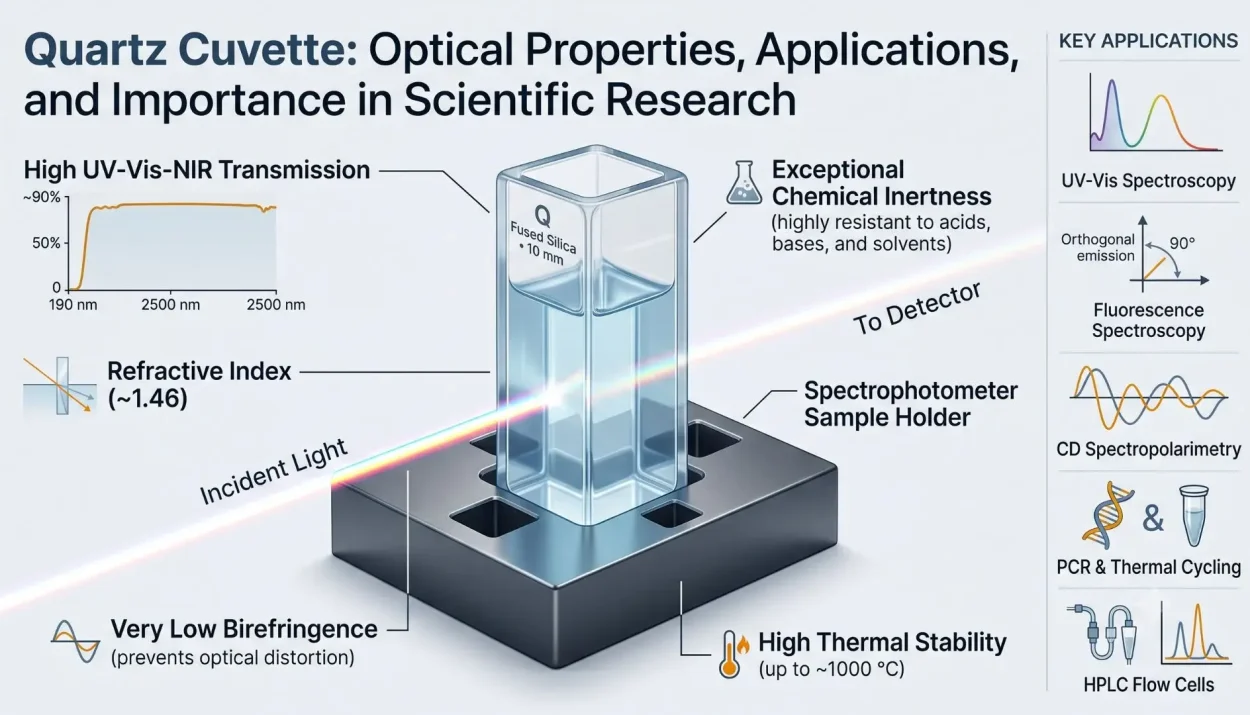
A Quartz Cuvette is a precision optical sample holder widely used in laboratory research involving spectroscopy, photochemical studies, material characterization, and analytical measurements. Manufactured from high-purity quartz, these cuvettes provide excellent optical transmission across a broad wavelength range, making them particularly useful for experiments involving ultraviolet (UV) and visible light.
Quartz cuvettes are available in different optical path lengths, volumes, and configurations to accommodate a wide range of experimental setups. Their combination of optical transparency, thermal stability, and chemical resistance makes them an important laboratory component for researchers working with advanced materials and analytical techniques.
What Is a Quartz Cuvette?
A quartz cuvette is a small transparent container designed to hold liquid samples, dispersions, or other experimental materials during optical measurements. Unlike ordinary glass cuvettes, quartz versions offer significantly better transmission in the ultraviolet region.
The most common material is fused quartz or fused silica, which provides high optical clarity and excellent resistance to thermal and chemical conditions.
Typical quartz cuvettes may feature:
- High UV transmission
- Excellent optical clarity
- Low fluorescence
- Good thermal stability
- High chemical resistance
- Precision optical surfaces
- Consistent optical path length
- Low background interference
These properties make quartz cuvettes suitable for demanding spectroscopic and photochemical experiments.
Why Quartz Is Used for Spectroscopic Research
The cuvette material can significantly affect optical measurement quality. Conventional glass has limited transmission in the deep-UV region, while fused quartz can transmit much shorter wavelengths.
This makes quartz particularly useful when researchers need to investigate:
- UV absorption
- Optical transmission
- Photochemical reactions
- Nanomaterial dispersions
- Semiconductor materials
- Thin-film materials
- Optical properties of solutions
- Light-induced material transformations
For experiments where the measurement wavelength extends into the UV region, quartz can provide a broader usable spectral range than standard optical glass.
Key Properties of Quartz Cuvettes
Broad Optical Transmission
One of the most important characteristics of quartz cuvettes is their broad optical transmission. High-quality fused quartz can transmit ultraviolet, visible, and portions of the near-infrared spectrum.
This enables researchers to use quartz cuvettes with instruments such as:
- UV-Visible spectrophotometers
- Fluorescence spectrometers
- Absorption spectroscopy systems
- Photochemical research equipment
- Optical characterization systems
High Optical Clarity
Quartz provides excellent transparency and optical uniformity. Properly manufactured optical surfaces help minimize unwanted scattering and reflection during measurements. This is especially important when analyzing samples with relatively small optical changes.
Thermal Stability
Quartz has a high softening temperature and excellent resistance to thermal shock compared with many conventional materials. As a result, quartz cuvettes can be used in controlled-temperature experiments where temperature variations could otherwise affect the sample holder.
Chemical Resistance
Fused quartz resists many laboratory chemicals and solvents. This makes it useful for research involving chemically active sample systems. However, always check compatibility for the specific chemical environment and experimental conditions.
Low Background Interference
For optical measurements, the sample holder should contribute as little interference as possible. High-quality quartz provides low background absorption over its usable wavelength range, helping researchers obtain cleaner measurement data.
Quartz Cuvettes in UV-Visible Spectroscopy
UV-Visible spectroscopy is a major research area that uses quartz cuvettes. During an absorption measurement, light passes through the sample contained inside the cuvette. The instrument compares the transmitted light intensity with the appropriate reference measurement.
The resulting spectrum can provide information about:
- Electronic transitions
- Optical absorption characteristics
- Band-edge behavior
- Concentration-dependent optical response
- Light interaction with nanomaterials
- Spectral changes during experiments
Quartz cuvettes are particularly useful when measurements extend below the transmission range of ordinary glass.
Applications in Nanomaterial Research
Quartz cuvettes are frequently useful in research involving nanomaterials and advanced materials.
Researchers can use them for studying optical responses from:
- Metal nanoparticles
- Metal oxide nanoparticles
- Carbon-based nanomaterials
- Graphene-related materials
- Quantum materials
- Semiconductor nanoparticles
- Colloidal dispersions
- Functional nanocomposites
For example, a researcher investigating the optical absorption of a nanoparticle dispersion can place the dispersion inside a quartz cuvette and analyze its spectral response using a UV-Visible spectrometer. Changes in particle size, concentration, aggregation, or surface characteristics may influence the measured optical spectrum.
Role in Photochemical Research
Quartz has excellent UV transmission, making quartz cuvettes useful in experiments where ultraviolet radiation interacts directly with a sample.
Researchers may use quartz sample holders for:
- Light-induced reactions
- Photocatalytic studies
- UV irradiation experiments
- Optical reaction monitoring
- Photoresponsive material research
- Photophysical investigations
Quartz’s transparency lets incident radiation reach the sample while enabling researchers to monitor optical changes.
Use in Materials Characterization
Quartz cuvettes can also support characterization studies involving advanced materials.
For example, researchers can investigate changes in optical absorption before and after:
- Material synthesis
- Thermal treatment
- Surface modification
- Functionalization
- Irradiation
- Chemical interaction
- Dispersion processing
Comparing spectra collected under controlled conditions can help researchers understand how processing conditions influence material properties.
Important Quartz Cuvette Specifications
When selecting a quartz cuvette, researchers should consider several specifications.
| Specification | Importance |
| Optical Path Length | Influences measurement sensitivity |
| Internal Volume | Determines sample requirement |
| External Dimensions | Must match the instrument holder |
| Optical Window | Determines measurement direction |
| Surface Quality | Influences optical accuracy |
| Wavelength Range | Determines suitable applications |
| Cuvette Type | Depends on instrument configuration |
| Cap/Stopper | Useful for containing volatile or sensitive samples |
| Manufacturing Tolerance | Important for reproducible measurements |
Optical Path Length
The optical path length is the distance that light travels through the sample.
Common research cuvettes include 10 mm optical path length models, although other dimensions are available for specialized applications.
The appropriate path length depends on:
- Sample concentration
- Expected absorbance
- Instrument sensitivity
- Sample volume
- Experimental design
For highly absorbing samples, a shorter path length may be useful, whereas dilute samples may benefit from a longer optical path.
Single-Cell and Multi-Cell Configurations
Quartz cuvettes are available in several configurations. Standard cuvettes are designed for routine optical measurements and are commonly compatible with conventional spectrophotometers.
Micro-Volume Cuvettes
Micro-volume designs require smaller sample volumes and can be useful when sample availability is limited.
Flow Cuvettes
Flow-through quartz cuvettes allow samples to pass continuously through the optical measurement area. They are useful for monitoring processes where sample composition changes over time.
Sealed Quartz Cuvettes
Sealed configurations can help maintain controlled sample conditions during experiments involving gases, volatile components, or controlled atmospheres.
Quartz Cuvettes for Fluorescence Studies
Quartz cuvettes can also be used with fluorescence spectroscopy systems.
Fluorescence measurements require careful consideration of the optical geometry because excitation and emission light interact with the cuvette and sample.
Depending on the instrument, researchers may select cuvettes with:
- Two optical windows
- Four optical windows
- Special fluorescence geometry
- Low-background optical surfaces
Select the correct configuration based on the spectrometer design.
Quartz Cuvettes and Reproducible Research
Reproducibility is an important part of scientific research. Variations in cuvette dimensions, optical surfaces, cleanliness, and path length can influence measurements.
For consistent results, researchers should maintain:
- Consistent cuvette orientation
- Identical optical path lengths
- Proper cleaning procedures
- Consistent sample volume
- Appropriate blank/reference measurements
- Careful handling of optical surfaces
- Using matched cuvettes can also reduce measurement-to-measurement variation.
Cleaning and Handling
Quartz is durable, but handle optical surfaces carefully.
Recommended practices include:
- Hold the cuvette by its non-optical surfaces.
- Avoid touching optical windows with fingers.
- Rinse immediately after use where appropriate.
- Use a compatible cleaning solvent.
- Avoid abrasive cleaning materials.
- Dry using suitable laboratory procedures.
- Store cuvettes in protective containers.
- Inspect optical windows for scratches or deposits before use.
Always select cleaning procedures based on the sample chemistry and the quartz manufacturer’s recommendations.
Quartz Cuvette vs. Glass Cuvette
Quartz and glass cuvettes serve different experimental requirements.
| Feature | Quartz Cuvette | Glass Cuvette |
| Visible Transmission | Excellent | Excellent |
| Thermal Stability | High | Moderate to high depending on glass type |
| Chemical Resistance | High | Depends on glass composition |
| UV Spectroscopy | Highly suitable | Limited for shorter wavelengths |
| Optical Research | Broad applications | General applications |
For experiments requiring significant UV transmission, quartz is often selected because of its broader optical transmission characteristics.
Use in Advanced Experimental Setups
Quartz cuvettes can be integrated into more specialized research platforms, including:
- Temperature-controlled spectroscopy
- In-situ optical measurements
- Photochemical reactors
- Kinetic experiments
- Nanomaterial characterization systems
- Automated spectroscopy platforms
- Fiber-optic measurement systems
Their compact geometry lets them serve as a controlled optical interface between the sample and the measurement system.
Factors to Consider When Selecting a Quartz Cuvette
Researchers should evaluate the following before purchasing:
- Wavelength range:
Select a material suitable for the intended spectral region. - Optical path length:
Match the path length to the expected sample absorbance and instrument requirements. - Sample volume:
Choose a cuvette that accommodates the available sample quantity. - Optical configuration:
Select the appropriate number and orientation of optical windows. - Chemical compatibility:
Confirm that the quartz and any sealing materials are compatible with the sample environment. - Instrument compatibility:
Check the external dimensions and holder configuration. - Surface quality:
High-quality optical surfaces are important for accurate measurements.
Future Scope of Quartz Cuvettes in Scientific Research
As optical characterization becomes increasingly important in advanced materials research, quartz cuvettes are expected to remain useful components of laboratory measurement systems. Emerging research areas such as nanomaterials, photocatalytic materials, semiconductor systems, optical sensors, energy-related materials, and photonic materials increasingly rely on precise optical measurements.
Future developments may focus on:
- Lower sample-volume designs
- Improved optical quality
- Specialized flow-through systems
- In-situ measurement configurations
- Temperature-controlled cuvettes
- Automated sample handling
- Customized optical geometries
Conclusion
Quartz cuvettes are important laboratory components for optical and spectroscopic research, particularly when experiments require high UV transmission, optical clarity, thermal stability, and chemical resistance. Their applications extend across nanomaterial research, materials characterization, UV-Visible spectroscopy, fluorescence studies, and photochemical investigations.
Selecting the right quartz grade, optical path length, geometry, and surface quality can significantly improve the reliability and reproducibility of experimental measurements. As scientific research increasingly relies on advanced optical characterization, quartz cuvettes remain a practical interface between complex samples and precision analytical instruments.