

The interaction between light, semiconductors, and electrical charge is central to modern materials research. As researchers develop new approaches for solar-energy conversion, photocatalysis, sensors, and advanced optoelectronic systems, interest is growing in substrates that provide both optical transparency and electrical conductivity.
Aluminum-doped zinc oxide (AZO) coated glass is one such material platform. Commonly represented as ZnO, AZO consists of zinc oxide modified with aluminum to alter its electrical and optical characteristics. When deposited as a thin coating on glass, it creates a transparent conductive surface that can be integrated with a wide range of functional materials.
This combination makes AZO-coated glass particularly interesting for photoelectrochemical experiments, photocatalytic thin films, semiconductor interfaces, and light-assisted electrochemical research.
What Is AZO Coated Glass?
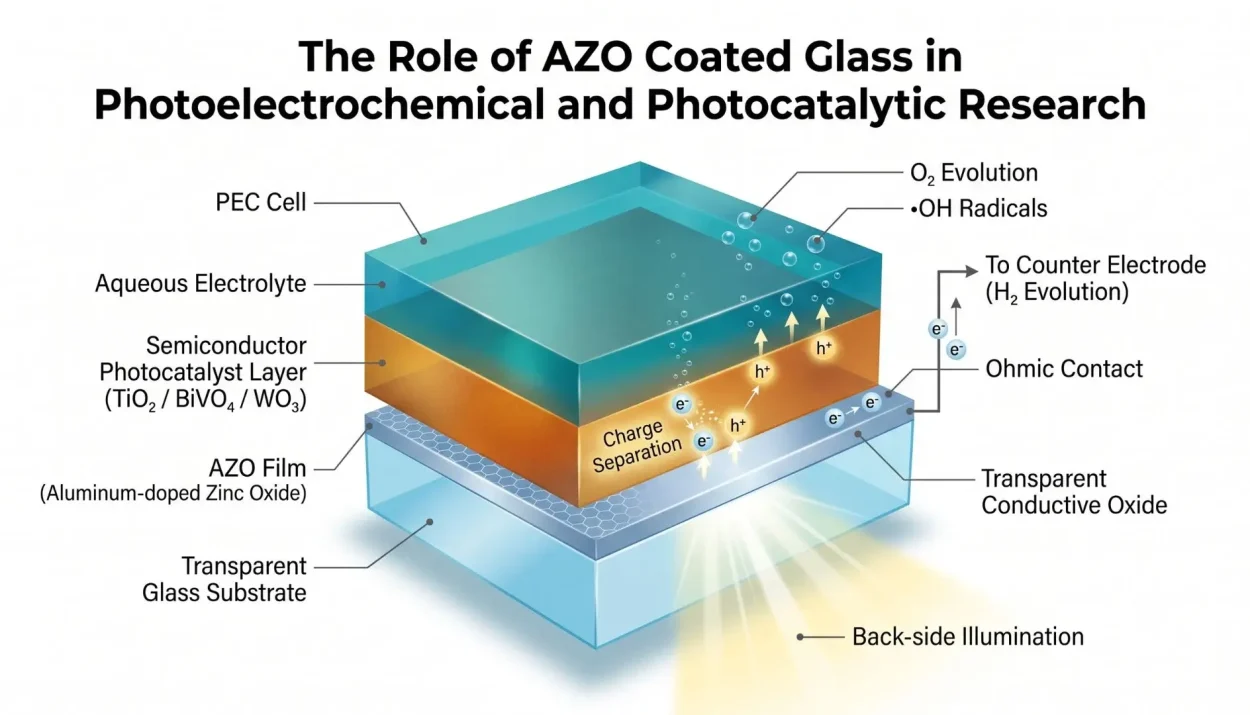
AZO-coated glass consists of a transparent glass substrate with a thin layer of aluminum-doped zinc oxide deposited on its surface. The glass provides the mechanical and optical foundation, while the AZO coating introduces electrical conductivity.
A typical structure can be represented as:
Glass Substrate → AZO Conductive Layer → Functional Material
Depending on the research objective, researchers can deposit an additional semiconductor, photocatalyst, nanomaterial, or other functional coating on top of the AZO layer. The resulting multilayer structure lets researchers investigate interactions among light, charge carriers, surfaces, and interfaces.
Why Is AZO Important in Photoelectrochemical Research?
Photoelectrochemical research examines processes in which light influences electrochemical behavior. When a semiconductor absorbs photons with sufficient energy, electrons can move to higher-energy states while positively charged vacancies, commonly called holes, remain behind.
A simplified process is:
Semiconductor + Light → Electrons + Holes
The subsequent movement and separation of these charge carriers strongly influence the performance of a photoactive system.
Important research parameters include:
- Light absorption
- Charge generation
- Charge separation
- Charge transport
- Interfacial charge transfer
- Electron–hole recombination
- Surface reactions
AZO-coated glass provides a conductive, optically accessible platform for studying these processes.
The Advantage of a Transparent Conductive Surface
A major feature of AZO-coated glass is the combination of visible-light transmission and electrical conductivity.
This is particularly useful in experimental systems where light must reach a photoactive layer while electrical signals need to be collected from the same structure.
A transparent conductive substrate can therefore be useful for:
- Photoelectrochemical electrodes
- Photocatalytic thin films
- Semiconductor heterostructures
- Light-assisted electrochemical experiments
- Transparent electrode research
- Thin-film energy materials
The balance between conductivity and optical transmission depends on factors such as coating thickness, aluminum concentration, deposition conditions, and post-deposition treatment.
AZO as a Supporting Platform for Photocatalysts
Photocatalysis involves using light to promote chemical transformations at the surface of a photoactive material.
Researchers investigate a wide range of photocatalytic materials, including:
- Titanium dioxide
- Zinc oxide
- Graphitic carbon nitride
- Metal oxides
- Semiconductor composites
- Nanostructured materials
- Semiconductor heterojunctions
AZO-coated glass can serve as a supporting conductive substrate for these materials.
For example, a researcher may construct a structure such as:
Glass / AZO / Photocatalytic Material
The conductive AZO layer provides an electrical pathway that lets researchers investigate the movement of photo-generated charge carriers through the functional layer.
Studying Charge Separation
One major challenge in photocatalytic research is the recombination of electrons and holes before they can participate in surface reactions. A carefully designed conductive interface can help investigate charge separation and transport.
Researchers can study properties such as:
- Photocurrent response
- Charge-transfer resistance
- Carrier transport
- Interfacial charge accumulation
- Recombination behavior
- Photoresponse stability
By comparing different substrate structures and coating conditions, researchers can investigate how the interface influences a photoactive material’s behavior.
AZO Coated Glass in Photoelectrochemical Experiments
A typical photoelectrochemical experiment may contain:
Light Source → Photoactive Electrode → Electrolyte → Counter Electrode → Reference Electrode → Measurement System
When researchers illuminate the photoactive electrode, they can measure the resulting electrical response. AZO-coated glass can be incorporated into such electrode structures when researchers require a transparent conductive surface.
Depending on the experimental design, researchers can investigate:
Photocurrent
The current generated under illumination can provide information about photo-induced charge generation and transport.
Wavelength Response
Changing the illumination wavelength can help researchers investigate how photon energy influences the photo response.
Applied Potential
Varying the applied potential can provide information about charge-transfer behavior at the electrode–electrolyte interface.
Long-Term Stability
Repeated illumination cycles can reveal changes in photoresponse over time.
AZO for Photocatalytic Thin-Film Research
Photocatalytic powders are widely investigated, but thin-film configurations can offer advantages when researchers need a fixed, well-defined surface.
AZO-coated glass can provide a suitable platform for depositing photocatalytic films using techniques such as:
- Spin coating
- Dip coating
- Spray deposition
- Sol-gel processing
- Electrodeposition
- Sputtering
- Chemical vapor deposition
- Hydrothermal growth
Researchers can evaluate the resulting films for their structural, optical, electrical, and surface characteristics. This enables researchers to establish relationships between film morphology, crystallinity, interface quality, and photo-induced activity.
Characterization of AZO-Based Structures
A combination of analytical methods can be used to understand AZO-coated glass and the functional layers deposited on it.
X-Ray Diffraction (XRD)
XRD can investigate the crystal structure, phase composition, and preferred orientation of the AZO coating and deposited materials.
UV–Visible Spectroscopy
UV–Vis measurements can provide information about optical transmission and absorption. These measurements are especially useful when studying transparent conductive structures.
Scanning Electron Microscopy
SEM can investigate surface morphology, particle distribution, coating uniformity, and film structure.
Atomic Force Microscopy
AFM provides nanoscale information about surface topography and roughness. Surface morphology can influence the growth and behavior of subsequently deposited layers.
Four-Point Probe Measurements
Four-point probe measurements can determine the sheet resistance of the AZO coating.
Hall Effect Measurements
Hall measurements can provide information about:
- Carrier concentration
- Carrier mobility
- Resistivity
- Electrical conductivity
- Carrier type
Electrochemical Impedance Spectroscopy
EIS can help researchers study interfacial electrical behavior and charge-transfer processes within an electrode structure.
AZO and Semiconductor Heterostructures
Modern photocatalytic research increasingly uses semiconductor heterostructures, combining two or more materials to improve control over charge movement.
An AZO-coated glass substrate can form part of a multilayer architecture such as:
Glass → AZO → Semiconductor A → Semiconductor B
Such structures allow researchers to investigate:
- Charge separation
- Interfacial charge transport
- Light absorption
- Energy-band alignment
- Surface reactions
- Recombination pathways
The resulting structure’s performance depends on the properties and interfaces of each layer.
Surface Engineering of AZO Coated Glass
The surface of a conductive substrate can strongly influence the behavior of subsequently deposited materials.
Important characteristics include:
- Surface roughness
- Grain structure
- Film uniformity
- Defect concentration
- Coating thickness
- Surface energy
- Adhesion
For this reason, AZO-coated glass should be viewed as more than simply a conductive sheet. It can serve as an engineered interface within a larger materials system.
Researchers can modify deposition parameters to investigate how changes in the AZO surface affect the growth and performance of functional coatings.
Influence of AZO Processing Conditions
AZO film properties depend strongly on how the coating is produced.
Aluminum Concentration
The amount of aluminum incorporated into ZnO can influence carrier concentration and electrical conductivity.
Coating Thickness
Film thickness can affect sheet resistance, optical transmission, and surface morphology.
Substrate Temperature
Deposition temperature can influence crystallinity, grain growth, and film density.
Deposition Conditions
Parameters such as pressure, power, gas composition, and deposition rate can affect film structure and composition.
Thermal Treatment
Post-deposition annealing can modify crystallinity, defect characteristics, and electrical behavior. These variables make AZO an interesting research material because its properties can be systematically adjusted and correlated with experimental results.
Applications in Solar-Energy Research
Transparent conductive materials play an important role in many experimental solar-energy architectures’-coated glass can be investigated as a transparent electrode or conductive substrate in research involving:
- Photovoltaic structures
- Photoelectrochemical cells
- Solar-fuel research
- Semiconductor thin films
- Light-assisted electrochemical systems
- Transparent optoelectronic devices
The ability to combine optical transmission with electrical conduction lets researchers design structures where light enters through the conductive surface while electrical measurements are performed simultaneously.
AZO in Environmental Photocatalysis Research
Supported photocatalytic films are an important area of research because a fixed catalyst layer can be easier to handle and characterize than a dispersed powder. AZO-coated glass can serve as a substrate for investigating these systems.
Researchers can examine parameters including:
- Light intensity
- Illumination wavelength
- Film thickness
- Surface morphology
- Reaction time
- Catalyst composition
- Charge-transfer behavior
- Reusability of the coated substrate
These studies can help researchers understand how photocatalyst structure and conductive interfaces influence light-driven surface reactions.
Why AZO Coated Glass Is Valuable for Research
The scientific value of AZO-coated glass comes from its multifunctional nature. A single substrate can provide:
Optical Function
Allows light to reach the active material.
Electrical Function
Provides a pathway for charge transport and measurement.
Structural Function
Supports thin films and multilayer architectures.
Surface Function
Provides an interface for depositing functional materials.
Research Function
Enables investigation of relationships between structure, light, and electrical response.
This combination makes AZO-coated glass useful across several interconnected fields of materials science.
Future Research Directions
The research potential of AZO-coated glass continues to expand as scientists investigate new semiconductor combinations, deposition methods, and device architectures.
Areas of continuing interest include:
- Nanostructured AZO coatings
- Optimized aluminum doping
- Large-area transparent electrodes
- Flexible conductive substrates
- AZO-based semiconductor heterostructures
- Two-dimensional material interfaces
- Advanced photocatalytic coatings
- Photoelectrochemical energy systems
- Improved charge-separation architectures
Future research may increasingly focus on controlling AZO interfaces at the nanoscale to relate better optical transmission, electrical conductivity, surface structure, and photo-induced charge transport.
Conclusion
AZO-coated glass is a versatile transparent conductive platform for studying interactions among light, electrical charge, and functional materials. Its combination of optical transparency, electrical conductivity, semiconductor compatibility, and tunable surface properties makes it useful for research in photo electrochemistry, photocatalysis, thin-film science, semiconductor interfaces, and solar-energy technologies.
By integrating AZO with photoactive materials, researchers can build experimental structures that enable investigation of light absorption, charge generation, charge separation, and electrical measurement within a controlled architecture. As research moves toward increasingly complex semiconductor interfaces and multifunctional thin films, AZO-coated glass offers a practical foundation for exploring how materials can be engineered to control the movement of light and charge at the surface and interface level.