

Magnesium Oxide (MgO) nanoparticles are an important class of inorganic nanomaterials that have attracted significant attention in materials science and nanotechnology. Their combination of chemical stability, thermal resistance, high surface area, basic surface characteristics, and tunable optical and structural properties makes them valuable for advanced research.
At the nanoscale, MgO can exhibit properties that differ considerably from those of bulk magnesium oxide. Particle size, crystallinity, morphology, surface defects, porosity, and synthesis conditions can strongly influence its performance.
Recent research has therefore focused on developing controlled synthesis methods that produce MgO nanoparticles with specific structural and surface characteristics. Researchers are investigating these materials for applications in energy-related materials, environmental engineering, catalysis, adsorption, coatings, ceramics, sensors, and composite systems.
What Are Magnesium Oxide Nanoparticles?
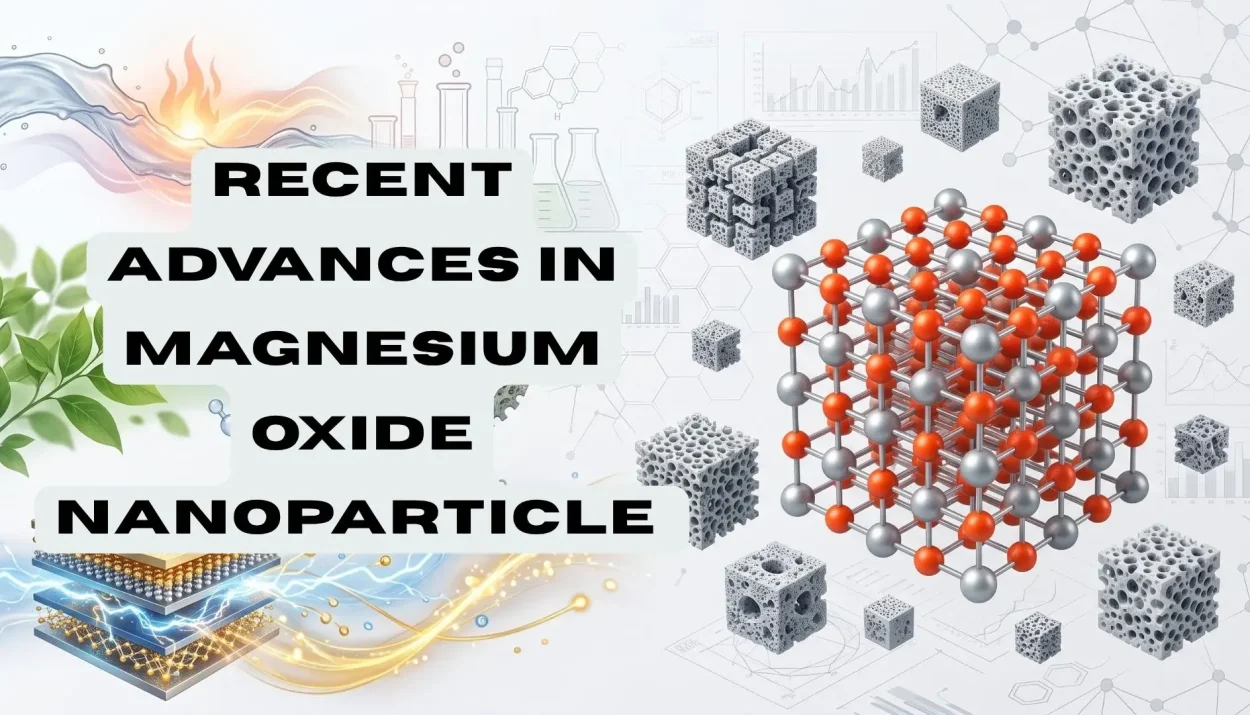
Magnesium Oxide nanoparticles are nanoscale particles composed of magnesium and oxygen with the chemical formula MgO. MgO generally possesses a cubic crystal structure and is known for its high melting point, thermal stability, and chemical resistance.
Reducing MgO to the nanoscale increases its specific surface area and alters its surface reactivity. These characteristics make MgO nanoparticles particularly interesting for research involving surface interactions, heterogeneous reactions, adsorption, and functional composites.
Important characteristics include:
- Crystal structure
- Particle size
- Particle-size distribution
- Morphology
- Specific surface area
- Porosity
- Surface defects
- Optical properties
- Thermal stability
- Surface chemistry
- Chemical purity
Recent Advances in MgO Nanoparticle Synthesis
The synthesis route strongly influences the final characteristics of MgO nanoparticles. Researchers have developed several approaches to control particle size, morphology, crystallinity, and surface properties.
Sol-Gel Synthesis
The sol-gel method is widely studied because it provides relatively good control over chemical composition and particle formation.
Typically, researchers convert a magnesium-containing precursor into a sol, then form a gel, dry it, and perform thermal treatment. Parameters such as precursor concentration, pH, reaction time, drying temperature, and calcination temperature can influence the resulting MgO structure.
Advantages include:
- Good compositional control
- Relatively uniform particle formation
- Adjustable morphology
- Suitable for laboratory-scale research
Precipitation Method
Precipitation is a comparatively simple method for producing MgO nanoparticles. A magnesium salt solution reacts with a suitable precipitating agent to form a magnesium-containing intermediate. After washing and drying, thermal treatment converts the precursor into MgO.
The final particle characteristics can be controlled through:
- Precursor concentration
- Precipitating-agent concentration
- pH
- Reaction temperature
- Aging time
- Calcination conditions
Hydrothermal Synthesis
Hydrothermal processing uses elevated temperature and pressure in a controlled reaction environment. It can produce crystalline nanostructures with controlled morphology.
This approach is particularly useful when researchers require specific particle shapes or improved crystallinity.
Hydrothermal conditions can influence:
- Crystal growth
- Particle morphology
- Crystallinity
- Surface structure
- Particle aggregation
Combustion Synthesis
Combustion synthesis is a rapid approach in which precursor materials undergo an exothermic reaction to generate MgO nanoparticles. The method can produce fine particles in relatively short processing times. However, controlling particle agglomeration and combustion temperature is important for obtaining reproducible material properties.
Green and Bio-Assisted Synthesis
Recent research has also explored alternative synthesis approaches using naturally derived materials as reaction or stabilization components. Researchers are investigating these approaches because they may reduce the use of certain conventional processing chemicals and provide alternative routes for nanoparticle production.
Important research parameters include:
- Precursor concentration
- Reaction temperature
- Processing time
- Extract or stabilizer concentration
- pH
- Calcination conditions
The resulting MgO particles must still be thoroughly characterized to establish their structural and chemical properties.
Microwave-Assisted Synthesis
Microwave-assisted processing can provide rapid and relatively uniform heating during nanoparticle synthesis. Compared with conventional heating, microwave processing can potentially reduce reaction times and influence nucleation and particle growth. Researchers are investigating microwave-assisted approaches for producing MgO nanoparticles with controlled particle sizes and morphologies.
Solvothermal and Other Advanced Routes
Solvothermal techniques, spray-based approaches, mechanochemical processing, and related methods are also being investigated for producing MgO nanostructures.
Each synthesis route provides different levels of control over nucleation, crystal growth, surface area, and morphology.
Factors Controlling MgO Nanoparticle Properties
The final characteristics of MgO nanoparticles are strongly dependent on synthesis conditions.
Particle Size
Particle size influences surface area, surface reactivity, optical behavior, and interaction with surrounding materials. Smaller particles generally provide a greater surface-to-volume ratio, although excessive aggregation can reduce the practically accessible surface area.
Morphology
MgO nanoparticles can occur in different shapes, including:
- Spherical particles
- Cubic structures
- Rod-like structures
- Plate-like structures
- Irregular nanostructures
Morphology can influence surface exposure and interaction with other materials.
Calcination Temperature
Thermal treatment plays an important role in converting precursor materials into crystalline MgO. Increasing calcination temperature can improve crystallinity but may also promote particle growth and aggregation. Therefore, selecting an appropriate thermal-treatment condition is an important part of MgO nanoparticle development.
Surface Area
High specific surface area is an important characteristic of nanoscale MgO. BET surface-area measurements are commonly used to evaluate the accessible surface area of MgO powders.
Characterization Techniques
A combination of analytical techniques is normally required to understand MgO nanoparticles comprehensively.
X-Ray Diffraction (XRD)
XRD is used to determine crystal structure and crystallinity. For MgO, diffraction patterns can confirm the characteristic cubic MgO phase and estimate crystallite size using appropriate analytical methods.
Scanning Electron Microscopy (SEM)
SEM provides information about particle morphology, surface structure, aggregation, and approximate particle dimensions.
Transmission Electron Microscopy (TEM)
TEM provides higher-resolution information about nanoscale morphology and particle structure.
It can be particularly useful for studying particle size, shape, lattice features, and aggregation.
Fourier Transform Infrared Spectroscopy (FTIR)
FTIR is useful for investigating chemical bonding and surface functional groups. It can help identify Mg–O-related vibrations and other surface species associated with the preparation process.
UV–Visible Spectroscopy
UV–Vis spectroscopy can be used to investigate optical absorption and estimate optical characteristics of MgO nanoparticles. Changes in particle size, defects, and synthesis conditions can influence the observed optical response.
BET Surface-Area Analysis
BET analysis provides information about specific surface area and, depending on the measurement approach, pore characteristics. This information is particularly valuable when investigating MgO nanoparticles for adsorption and surface-related processes.
Thermogravimetric Analysis
TGA can evaluate thermal behavior and identify mass changes associated with residual precursor materials, surface species, or thermal decomposition.
Applications in Energy Materials Research
Researchers are exploring MgO nanoparticles as functional components in several energy-related material systems.
Energy Storage Materials
Researchers can investigate MgO as a component or additive in electrode and composite systems. Its thermal stability, surface characteristics, and compatibility with different materials make it useful for studying advanced energy-storage architectures. Researchers investigate MgO-containing composites to understand how surface interactions and structural modifications influence electrochemical and thermal behavior.
Electrochemical Research
The high surface area and tunable surface chemistry of nanoscale MgO make it interesting for electrochemical interfaces and composite electrode research. MgO can also be combined with conductive carbon materials and other inorganic phases to develop multifunctional structures.
Thermal Management Materials
MgO possesses good thermal characteristics and can be incorporated into selected composite materials for thermal management research. Nanoscale MgO may influence thermal transport depending on particle concentration, dispersion, interfacial resistance, and matrix composition.
Dielectric and Insulating Materials
MgO is electrically insulating and thermally stable, making it relevant to research into dielectric and insulating materials. Researchers can incorporate MgO nanoparticles into polymeric or ceramic matrices to investigate changes in dielectric properties, thermal stability, and mechanical performance.
Applications in Environmental Materials Research
Adsorption Research
MgO nanoparticles provide a high surface-to-volume ratio and chemically active surface sites. These properties make them useful for investigating adsorption processes involving selected inorganic and organic species.
Research can focus on parameters such as:
- Adsorption capacity
- Contact time
- Temperature
- pH
- Initial concentration
- Surface area
- Particle size
Water and Aqueous-System Research
Researchers investigate MgO-based nanomaterials as functional materials for controlling selected chemical species in aqueous environments. MgO surface chemistry can influence interactions with dissolved compounds, making it an interesting platform for laboratory-scale environmental materials research.
Catalytic Materials
MgO is a basic oxide and can act as a support or functional component in heterogeneous catalytic systems. At the nanoscale, increased surface area can provide additional surface sites for chemical reactions.
Researchers are studying MgO-containing systems for:
- Surface reactions
- Biomass-related conversion processes
- Chemical transformation
- Heterogeneous catalysis
- Composite catalyst development
Environmental Sensors
MgO nanoparticles can be incorporated into sensor materials where changes in surface interactions influence measurable electrical or optical signals. Combining MgO with conductive or semiconducting materials can provide additional opportunities for developing functional sensing platforms.
MgO Nanoparticles in Composite Materials
A major research direction is incorporating MgO nanoparticles into composite systems.
MgO can be combined with:
- Polymers
- Ceramics
- Carbon nanomaterials
- Metals
- Metal oxides
- Glass-based materials
The objective is often to combine MgO’s characteristics with those of another material.
For example, MgO nanoparticles can influence mechanical behavior, thermal stability, dielectric characteristics, surface properties, or chemical resistance depending on the selected matrix.
Structure–Property Relationships
Understanding the relationship between synthesis conditions and material performance is essential for advanced MgO research.
A simplified structure-property pathway can be represented as:
Synthesis Conditions → Nucleation and Growth → Particle Size & Morphology → Surface Area & Defects → Functional Properties → Application Performance
Small changes in precursor concentration, pH, reaction temperature, or calcination conditions can therefore produce measurable changes in the final material.
This makes process optimization an important aspect of MgO nanoparticle research.
Current Research Challenges
Despite extensive research, several challenges remain.
Particle Agglomeration
Nanoparticles naturally tend to form aggregates because of their high surface energy. Aggregation can reduce accessible surface area and affect performance.
Reproducibility
Different synthesis methods can produce MgO nanoparticles with significantly different properties. Consistent control of precursor quality and processing conditions is therefore important.
Surface Chemistry Control
MgO surface composition can change during synthesis, washing, drying, storage, and exposure to the surrounding atmosphere. Controlled surface characterization is therefore essential.
Scale-Up
A synthesis method that performs well at laboratory scale may require significant optimization for larger-scale production. Maintaining consistent particle size, morphology, purity, and surface area during scale-up remains an important research consideration.
Future Research Directions
Future research is expected to focus on precise control of MgO nanoparticle structure and surface characteristics.
Potential research directions include:
- Controlled morphology synthesis
- Low-energy synthesis routes
- Improved particle-dispersion techniques
- Surface modification
- MgO-based hybrid nanocomposites
- Advanced adsorption materials
- Functional coatings
- Energy-storage composites
- Dielectric nanocomposites
- Catalytic materials
- Sensor platforms
- Sustainable synthesis approaches
Combining MgO nanoparticles with other nanomaterials may also enable multifunctional structures with tailored electrical, thermal, optical, and surface properties.
Conclusion
Magnesium Oxide nanoparticles are versatile research materials with nanoscale surface area, chemical stability, thermal resistance, and tunable structural properties. Advances in sol-gel, precipitation, hydrothermal, combustion, microwave-assisted, and alternative synthesis methods have expanded control over particle size, morphology, crystallinity, and surface characteristics. Characterization techniques such as XRD, SEM, TEM, FTIR, UV–Vis, BET, and TGA provide complementary information for understanding the relationship between synthesis conditions and material properties.
In energy and environmental materials research, MgO nanoparticles are being investigated for adsorption, catalysis, thermal management, dielectric materials, electrochemical systems, composite development, and functional surfaces. Continued research into controlled synthesis, surface engineering, dispersion, scale-up, and structure-property relationships can further expand the scientific potential of MgO nanoparticles as advanced inorganic nanomaterials.