
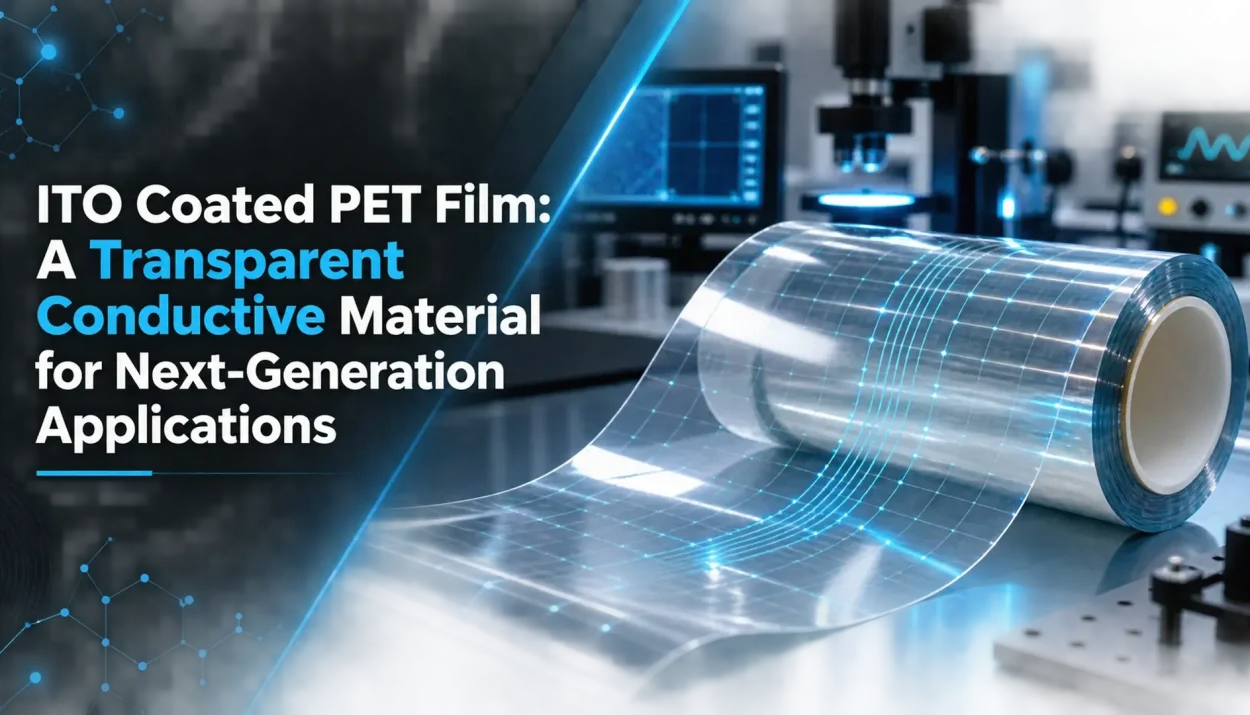
Modern electronic materials are increasingly expected to perform more than one function. A surface may need to remain transparent while carrying electrical current, dissipating static charge or acting as an electrode. ITO-coated PET film combines optical transparency and electrical conductivity in a lightweight, flexible format.
ITO, or indium tin oxide, is a transparent conductive oxide used in electronic and optoelectronic applications. Depositing a thin ITO layer on PET (polyethylene terephthalate) film creates a flexible, transparent conductive material for applications in which conventional rigid substrates may not be suitable.
What Is ITO Coated PET Film?
ITO coated PET film consists of a thin, uniform layer of indium tin oxide deposited on a PET substrate. Each component gives the finished material a distinct set of useful characteristics.
Properties provided by the PET substrate
- Flexibility
- Lightweight construction
- Mechanical support
- Good dimensional stability
- Ease of handling and processing
Properties provided by the ITO coating
- Electrical conductivity
- Optical transparency
- Surface conductivity
- Electrode functionality
Together, these properties create a functional material that allows visible light to pass through while providing a conductive surface.
How Does an ITO Coating Work?
ITO is generally composed of indium oxide (In2O3) doped with a controlled amount of tin oxide (SnO2). Adding tin improves the electrical conductivity of indium oxide while helping the material retain high optical transparency.
A thin ITO layer is deposited on the PET substrate using a process such as magnetron sputtering. Manufacturers carefully control the coating thickness and deposition conditions because they influence sheet resistance, optical transmission, adhesion and surface uniformity.
Balancing transparency and conductivity is essential. Increasing the amount or thickness of conductive material may reduce sheet resistance, but an excessively thick coating can lower optical transmission.
Why Is PET Used as the Substrate?
PET is an attractive substrate for transparent conductive films because it provides flexibility that glass cannot easily offer. Compared with rigid transparent conductive substrates, ITO coated PET film can be:
- Bent and handled more easily
- Produced in lightweight formats
- Cut into application-specific shapes
- Integrated into flexible assemblies
- Used where reducing component weight is important
These advantages make the material particularly useful in flexible electronics, sensors, touch interfaces and laboratory prototypes.
Key Properties of ITO Coated PET Film
The performance of an ITO coated PET film depends on both the PET substrate and the characteristics of the deposited ITO layer.
1. High Optical Transparency
One of ITO’s defining advantages is its ability to conduct electricity without significantly obstructing visible light when deposited as a sufficiently thin layer. This makes the film useful when visibility and electrical functionality are required simultaneously.
2. Electrical Conductivity
ITO provides a conductive surface that can function as an electrode or conductive layer. Its electrical performance is commonly specified as sheet resistance, expressed in ohms per square (Ω/□). The appropriate sheet-resistance range depends on the intended application.
3. Flexibility
Unlike ITO coated glass, PET-based ITO film can flex within the limits of its substrate and coating design. It can therefore support curved, flexible or lightweight components. The minimum bend radius and expected bending cycles should always be confirmed for the selected grade.
4. Lightweight Construction
PET is considerably lighter than glass, making an ITO coated PET substrate useful in devices and assemblies where weight reduction matters.
5. Functional Conductive Surface
Depending on the device design, the ITO surface can serve as an electrode, sensing layer, antistatic layer or electrical interface.
Applications of ITO Coated PET Film
Its combination of transparency, conductivity and flexibility makes ITO coated PET film relevant to a broad range of electronics and research applications.
Touch Sensors and Touch Interfaces
Transparent conductive films are fundamental components in many touch-sensing systems. ITO coated PET can act as a transparent electrode that helps detect changes in electrical characteristics when a user interacts with a surface.
Flexible Electronics
As devices become thinner and more flexible, their conductive materials must adapt. ITO coated PET offers a practical substrate for developing flexible electronic structures, proof-of-concept devices and prototypes.
Transparent Electrodes
The film can function as a transparent electrode in research involving electrochemical, optical and electronic devices.
Sensors
Engineers can incorporate the conductive surface into capacitive, resistive, optical and experimental sensing systems, depending on the device architecture.
Antistatic Applications
A controlled conductive surface can help dissipate electrostatic charge, which makes conductive PET films useful for selected antistatic and electrostatic-discharge-control applications.
Optoelectronic Research
ITO coated films are widely studied in devices involving the interaction of light and electricity, including experimental displays, photovoltaic research and other optoelectronic structures.
Laboratory and Prototype Development
Because the film can be cut, patterned, contacted and integrated into custom assemblies, it is a versatile material for laboratory research and prototype development. Projects requiring a different flexible substrate may also consider an ITO-coated PEN sheet, subject to the project’s thermal, mechanical and electrical requirements.
ITO Coated PET Film vs. ITO Coated Glass
ITO coated PET and ITO coated glass both provide transparent conductive surfaces, but their physical and processing characteristics differ.
| Property | ITO Coated PET | ITO Coated Glass |
|---|---|---|
| Substrate | PET | Glass |
| Flexibility | Flexible within product limits | Rigid |
| Weight | Low | Higher |
| Transparency | High | High |
| Electrical conductivity | Depends on the ITO coating | Depends on the ITO coating |
| Processing | Relatively easy to cut and handle | Requires glass-compatible processing |
| Flexible-electronics suitability | High | Limited |
| Rigid-device suitability | Application-dependent | Excellent |
PET is generally preferred when flexibility, low weight and easy handling are priorities. Glass may be preferred when rigidity, thermal stability or dimensional stability at elevated temperatures is required.
How to Select the Right ITO Coated PET Film
ITO films are available in different specifications. Evaluating the following factors helps ensure that the chosen material is suitable for the intended device or experiment.
Sheet Resistance
Lower sheet resistance generally indicates a more conductive surface. However, the best choice is the resistance range required by the application, not necessarily the lowest available value.
Optical Transmission
Visible-light transmission is important in optical, display and sensor applications. PET grade, substrate thickness, ITO thickness and deposition conditions can all affect transmission.
ITO Coating Thickness
Conductive-layer thickness affects both electrical and optical performance, so a consistently controlled coating is essential.
PET Thickness
Substrate thickness influences flexibility, mechanical strength, handling and dimensional stability.
Surface Uniformity
Uniform coating is important for electrodes, sensors and patterned electronic structures because local variations can affect device performance.
Adhesion and Bend Requirements
Good adhesion between the ITO layer and PET substrate supports reliable handling. For dynamic-flex applications, verify bend radius, cycling requirements and the risk of coating cracks before finalizing the material.
How Is ITO Coated PET Film Manufactured?
A typical production process follows these controlled stages:
PET preparation → Surface cleaning → ITO deposition → Coating control → Inspection → Cutting or slitting → Quality testing
The PET substrate is cleaned and prepared to provide a suitable coating surface. The ITO layer is then deposited, commonly through a vacuum-based process such as magnetron sputtering.
After deposition, the film may be tested for:
- Sheet resistance
- Optical transmission
- Coating uniformity
- Surface appearance
- Adhesion
- Film thickness
Depending on the final application, manufacturers or device developers may perform additional processes such as patterning, cutting, printing or electrode formation.
Balancing Transparency and Conductivity
The most useful characteristic of ITO coated PET is not simply that it is conductive or transparent; it is that both properties are available in the same thin material system.
This combination creates an engineering trade-off. A coating designed for very low resistance may require different characteristics from one optimized for maximum optical transmission. The film should therefore be selected according to the electrical, optical and mechanical requirements of the application rather than a single specification.
Future Potential of ITO Coated PET Film
The development of thinner, lighter and more flexible electronic devices continues to create demand for transparent conductive materials. ITO coated PET remains relevant because it combines transparency, conductivity, flexibility and low weight.
These characteristics support established technologies as well as experimental work involving flexible sensors, wearable electronics, transparent electrodes, smart interfaces and emerging optoelectronic devices.
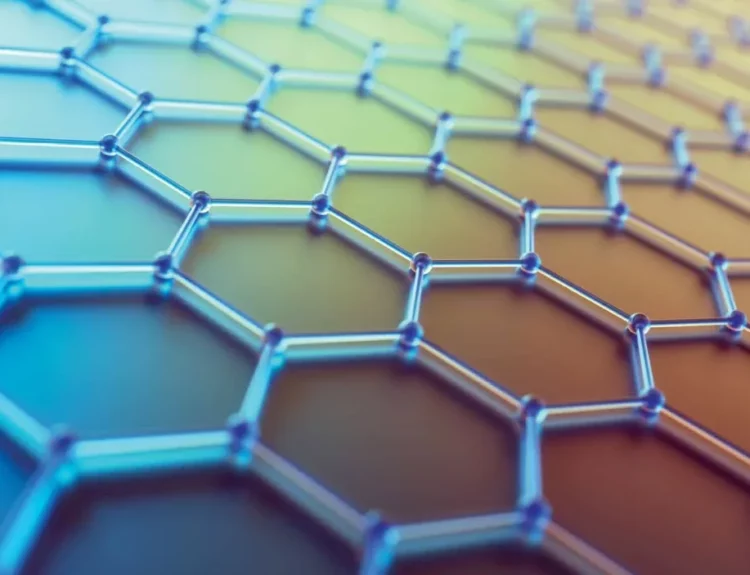
Researchers are also investigating alternatives such as conductive polymers, metal nanowires, graphene and other nanostructured materials. Continued development across this field is encouraging improvements in coating quality, flexibility, cost and performance.
Frequently Asked Questions
Is ITO coated PET film electrically conductive?
Yes. The deposited ITO layer creates an electrically conductive surface. The actual conductivity depends on factors including coating thickness, quality and specified sheet resistance.
Is ITO coated PET film transparent?
Yes. A properly deposited ITO layer can provide electrical conductivity while maintaining high visible-light transmission. Exact transmission varies by product specification.
Can ITO coated PET film be bent?
It can flex within its specified mechanical limits. Excessive or repeated bending may damage the brittle ITO coating, so the permitted bend radius and cycle life should be checked for the selected film.
What is sheet resistance in ITO film?
Sheet resistance measures the electrical resistance of a thin conductive layer and is expressed in ohms per square (Ω/□). A lower value generally represents greater conductivity.
What is the main difference between ITO coated PET and ITO coated glass?
ITO coated PET is flexible and lightweight, while ITO coated glass is rigid and generally better suited to applications requiring greater thermal and dimensional stability.
Conclusion
ITO coated PET film is more than a transparent plastic sheet: it is a functional electronic material that brings conductivity to flexible surfaces.
By combining the lightweight, flexible nature of PET with the transparent conductive properties of indium tin oxide, the material provides a practical platform for touch sensors, transparent electrodes, flexible electronics, antistatic applications and laboratory research.
As electronics continue moving toward thinner, lighter and more flexible designs, ITO coated PET film is likely to remain an important part of the transparent-electronics landscape. In simple terms, it turns a flexible polymer film into a transparent electrical interface that can transmit light and conduct electricity at the same time.