

Nanoparticles have attracted considerable scientific interest because their optical behavior can differ significantly from that of bulk materials. At the nanoscale, interactions between light and matter are influenced by particle dimensions, electronic structure, surface characteristics, and particle aggregation. These effects can change absorption spectra, scattering intensity, and wavelength-dependent optical responses.
Reliably measuring these characteristics requires suitable optical instrumentation and sample containers. Quartz cuvettes are widely used in ultraviolet-visible spectroscopy because they transmit ultraviolet and visible radiation effectively, making them appropriate for investigating a broad range of nanomaterials.
The cuvette acts as an optical interface between the instrument and the sample. Its transparency, surface quality, dimensions, and cleanliness can influence the recorded spectrum. Understanding the relationship between quartz cuvette properties and nanoparticle optical measurements is therefore essential for obtaining reproducible scientific results.
Optical Properties of Nanoparticles
Nanoparticles interact with incident electromagnetic radiation through processes such as absorption, scattering, and, in certain materials, photoluminescence. The relative contribution of these processes depends on material composition, particle size, shape, concentration, and wavelength.
Metallic nanoparticles, including gold and silver, can exhibit localized surface plasmon resonance. This phenomenon involves the collective oscillation of conduction electrons in response to an electromagnetic field. The resulting spectral features are sensitive to particle dimensions, geometry, interparticle spacing, and the refractive index of the surrounding medium.
Semiconductor nanoparticles may demonstrate size-dependent optical transitions associated with quantum confinement. Changes in particle size can shift the absorption onset wavelength and may alter the material’s emission characteristics.
These optical responses provide valuable information about nanoparticle structure and behavior. Ultraviolet-visible spectroscopy is frequently employed to investigate these effects, making the selection of an appropriate cuvette an important part of experimental design.
Material Characteristics of Quartz Cuvettes
Quartz cuvettes are commonly manufactured from high-purity fused silica. Their distinctive material properties make them suitable for optical measurements requiring ultraviolet transmission and low background interference.
High Optical Transmission
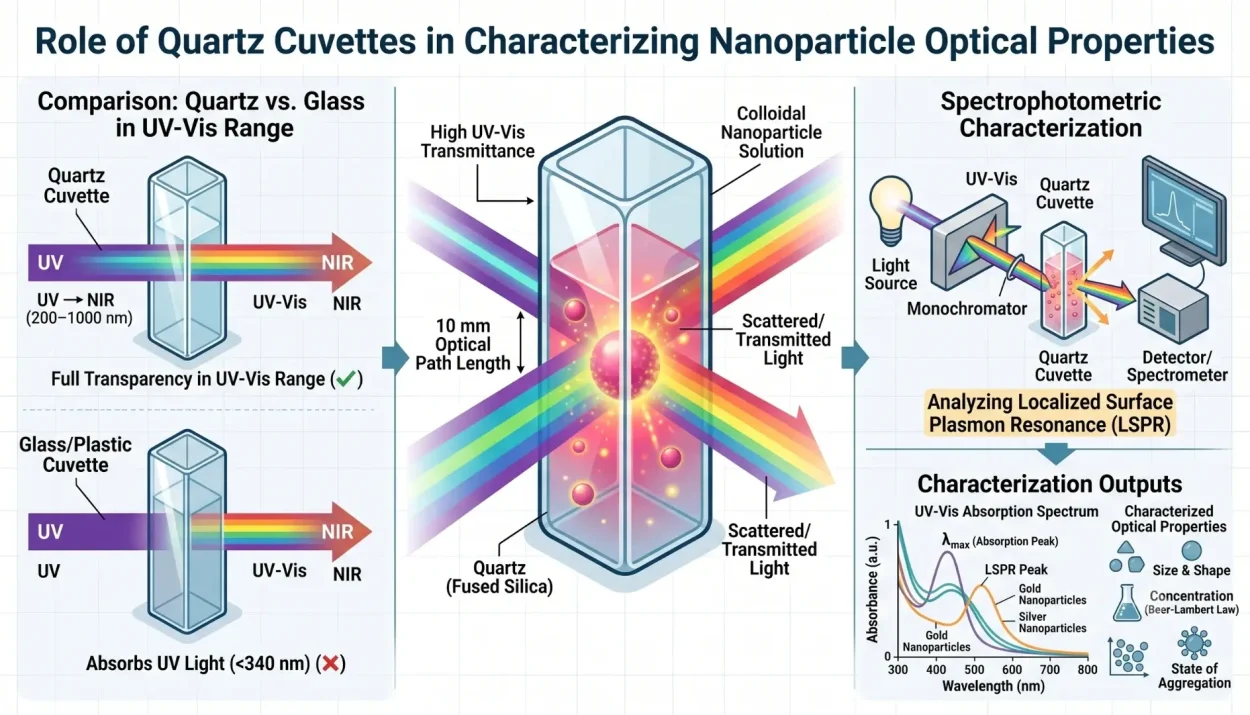
One of quartz’s primary advantages is its ability to transmit ultraviolet and visible light over a broad spectral range. Depending on the quartz grade and optical quality, suitable quartz cuvettes can support measurements at wavelengths below the transmission range of ordinary glass.
This capability is particularly important when studying nanoparticles whose absorption features occur in the ultraviolet region or extend across ultraviolet and visible wavelengths.
Optical Clarity and Surface Quality
A cuvette’s optical windows should be sufficiently clear and free of scratches, residues, and other defects. Surface imperfections can scatter light and introduce unwanted background signals, potentially affecting absorbance measurements.
High-quality quartz cuvettes help minimize these sources of interference when used with appropriate instrument settings and reference measurements.
Chemical and Thermal Stability
Quartz generally resists many chemical environments and maintains useful optical properties under suitable operating conditions. These characteristics make quartz cuvettes appropriate for numerous nanoparticle dispersions and selected experimental environments.
However, compatibility depends on sample composition, solvent, temperature, and exposure duration. Certain chemicals can attack silica, so evaluate material compatibility before use.
Role of Quartz Cuvettes in Ultraviolet-Visible Spectroscopy
Ultraviolet-visible spectroscopy is a widely used technique for examining the optical behavior of nanoparticle dispersions. During a measurement, light passes through the sample, and the instrument evaluates the amount of radiation transmitted relative to a reference measurement. Quartz cuvettes provide a consistent optical path through which incident radiation interacts with the nanoparticle suspension. Their transmission characteristics help researchers collect spectra across an appropriate wavelength range.
When cuvette dimensions, orientation, and measurement conditions remain consistent, researchers can compare spectral measurements between samples and experimental conditions. Quartz cuvettes are especially useful when an investigation includes ultraviolet absorption features or requires careful evaluation of wavelength-dependent optical changes.
The measured reduction in transmitted light may result from both absorption and scattering. Therefore, spectra obtained from nanoparticle suspensions must be interpreted in consideration of particle size, aggregation, concentration, and instrument geometry.
Influence of Optical Path Length on Measurement Accuracy
Optical path length refers to the distance light travels through the sample inside the cuvette. It is an important experimental parameter because it affects the measured absorbance and the measurement sensitivity.
A longer optical path generally increases the measured absorbance when other conditions remain comparable, and the instrument operates within its suitable measurement range. A shorter path may be preferable for concentrated nanoparticle suspensions that produce strong optical attenuation.
Quartz cuvettes are available with different optical path lengths to accommodate varying sample concentrations and experimental requirements. Selecting an appropriate path length helps researchers avoid excessively high absorbance and obtain spectra suitable for quantitative comparison.
For meaningful comparisons, researchers should document the cuvette path length, sample concentration, solvent composition, and instrument configuration.
Characterization of Different Nanoparticle Systems
Metallic Nanoparticles
Quartz cuvettes are frequently used to investigate the optical response of metallic nanoparticles. Gold and silver nanoparticles, for example, can exhibit characteristic plasmon resonance bands that depend on particle size, shape, and the surrounding dielectric environment.
Changes in the position, width, and intensity of these spectral features may indicate differences in particle morphology, aggregation, or local environmental conditions. Quartz cuvettes provide the ultraviolet-visible transparency needed to observe many of these features.
Semiconductor Nanoparticles
Semiconductor nanoparticles can exhibit absorption edges and optical transitions influenced by their dimensions and composition. Quartz cuvettes enable researchers to investigate these characteristics through ultraviolet-visible absorption spectroscopy.
Comparing spectra from different particle sizes or preparation conditions helps researchers evaluate changes in optical response. However, spectral shifts may also arise from differences in composition, surface structure, dispersion conditions, or measurement settings.
Carbon-Based Nanomaterials
Carbon-based nanomaterials, including graphene-derived dispersions and carbon dots, can exhibit wavelength-dependent absorption and emission behavior. Quartz cuvettes are useful for collecting absorption spectra and, with suitable instrument configurations, fluorescence measurements.
For fluorescence studies, cuvette orientation, optical geometry, sample concentration, and excitation wavelength can affect the measured signal. Consistent measurement conditions are therefore essential for reliable comparisons.
Experimental Factors Affecting Spectral Reliability
Although quartz cuvettes provide important optical advantages, accurate nanoparticle characterization depends on several experimental factors.
Sample homogeneity: Agglomeration and sedimentation can change particle concentration within the optical path. Consistent dispersion and appropriate sample handling help reduce variability.
Cuvette cleanliness: Residual particles, fingerprints, dried solvent, and other contaminants can interfere with light transmission. Clean optical windows using a method compatible with the cuvette and sample.
Reference selection: The reference should match the sample solvent and other relevant components while excluding the nanoparticles when appropriate. This helps account for background absorption from the surrounding medium.
Orientation and positioning: Differences in cuvette alignment can change the measured optical response. Consistent positioning is particularly important when comparing multiple samples.
Concentration and scattering: Highly concentrated dispersions may produce excessive attenuation or substantial multiple scattering. Dilution studies and complementary measurements can help distinguish genuine spectral changes from
concentration-related effects.
Instrument calibration: Appropriate wavelength and photometric checks help ensure that spectral measurements remain consistent and comparable.
Best Practices for Quartz Cuvette-Based Measurements
Reliable nanoparticle characterization requires a standardized experimental procedure. Researchers should select a cuvette with a wavelength range and optical path length appropriate for the intended measurement.
Before collecting data, inspect the cuvette for scratches, cracks, and visible contamination. Prepare the sample consistently, and avoid air bubbles in the optical path. Record a suitable reference measurement before analyzing the nanoparticle dispersion.
Replicate measurements can help evaluate experimental variability. Recording sample concentration, preparation conditions, temperature, wavelength range, and cuvette specifications improves reproducibility and facilitates comparisons between research groups.
Where scattering is significant, ultraviolet-visible extinction spectra should not automatically be interpreted as pure absorption spectra. Complementary techniques, such as dynamic light scattering, electron microscopy, or integrating-sphere spectroscopy, may provide additional information about particle dimensions, morphology, and optical behavior.
Limitations and Future Research Directions
Quartz cuvettes are valuable for many optical investigations, but they do not eliminate every source of measurement error. Surface damage, contamination, manufacturing tolerances, and unsuitable chemical exposure can affect their performance. Furthermore, conventional ultraviolet-visible spectrometers may not independently distinguish absorption from scattering in a nanoparticle suspension.
Future research may investigate improved cuvette surface treatments, lower-background optical materials, specialized microvolume designs, and measurement systems that combine absorption and scattering analysis. Advances in automated sample positioning and optical calibration may also improve reproducibility in high-throughput nanomaterials research.
Another promising direction is developing standardized procedures for comparing nanoparticle spectra across laboratories. Consistent reporting of cuvette specifications, optical path length, sample preparation, and instrument settings would strengthen the reliability of published optical data.
Conclusion
Quartz cuvettes play an important role in characterizing nanoparticle optical properties by providing a transparent, stable, and reproducible environment for spectroscopic measurements. Their broad ultraviolet-visible transmission makes them particularly useful for investigating plasmon resonance in metallic nanoparticles, absorption transitions in semiconductor nanomaterials, and wavelength-dependent optical responses in carbon-based systems.
However, reliable results require careful control of sample preparation, optical path length, cuvette cleanliness, reference selection, and instrument configuration. Researchers must also consider light scattering when interpreting nanoparticle spectra.
By combining suitable quartz cuvettes with standardized measurement procedures and complementary characterization techniques, researchers can improve the accuracy, reproducibility, and scientific value of optical investigations in nanomaterials science.