
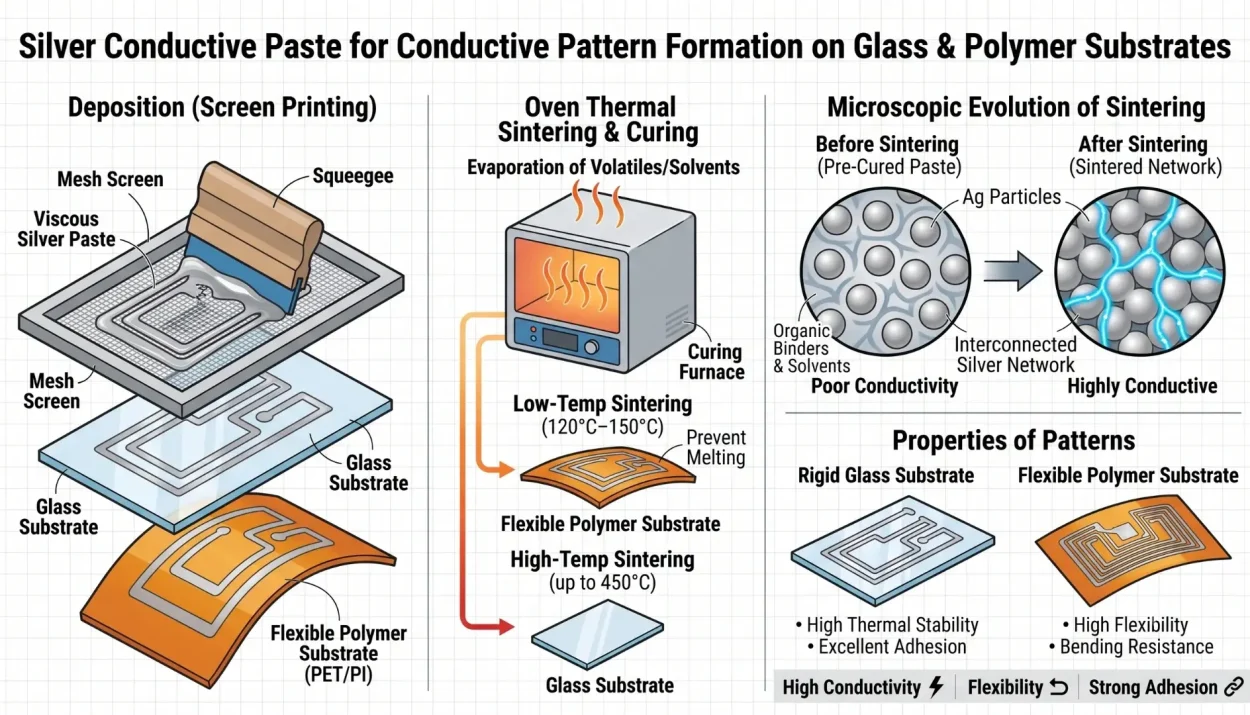
Silver conductive paste is an important functional material in scientific research involving printed electronics, thin-film devices, flexible circuits, and microelectronic components. Its high electrical conductivity, printability, and compatibility with different substrate materials make it suitable for fabricating conductive patterns on glass and polymer surfaces. Researchers use silver-based formulations to investigate electrical performance, pattern resolution, surface adhesion, and how processing conditions affect printed-structure properties.
Glass and polymer substrates have different physical and chemical characteristics, which influence conductive paste selection and the fabrication process. Understanding these differences is essential for developing reliable conductive patterns for laboratory experiments, prototype development, and advanced electronic applications.
Material Characteristics of Silver Conductive Paste
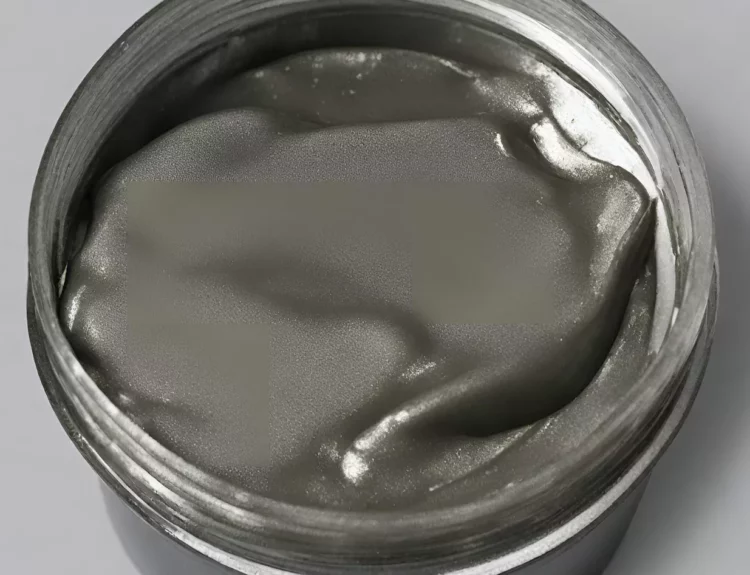
Silver conductive paste generally consists of silver particles dispersed in a liquid vehicle containing binders, solvents, and other formulation additives. The silver particles provide electrical pathways, while the remaining components influence viscosity, surface wetting, adhesion, and film formation.
The electrical performance of the printed layer depends on several parameters, including silver particle size, particle distribution, solids loading, paste viscosity, and post-deposition processing conditions.
Important material characteristics include:
- Electrical conductivity: Determines the printed pattern’s ability to carry electrical current.
- Particle distribution: Influences packing density and the formation of conductive pathways.
- Viscosity and rheology: Affect material flow, line definition, and printing consistency.
- Adhesion: Determines how effectively the printed layer remains attached to the substrate.
- Curing behavior: Influences binder removal, particle contact, and the development of electrical conductivity.
- Film uniformity: Affects electrical resistance and the reproducibility of experimental results.
Researchers can evaluate these characteristics to identify suitable formulations for different substrate materials and fabrication techniques.
Conductive Pattern Formation on Glass Substrates
Glass is widely investigated as a substrate for electronic structures because of its dimensional stability, optical transparency, and resistance to many processing conditions. Silver conductive paste can be deposited onto glass to produce conductive tracks, electrode patterns, contact regions, and experimental circuit structures.
Screen printing is a commonly used method for producing conductive patterns on glass. It allows the controlled deposition of paste through a patterned mesh. Other techniques, such as stencil printing and direct dispensing, may be suitable depending on the required geometry and experimental objectives.
The resulting pattern quality depends on surface cleanliness, paste wetting, printing pressure, deposition thickness, and curing conditions. Contamination or poor wetting may cause discontinuities, irregular edges, or reduced adhesion.
Glass can tolerate processing temperatures that exceed the limits of many polymer substrates. However, researchers must still select the appropriate curing temperature based on the glass composition, paste formulation, and intended application.
Key Research Parameters for Glass
Researchers may investigate:
- Line width and pattern resolution.
- Film thickness and surface uniformity.
- Electrical resistance before and after curing.
- Adhesion strength under mechanical loading.
- Optical transparency where required.
- Changes in conductivity following thermal processing.
These measurements help establish the relationship between printing conditions and the functional performance of silver-based conductive patterns.
Conductive Pattern Formation on Polymer Substrates
Polymer substrates are important in research involving flexible electronics, lightweight electronic structures, and printed functional surfaces. Materials such as polyethylene terephthalate (PET) and polyimide (PI) are frequently investigated because they provide different combinations of flexibility, thermal stability, and surface properties.
Unlike glass, polymers may be more sensitive to temperature, solvents, surface deformation, and mechanical stress. Consequently, researchers must carefully select silver conductive paste formulations and processing conditions to prevent substrate distortion and pattern damage.
Screen printing, stencil printing, and direct-write deposition can form silver-based conductive patterns on polymer films. The choice depends on the substrate characteristics, required feature size, production method, and desired electrical performance.
Surface treatment may improve wetting and adhesion when the untreated polymer surface is difficult to coat. However, evaluate any treatment to determine whether it affects the substrate or the electrical characteristics of the final pattern.
Key Research Parameters for Polymer Substrates
Scientific investigations may focus on:
- Adhesion of the printed layer to the polymer surface.
- Electrical resistance under bending or repeated deformation.
- Pattern continuity after mechanical cycling.
- Curing temperature and substrate dimensional stability.
- Resistance to cracking and delamination.
- Compatibility between the paste vehicle and polymer material.
These parameters are especially important when studying conductive patterns intended to remain functional under repeated handling or bending.
Comparison Between Glass and Polymer Substrates
The differences between glass and polymer substrates influence both fabrication methods and the interpretation of experimental results.
| Parameter | Glass Substrate | Polymer Substrate |
| Dimensional stability | Generally high | Depends on polymer type and temperature |
| Flexibility | Rigid or brittle | Often flexible |
| Thermal processing | Can support relatively higher temperatures, depending on composition | Limited by the polymer’s thermal properties |
| Surface characteristics | Depend on glass composition and cleaning | Depend on polymer chemistry and surface treatment |
| Mechanical durability of pattern | Influenced by adhesion and glass integrity | Influenced by adhesion, flexibility, and repeated deformation |
| Research focus | Pattern precision, resistance, and adhesion | Flexibility, strain response, and pattern integrity |
A controlled comparison should use the same paste formulation wherever possible while accounting for differences in surface preparation, curing conditions, and substrate properties. This approach helps researchers distinguish substrate-related effects from changes caused by the processing method.
Influence of Printing and Curing Conditions
Printing and curing parameters play a major role in determining the final properties of silver conductive patterns. During deposition, paste viscosity, printing speed, mesh characteristics, and applied pressure can influence the shape and thickness of the printed lines.
After deposition, curing or sintering allows the conductive structure to develop. Depending on the formulation, this process may involve solvent evaporation, binder transformation, and improved electrical contact between silver particles.
Insufficient processing can lead to poor particle contact and higher electrical resistance. Excessive temperature or an unsuitable curing duration may damage a polymer substrate, alter the binder system, or cause defects in the printed layer.
For meaningful experimental comparisons, researchers should document the paste composition, substrate type, printing parameters, curing temperature, curing duration, and measurement conditions. These details support repeatability and allow comparison across experiments.
Characterization Methods for Printed Conductive Patterns
Characterization is necessary to determine whether a printed silver layer meets the requirements of a particular research application.
Electrical characterization: Four-point probe measurements can assess sheet resistance, while resistance measurements can evaluate individual conductive tracks. Where appropriate, you can calculate conductivity from measured resistance and the printed structure’s geometry.
Surface and morphological analysis: Optical microscopy and scanning electron microscopy (SEM) can reveal line-edge quality, particle distribution, surface defects, and cracks or discontinuities.
Thickness measurement: Profilometry or other suitable thickness-measurement techniques can establish the thickness of the printed layer and support the interpretation of electrical results.
Adhesion evaluation: Appropriate tape tests or other standardized adhesion methods can help assess the attachment of the conductive layer to the substrate.
Mechanical testing: For polymer-supported patterns, resistance measurements during and after bending cycles can indicate changes in electrical continuity and mechanical integrity.
Using several complementary characterization techniques provides a more complete understanding than relying on electrical resistance measurements alone.
Potential Research Applications
Silver conductive paste supports experimental investigations across several areas of electronic materials research.
- Printed electronics: Fabrication of conductive tracks and patterned electrical connections.
- Flexible circuits: Development of conductive pathways on bendable polymer films.
- Transparent device structures: Formation of selected conductive regions on glass-based platforms, depending on pattern geometry and coverage.
- Sensor research: Production of conductive electrodes and interconnects for experimental sensing systems.
- Thin-film electronics: Investigation of interfaces between conductive layers and supporting substrates.
- Electronic prototyping: Rapid fabrication of circuit layouts and test structures for material evaluation.
The suitability of a specific paste depends on its electrical properties, adhesion, curing requirements, feature resolution, and compatibility with the intended substrate.
Research Challenges and Future Directions
Although silver conductive paste offers several advantages, challenges remain in achieving consistent conductivity, high-resolution patterning, strong adhesion, and long-term stability. Differences in particle distribution, binder composition, substrate surface energy, and curing behavior can produce variations in the final printed structure.
Future research may focus on optimizing silver particle morphology, developing lower-temperature curing formulations, improving adhesion to polymer films, and reducing resistance variations across printed patterns. Investigations into mechanical cycling, environmental stability, and reproducible deposition may also help establish processing guidelines for specific electronic applications.
Another important direction is developing standardized experimental procedures. Consistent sample preparation, defined measurement conditions, and repeatable characterization methods are necessary to compare results across different paste formulations and substrate materials.
Conclusion
Silver conductive paste is a versatile material for scientific research on conductive pattern formation over glass and polymer substrates. Its performance depends on interactions among silver particles, formulation components, substrate properties, printing conditions, and post-deposition processing. Glass provides a dimensionally stable platform for investigating precise conductive patterns, while polymer substrates enable research into flexible and mechanically responsive electronic structures. By combining controlled deposition with electrical, morphological, adhesion, and mechanical characterization, researchers can better understand the factors governing pattern quality and functional performance. Systematic optimization of material composition and processing conditions can support the development of reliable conductive structures for printed electronics, flexible circuits, and research on advanced electronic materials.