
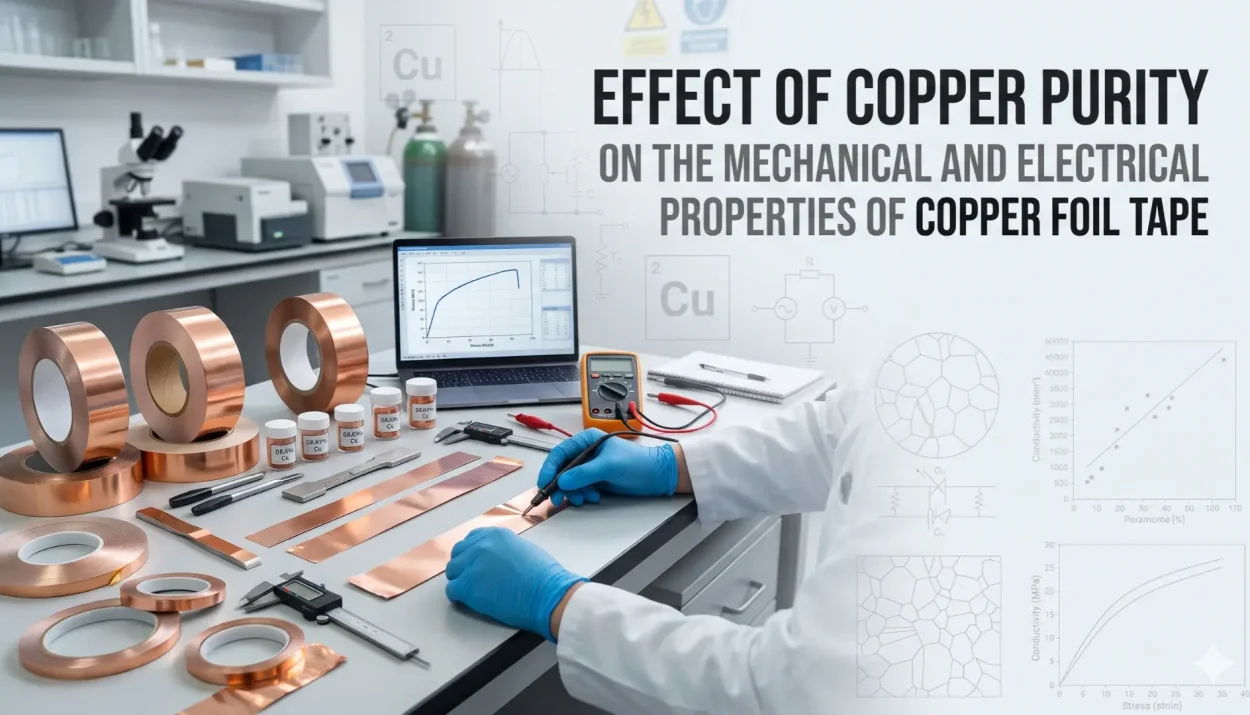
Copper foil tape is a functional conductive material widely used in electrical engineering, electromagnetic interference shielding, grounding systems, electronic assemblies, and flexible conductive applications. Its performance depends on several material characteristics, including copper purity, foil thickness, grain structure, surface morphology, mechanical condition, and adhesive composition.
Copper purity is an important factor influencing the electrical and mechanical behavior of copper foil. Impurities can affect electron movement, electrical resistivity, grain development, ductility, and the foil’s overall structural characteristics. These variations may influence the electrical continuity and mechanical reliability of copper foil tape during practical use.
This article examines how copper purity affects the mechanical and electrical properties of copper foil tape. It focuses on electrical conductivity, tensile strength, elongation, flexibility, surface characteristics, and the interaction between the copper foil and adhesive layers. It also discusses material characterization techniques, manufacturing considerations, and future research opportunities for developing high-performance copper foil tape for advanced engineering applications.
Copper Purity and Material Characteristics
Copper purity describes the proportion of copper present in a material relative to other elements and impurities. Commercial copper materials come in different purity grades, depending on the manufacturing process and intended application.
High-Purity Copper
High-purity copper is widely used in electrical applications because of its excellent electrical and thermal conductivity.
Its important characteristics include:
- High electrical conductivity.
- Good thermal conductivity.
- High ductility.
- Good formability.
- Relatively low electrical resistivity.
- Suitability for thin foil manufacturing.
These characteristics make high-purity copper a suitable material for conductive foil products.
Commercial-Grade Copper
Commercial copper grades may contain controlled amounts of oxygen and other residual elements depending on their manufacturing route and specification.
These elements can influence grain structure, mechanical strength, ductility, and electrical properties.
The actual effect depends on the type, concentration, and distribution of the additional elements.
Influence of Impurities
Impurities can affect electron movement through the copper structure.
Certain impurity atoms disturb the regular arrangement of copper atoms and increase electron scattering, which can increase electrical resistivity.
Their influence on mechanical properties is more complex. Some impurities may increase strength while reducing ductility, whereas others may have different effects depending on their concentration and distribution.
Therefore, evaluate copper purity alongside the material’s processing history and microstructure.
Influence of Copper Purity on Electrical Properties
Electrical conductivity is one of the most important properties of copper foil tape.
The tape’s conductive performance depends on the copper foil’s electrical characteristics and the quality of electrical contact between connected surfaces.
Electrical Conductivity
Electrical conductivity describes a material’s ability to transport electrical current.
High-purity copper generally exhibits higher electrical conductivity because fewer impurity atoms interfere with electron movement.
In copper foil tape, this characteristic is important for applications involving electrical grounding, conductive bonding, and electromagnetic shielding.
However, the measured conductivity can also be influenced by:
- Foil thickness.
- Grain boundaries.
- Surface oxidation.
- Cold-working conditions.
- Material defects.
- Contact quality.
Consequently, two copper foil tapes manufactured using copper of similar purity may still demonstrate different electrical performance.
Electrical Resistivity
Electrical resistivity represents copper’s inherent resistance to electrical current.
Impurity atoms and structural defects can increase electron scattering, resulting in higher resistivity.
Copper foil with lower impurity content generally offers lower electrical resistivity under comparable testing conditions.
For copper foil tape, this characteristic affects the effectiveness of conductive pathways, particularly in applications that require consistent electrical contact.
Electromagnetic Shielding Performance
Copper foil tape is commonly used in electromagnetic interference shielding because copper is an effective electrical conductor.
Its shielding behavior depends on several factors, including:
- Copper purity.
- Foil thickness.
- Electrical conductivity.
- Surface continuity.
- Adhesive conductivity.
- Joint and overlap quality.
- Frequency of the electromagnetic field.
Higher-purity copper can provide favorable electrical characteristics, but purity alone does not determine shielding effectiveness.
The tape’s overall construction and installation quality are equally important.
Electrical Contact Resistance
Electrical contact resistance depends on the physical condition of the copper surface and the quality of the connection between adjoining conductive materials.
Surface oxidation, contamination, roughness, and insufficient contact pressure can increase resistance.
Although copper purity influences bulk electrical properties, surface condition may become more significant at electrical contact interfaces.
For this reason, research into copper foil tape should evaluate both bulk conductivity and actual contact resistance.
Influence of Copper Purity on Mechanical Properties
The mechanical properties of copper foil determine its ability to withstand bending, stretching, handling, and repeated deformation without developing cracks or losing structural integrity.
Copper purity can affect these properties by changing grain structure, impurity distribution, and deformation behavior.
Tensile Strength
Tensile strength describes copper foil’s ability to withstand stretching forces before failure.
Copper foil strength depends on copper purity, grain size, rolling conditions, and material temper.
High-purity copper generally provides good ductility, but it does not necessarily have higher tensile strength than every lower-purity copper grade.
Some impurities and controlled alloying elements can increase strength by influencing the metal’s internal structure.
Therefore, evaluate tensile strength alongside purity rather than treating it as a direct indicator of purity.
Elongation and Ductility
Ductility describes copper foil’s ability to undergo permanent deformation before fracture. High-purity copper is generally associated with good ductility, making it suitable for manufacturing thin and flexible foil products.
In copper foil tape, ductility is important because the material may be applied to curved surfaces, corners, electronic assemblies, and irregular geometries. Reduced ductility increases the risk of cracking during repeated bending or installation.
However, the final elongation also depends on grain size, foil thickness, rolling history, and annealing conditions.
Flexibility and Bending Performance
Flexibility is an important functional property of copper foil tape. During installation and operation, the tape may experience repeated bending and mechanical deformation. The copper foil should maintain electrical continuity without developing visible cracks or separation from the adhesive layer.
Copper purity affects bending performance by influencing ductility and microstructural characteristics. Research should also consider the foil temper because annealed and work-hardened copper foils can demonstrate significantly different bending behavior.
Fatigue Resistance
Repeated mechanical deformation can gradually influence the structural integrity of copper foil. During cyclic bending, small cracks may develop at localized regions of stress concentration. These cracks can eventually interrupt electrical continuity.
Copper purity may influence deformation behavior, but fatigue performance also depends on grain orientation, foil thickness, surface defects, and manufacturing conditions. Evaluating repeated bending performance is therefore important when selecting copper foil tape for flexible electrical assemblies.
Adhesion and Mechanical Stability
Copper foil tape generally contains a metallic foil layer attached to an adhesive coating. Although copper purity directly influences foil properties, it does not determine adhesive bonding strength on its own.
Adhesion is influenced by:
- Copper surface cleanliness.
- Surface roughness.
- Oxide layer characteristics.
- Adhesive composition.
- Coating uniformity.
- Application pressure.
- Temperature and environmental conditions.
A comparative study should evaluate copper foil characteristics and adhesive performance separately to avoid attributing all mechanical variations to copper purity.
Microstructural Characteristics of Copper Foil
Microstructure is an important factor in understanding how copper purity influences mechanical and electrical properties. The internal arrangement of copper grains, grain boundaries, impurities, and structural defects can affect both conductivity and deformation behavior.
Grain Size and Distribution
Copper foil consists of crystalline grains separated by grain boundaries. Grain size and distribution influence the material’s mechanical behavior and electrical properties.
Fine-grained copper may exhibit increased strength due to grain-boundary effects, while larger grains may provide different deformation characteristics.
However, the influence of grain size on electrical conductivity is not always straightforward because impurity content, defects, and processing conditions also contribute.
Grain Boundary Characteristics
Grain boundaries are regions separating individual crystalline grains. They can influence electron movement and the deformation behavior of copper foil.
The distribution and characteristics of grain boundaries depend on manufacturing methods, thermal treatment, and mechanical processing.
Understanding these features is important for evaluating the relationship between microstructure and electrical conductivity.
Impurity Distribution
Impurities may be distributed within copper grains or concentrated near grain boundaries. Their distribution can influence electrical resistivity and mechanical behavior.
Advanced microscopy and elemental analysis can help investigate the presence and distribution of additional elements within copper foil.
Surface Morphology
The surface condition of copper foil influences electrical contact, adhesive bonding, and resistance to environmental exposure.
Surface irregularities, oxidation, and contamination can affect the functional performance of copper foil tape.
Therefore, surface characterization should be included in material evaluation, particularly for applications involving electrical connections and electromagnetic shielding.
Manufacturing Methods and Their Influence on Copper Foil Properties
Copper foil is generally manufactured through different processing routes, with rolled copper foil and electrodeposited copper foil being two important categories.
Rolled Copper Foil
Rolled copper foil is produced by mechanically reducing copper thickness through rolling operations. The process influences the grain structure, surface finish, thickness uniformity, and mechanical properties.
Important characteristics include:
- Controlled foil thickness.
- Good flexibility depending on temper.
- Directional grain structure.
- Smooth surface finish with suitable processing.
- Mechanical properties influenced by rolling and annealing.
Rolling conditions can significantly influence the final strength and elongation of copper foil.
Electrodeposited Copper Foil
Electrodeposited copper foil is produced through electrochemical deposition. Copper is deposited onto a rotating cathode surface and subsequently separated to obtain a thin foil.
Deposition conditions, electrolyte composition, current density, additives, and surface treatment influence its properties.
Important characteristics include:
- Controlled thickness.
- Distinctive grain morphology.
- Surface characteristics influenced by deposition conditions.
- Potential for tailored mechanical properties.
- Suitability for specialized electronic applications.
Influence of Annealing
Annealing modifies the microstructure and mechanical characteristics of copper foil.
It can reduce the effects of cold working, influence grain size, and improve ductility.
The resulting electrical and mechanical properties depend on the initial copper condition and the selected thermal processing conditions.
Effect of Surface Treatment
Surface treatment may improve adhesive bonding, oxidation resistance, or electrical contact characteristics.
Different treatment methods can influence surface roughness and surface chemistry.
However, treatments intended to improve adhesion should be evaluated carefully because some surface layers may influence electrical contact resistance.
Characterization Techniques for Copper Foil Tape
Scientific characterization is necessary to establish relationships among copper purity, microstructure, mechanical behavior, and electrical performance.
The following techniques are particularly relevant.
| Characterization technique | Research purpose |
| SEM | Examines grain morphology and surface defects |
| EDS | Identifies elemental composition and impurity distribution |
| XRF | Evaluates elemental composition and copper content |
| ICP-OES | Determines trace elemental concentrations |
| XRD | Studies crystalline structure and grain-related characteristics |
| Four-Point Probe | Measures electrical resistivity |
| Tensile Testing | Evaluates tensile strength and elongation |
| Bend Testing | Examines flexibility and resistance to cracking |
| Peel Strength Testing | Evaluates adhesive bonding performance |
| Surface Profilometry | Measures surface roughness |
| Contact Resistance Testing | Evaluates electrical contact quality |
Elemental Composition Analysis
XRF and ICP-OES are useful methods for investigating copper purity.
XRF can identify and quantify many elemental constituents, while ICP-OES is useful for determining trace elements following suitable sample preparation.
These techniques help researchers establish whether differences in electrical or mechanical performance are associated with variations in chemical composition.
SEM and EDS Analysis
SEM provides detailed images of the copper foil surface and microstructure.
EDS can be used alongside SEM to investigate elemental composition at selected regions.
Together, these techniques provide information about surface defects, grain-related features, and the distribution of additional elements.
Electrical Resistivity Testing
Four-point probe measurements commonly evaluate the electrical properties of conductive foil.
This method helps minimize the influence of electrical contact resistance associated with measurement probes.
For meaningful comparisons, control foil thickness, measurement temperature, and sample preparation.
Mechanical Testing
Tensile and bending tests provide information about the mechanical performance of copper foil.
These tests help evaluate the relationship between copper composition, manufacturing history, and resistance to deformation.
Adhesion Testing
Peel testing can assess the bonding strength between copper foil and the adhesive layer.
Because adhesive performance is not determined by copper purity alone, keep the adhesive type and application conditions consistent when comparing different copper foil materials.
Comparative Evaluation of Copper Purity and Material Performance
The influence of copper purity on copper foil tape can be understood by considering the following general material relationships.
| Material characteristic | Potential influence of higher copper purity |
| Electrical conductivity | Generally improves |
| Electrical resistivity | Generally decreases |
| Thermal conductivity | Generally improves |
| Ductility | Often favourable, depending on processing |
| Tensile strength | Depends on grain structure and temper |
| Elongation | Often favourable, depending on material condition |
| Bending performance | Influenced by ductility and processing |
| Surface characteristics | Depends on manufacturing and finishing |
| Adhesive bonding | Not directly determined by purity |
| Electromagnetic shielding | May benefit from improved conductivity, but also depends on tape construction |
These trends should not be interpreted as universal experimental conclusions. Actual performance must be established using materials with verified composition and comparable manufacturing conditions.
Research Challenges and Future Developments
Several research opportunities remain in understanding how copper purity affects copper foil tape.
Purity and conductivity relationship
Further investigation can establish how different impurity concentrations influence electrical conductivity under controlled manufacturing conditions.
Microstructure optimization
Research into grain size, grain orientation, and processing conditions can help balance conductivity and mechanical strength.
Improved flexibility
Developing copper foil with suitable ductility and fatigue resistance can support flexible electrical assemblies.
Surface engineering
Advanced surface treatments may improve adhesive bonding, oxidation resistance, and electrical contact characteristics.
Adhesive and foil interaction
Further research can examine how different adhesive systems interact with copper surface conditions and influence the overall performance of copper foil tape.
Long-term electrical stability
Investigating changes in electrical continuity under repeated bending, temperature variation, and environmental exposure can provide valuable information about product reliability.
Manufacturing consistency
Improving thickness uniformity, surface quality, and elemental composition control can help produce copper foil tape with consistent properties.
Conclusion
Copper purity is an important material parameter influencing the electrical and mechanical characteristics of copper foil tape. High-purity copper generally provides favorable electrical conductivity and low electrical resistivity because it contains fewer impurity-related disturbances to electron movement.
Its mechanical behavior, however, depends on additional factors such as grain size, rolling conditions, annealing, foil thickness, and temper. Higher copper purity does not automatically guarantee greater tensile strength or better fatigue performance. The study also highlights the importance of evaluating the adhesive layer separately from the metallic foil. Adhesive bonding, surface preparation, and electrical contact quality contribute significantly to the overall performance of copper foil tape.
Characterization techniques such as SEM, EDS, XRF, ICP-OES, XRD, four-point probe measurements, and tensile testing provide valuable information for investigating these relationships. Overall, understanding the interaction between copper purity, microstructure, electrical conductivity, and mechanical behavior is essential for developing reliable copper foil tape for advanced electrical and industrial applications.
Further research into material composition, surface engineering, and manufacturing optimization can improve conductive materials with consistent performance and enhanced mechanical reliability.