
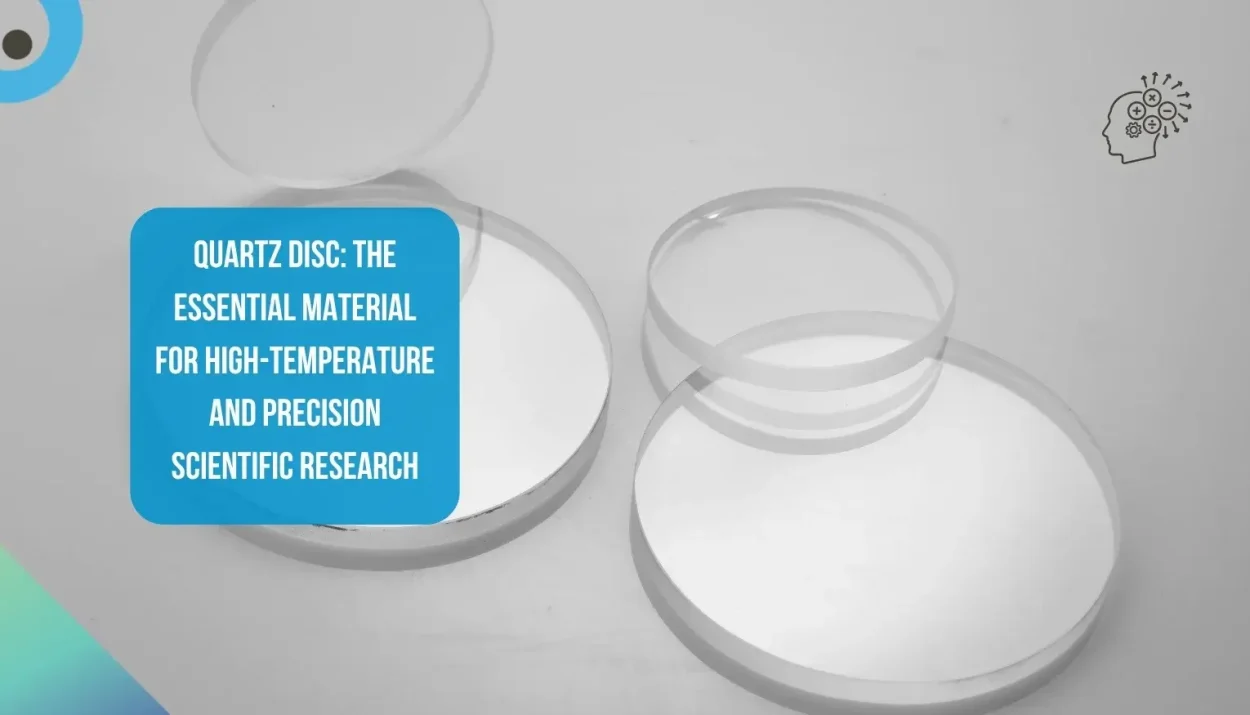
In scientific research, the choice of material can significantly influence the accuracy, reliability, and repeatability of experimental results. Whether working in materials science, semiconductor fabrication, chemical analysis, or optical engineering, researchers require substrates that can withstand extreme conditions without compromising performance. Among the most trusted materials for these demanding applications is the Quartz Disc.
Manufactured from high-purity fused quartz, quartz discs are valued for their exceptional thermal stability, chemical resistance, optical transparency, and dimensional accuracy. These properties make them indispensable in laboratories, research institutions, and advanced manufacturing facilities worldwide.
From serving as substrates for thin-film deposition to acting as windows in high-temperature furnaces, quartz discs continue to play a vital role in modern scientific and industrial innovation.
What is a Quartz Disc?
A quartz disc is a circular component fabricated from high-purity fused quartz (fused silica). Unlike ordinary glass, fused quartz is produced by melting high-purity silica at extremely high temperatures, resulting in a material with exceptional purity and a highly stable amorphous structure.
Quartz discs are available in various diameters, thicknesses, and surface finishes to meet the requirements of diverse research and industrial applications. They can also be custom-manufactured with polished surfaces, precision edges, drilled holes, or specific dimensional tolerances depending on the intended use.
Why Researchers Choose Quartz Discs
Researchers select quartz discs because they maintain their physical and chemical properties even under challenging laboratory conditions.
Outstanding Thermal Stability
Quartz discs can tolerate continuous exposure to elevated temperatures while maintaining their structural integrity. Their low coefficient of thermal expansion significantly reduces the risk of cracking caused by rapid temperature changes, making them ideal for thermal cycling experiments and furnace applications.
Excellent Optical Transparency
Fused quartz transmits light across a broad wavelength range, including ultraviolet, visible, and infrared regions. This makes quartz discs suitable for optical experiments, spectroscopy, laser systems, and photochemical research where accurate light transmission is essential.
High Chemical Resistance
Quartz is highly resistant to most acids, solvents, and other laboratory chemicals, making it reliable in corrosive environments. This chemical stability helps minimize contamination and extend the material’s service life.
Exceptional Purity
The extremely low impurity content of fused quartz minimizes unwanted interactions during sensitive experiments. This is particularly important in semiconductor processing, analytical chemistry, and high-purity materials research.
Electrical Insulation
Quartz is an excellent electrical insulator, making it suitable for applications that require electrical isolation alongside thermal or optical performance.
Key Properties of Quartz Disc
Quartz discs offer a unique combination of characteristics that make them suitable for advanced research:
- High thermal resistance
- Low thermal expansion
- Excellent UV, visible, and infrared transmission
- Superior chemical resistance
- High dimensional stability
- Low impurity levels
- Excellent dielectric properties
- Smooth, polishable surface
- High mechanical strength under controlled conditions
These properties enable researchers to achieve consistent and reproducible experimental outcomes.
Applications of Quartz Disc in Scientific Research
Thin-Film Deposition
Quartz discs are widely used as substrates for thin-film deposition techniques, including sputtering, thermal evaporation, electron-beam evaporation, and chemical vapor deposition. Their smooth surface and thermal stability support the formation of uniform, high-quality coatings.
Semiconductor Research
In semiconductor laboratories, quartz discs serve as carrier substrates, process components, and insulating elements during wafer fabrication, oxidation, diffusion, and high-temperature processing.
Optical Research
The excellent transparency of quartz makes these discs ideal for optical experiments involving lasers, spectroscopy, interferometry, and photonics. Researchers rely on quartz to ensure minimal optical distortion and high transmission efficiency.
High-Temperature Furnaces
Quartz discs serve as support plates, sample holders, and protective barriers in laboratory and tube furnaces, where conventional glass would fail.
Photocatalysis
Researchers studying photocatalytic materials frequently use quartz discs because they transmit ultraviolet light efficiently, allowing photocatalysts to receive maximum illumination during experiments.
Chemical Analysis
Quartz discs are used in analytical laboratories where resistance to chemical attack and thermal stability are critical. Their inert nature minimizes interference with sensitive analytical procedures.
Materials Science
Scientists investigating ceramics, nanomaterials, composites, and advanced coatings use quartz discs as stable platforms for synthesis, heat treatment, and characterization.
Advantages Over Conventional Glass
Although ordinary glass is suitable for many general laboratory applications, quartz discs offer several significant advantages:
- Greater resistance to high temperatures
- Lower thermal expansion, reducing thermal shock
- Superior ultraviolet transmission
- Higher chemical purity
- Better dimensional stability
- Longer service life under demanding laboratory conditions
These benefits make quartz the preferred choice for experiments that require precision and reliability.
Factors to Consider When Selecting a Quartz Disc
Choosing the appropriate quartz disc depends on the specific research application.
Researchers should evaluate:
Diameter
The disc diameter should match the equipment or experimental setup while minimizing unnecessary material usage.
Thickness
Thicker discs provide greater mechanical strength, while thinner discs may be preferred for optical or weight-sensitive applications.
Surface Finish
Depending on the application, researchers may require:
- Optical polishing
- Fire-polished edges
- Ground surfaces
- Double-side polishing
Surface quality directly influences optical performance and coating uniformity.
Dimensional Tolerance
High-precision research often requires tight dimensional tolerances to ensure compatibility with instruments and experimental fixtures.
Purity
High-purity fused quartz is recommended for semiconductor processing, analytical chemistry, and contamination-sensitive experiments.
Best Practices for Laboratory Handling
Proper handling helps maintain the quality and longevity of quartz discs.
Researchers should:
- Handle discs using powder-free gloves or clean tweezers.
- Avoid impacts or excessive mechanical stress.
- Clean with suitable laboratory-grade solvents or deionized water when required.
- Store in protective containers to prevent scratches.
- Inspect surfaces before use to ensure they remain free from contamination.
These practices help preserve optical clarity and maintain consistent experimental performance.
The Future of Quartz Discs in Research
As scientific research advances into areas such as quantum materials, advanced photonics, semiconductor manufacturing, hydrogen energy, and next-generation optical systems, the demand for high-performance quartz components continues to grow.
Quartz discs are expected to remain fundamental laboratory materials because of their proven reliability, compatibility with high-temperature processes, and ability to support increasingly sophisticated analytical techniques.
Their versatility ensures they will continue enabling scientific breakthroughs across multiple disciplines.
Conclusion
Quartz discs are far more than simple laboratory components. Their exceptional thermal stability, optical transparency, chemical resistance, and dimensional precision make them indispensable tools for researchers working in demanding scientific environments.
Whether supporting thin-film deposition, semiconductor fabrication, photocatalytic research, optical experimentation, or high-temperature processing, quartz discs provide a stable, reliable platform for accurate, reproducible results.
As research technologies continue to evolve, quartz discs will remain a trusted material that supports innovation across laboratories, universities, and advanced industrial research facilities worldwide.