
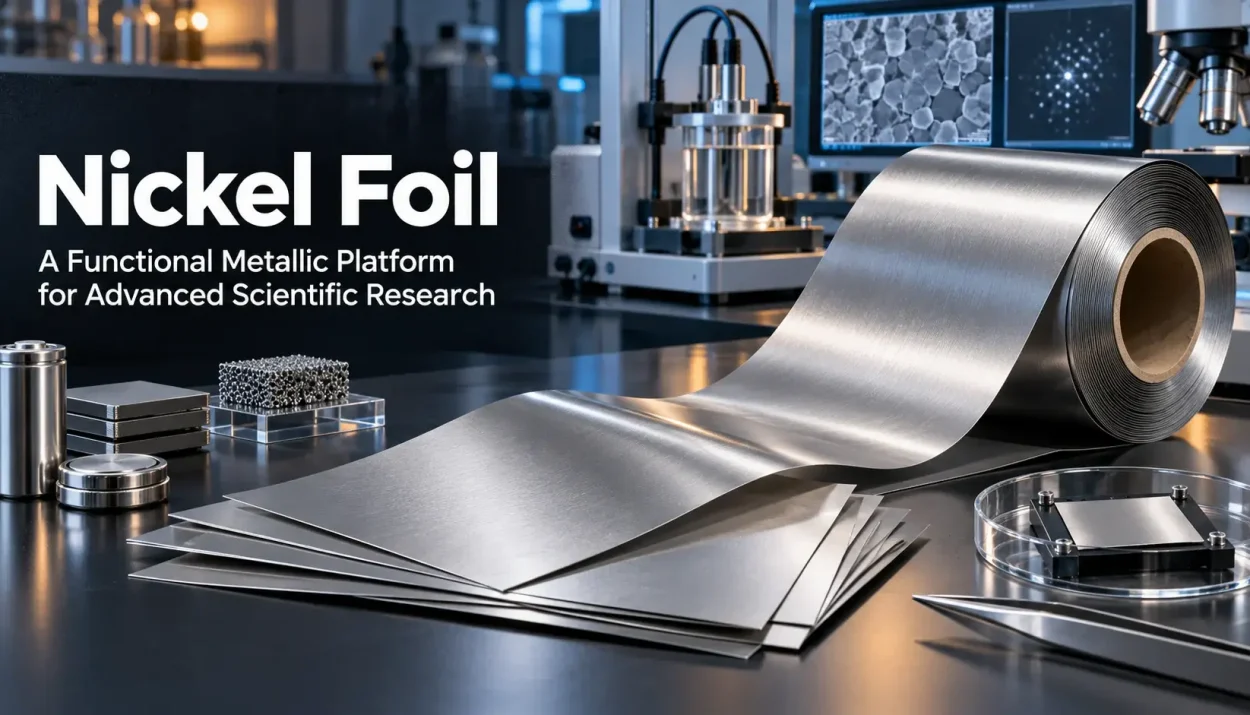
Nickel foil is a thin, flexible metallic material that has become increasingly valuable in experimental materials research because it combines electrical conductivity, thermal stability, mechanical strength, and surface adaptability. Although it may appear to be a simple metallic sheet, its controlled thickness, surface condition, and microstructural characteristics make it an important platform for a wide range of scientific investigations.
In advanced laboratory environments, nickel foil can serve as a substrate, conductive interface, support material, current-collecting layer, thermal-transfer surface, or base for forming other functional materials. These characteristics make it particularly interesting for researchers investigating surface engineering, thin-film development, thermal processing, nanomaterial growth, and electrochemical interfaces.
Understanding Nickel Foil as a Research Material
Nickel foil is produced by processing nickel into a thin, continuous sheet with carefully controlled thickness and surface characteristics. Depending on the manufacturing process, nickel foil can have different levels of surface smoothness, hardness, grain structure, and dimensional precision. For scientific research, these parameters matter because a substrate’s physical surface can influence how another material interacts with it.
Surface roughness, cleanliness, grain boundaries, and crystal orientation can affect coating adhesion, nucleation behavior, electrical contact, and surface reactions. Consequently, nickel foil should not simply be considered a thin piece of metal. Instead, it can be viewed as a controllable experimental interface whose properties can influence the behavior of materials placed on it.
Electrical Conductivity and Experimental Applications
One of the most useful characteristics of nickel foil is its ability to conduct electrical current. This makes it suitable for experiments that require a metallic substrate to provide a reliable conductive pathway. Nickel foil can be incorporated into laboratory assemblies as a conductive substrate for deposited materials, thin coatings, patterned structures, and interface studies.
Its uniform geometry also makes it convenient for experiments that require a consistent metallic surface. The material’s thin form can be particularly advantageous when researchers want to minimize the physical distance between a functional layer and the underlying conductive support.
Thermal Stability in Materials Research
Nickel foil is also useful in controlled heating experiments. Its metallic structure allows it to transfer heat efficiently across its surface, while its relatively high-temperature capability makes it suitable for many thermal-processing environments. Researchers can use nickel foil as a substrate during controlled heating, annealing, coating treatment, and material transformation studies.
The foil provides a defined surface for investigating changes in morphology, crystallinity, adhesion, or composition. Foil thickness is an important experimental parameter because it can influence thermal response, flexibility, mechanical behavior, and heat distribution.
Nickel Foil as a Substrate for Material Growth
A particularly important application is using nickel foil as a substrate for growing or depositing other materials. During material synthesis, the substrate is not always an inactive support. Its surface can influence nucleation, growth orientation, defect formation, morphology, and adhesion. Nickel provides a metallic surface that can interact with deposited species during thermal or controlled-atmosphere processing.
This makes nickel foil useful for investigating the relationship between substrate properties and the resulting structure of functional materials. Researchers can modify experimental variables such as surface preparation, temperature, treatment duration, gas environment, and foil thickness to study how these parameters influence material growth.
Surface Engineering of Nickel Foil
The surface of nickel foil offers opportunities for controlled modification. Researchers can investigate mechanical polishing, thermal treatment, chemical surface preparation, plasma treatment, coating deposition, and other surface-engineering approaches.
Such modifications can change surface roughness, wettability, adhesion characteristics, and interfacial behavior. Surface engineering is especially important when nickel foil serves as the foundation for another functional layer. A carefully prepared surface can provide better control over the interaction between the substrate and the deposited material.
Role in Thin-Film Research
Nickel foil can serve as a flexible metallic substrate for thin-film research. Researchers can deposit functional layers onto the foil and subsequently examine their morphology, thickness, adhesion, conductivity, and stability. The foil geometry offers an advantage over rigid substrates when researchers need a metallic support that can be cut, shaped, or integrated into compact experimental assemblies.
It can also be useful for comparative studies in which the same coating is deposited onto different substrate materials. Such experiments allow researchers to investigate how the underlying substrate influences the final characteristics of the deposited layer.
Microstructure and Grain Characteristics
The internal microstructure of nickel foil can play an important role in its performance. Grain size, grain boundaries, crystallographic orientation, and manufacturing history can influence mechanical and surface behavior. During thermal processing, the microstructure may evolve.
Researchers can study these changes using microscopy and other characterization techniques to understand how processing conditions affect the foil. Such studies help deepen understanding of the relationship between metallic microstructure and functional performance.
Mechanical Flexibility and Handling
Compared with bulk nickel components, thin foil offers considerably greater flexibility. This makes it convenient for laboratory experiments where the substrate must conform to a particular geometry or fit into a compact assembly.
The mechanical behavior of nickel foil depends strongly on its thickness and processing history. Very thin foils are easy to shape, while thicker grades provide greater mechanical rigidity. This tunability lets researchers choose a foil that matches the requirements of their experimental setup.
Nickel Foil in Controlled-Atmosphere Research
Nickel foil can be incorporated into systems where temperature and surrounding atmosphere are carefully controlled. These environments are common in materials-processing experiments, thermal-treatment studies, surface modification, and material-growth research.
In such systems, nickel foil provides a stable metallic surface while allowing researchers to investigate changes driven by temperature, gas composition, pressure, and exposure duration. Positioning a thin metallic substrate within a controlled experimental chamber also makes nickel foil useful for studying surface transformations under carefully defined conditions.
Applications in Nanomaterial Research
The surface of nickel foil can serve as an interesting platform for nanomaterial research. Researchers can investigate the formation, attachment, alignment, and transformation of nanoscale structures on nickel surfaces. The interaction between the metallic substrate and a growing material can influence the resulting morphology.
By modifying surface preparation and processing conditions, researchers can investigate how substrate characteristics affect nanoscale growth. Nickel foil therefore provides a practical bridge between conventional metallic substrates and advanced nanostructured materials.
Advantages of Nickel Foil in Scientific Experiments
Nickel foil offers several characteristics that make it attractive for laboratory research:
- Good electrical conductivity
- Useful thermal stability
- High mechanical strength
- Flexible thin-sheet geometry
- Adjustable thickness
- Suitable surface for coating and deposition studies
- Compatibility with controlled-atmosphere experiments
- Potential for surface modification
- Convenient integration into laboratory assemblies
- Availability in different surface and dimensional specifications
These characteristics allow nickel foil to serve several functions in experimental systems.
Importance of Thickness Selection
Thickness is one of the most important parameters when selecting nickel foil for research. Thin foil offers greater flexibility and lower material volume, which can be advantageous in compact experimental systems. Thicker foil may provide improved mechanical stability and easier handling.
The appropriate thickness depends on the experiment’s purpose. Researchers should consider mechanical requirements, thermal behavior, electrical performance, substrate stability, and the method used to process or characterize the foil.
Surface Cleanliness and Preparation
Surface cleanliness can substantially affect experimental reproducibility. Residues, particles, surface oxides, and handling contaminants may affect coating adhesion or surface reactions. For this reason, nickel foil used in sensitive experiments should be appropriately cleaned and handled according to the requirements of the research process.
Consistent surface preparation is particularly important when comparing experimental samples because variations in surface condition can introduce differences that are unrelated to the primary research variable.
Characterization of Nickel Foil
Researchers can use a variety of analytical techniques to study nickel foil and its modified surfaces. Microscopy can provide information about surface morphology and microstructure. Surface-profiling techniques can investigate roughness. Electrical measurements can evaluate conductivity and contact behavior, while thermal analysis can reveal changes during heating.
After coating or surface modification, additional characterization can reveal changes in adhesion, morphology, composition, and structural properties. Combining multiple characterization approaches can provide a more complete understanding of how processing influences nickel foil and the materials associated with its surface.
Research Potential and Future Development
The scientific potential of nickel foil extends beyond its traditional role as a metallic substrate. Advances in thin-film deposition, surface engineering, nanostructured materials, and controlled thermal processing continue to create opportunities for more specialized applications.
Future research may focus on engineering nickel foil surfaces with carefully controlled roughness, texture, microstructure, and interfacial properties. Such approaches could enable researchers to design metallic substrates specifically for particular material-growth or surface-interaction studies.
Another promising direction is integrating nickel foil with flexible experimental platforms. Its combination of conductivity, mechanical flexibility, and thin geometry makes it a strong candidate for developing compact, adaptable research structures.
Conclusion
Nickel foil represents much more than a thin metallic sheet. Its electrical, thermal, mechanical, and surface characteristics make it a versatile platform for advanced scientific research. From thin-film deposition and surface modification to high-temperature processing and nanomaterial studies, nickel foil provides researchers with a controllable metallic interface that can be adapted to a wide range of experimental conditions.
Its scientific importance comes from the ability to control parameters such as thickness, surface condition, microstructure, and processing history. By treating nickel foil as an engineered research platform rather than simply a supporting material, researchers can explore new relationships between metallic substrates, surfaces, and functional materials.
As materials research increasingly focuses on controlled interfaces and precisely engineered surfaces, nickel foil is likely to remain a valuable and adaptable component in the development of next-generation experimental systems.