

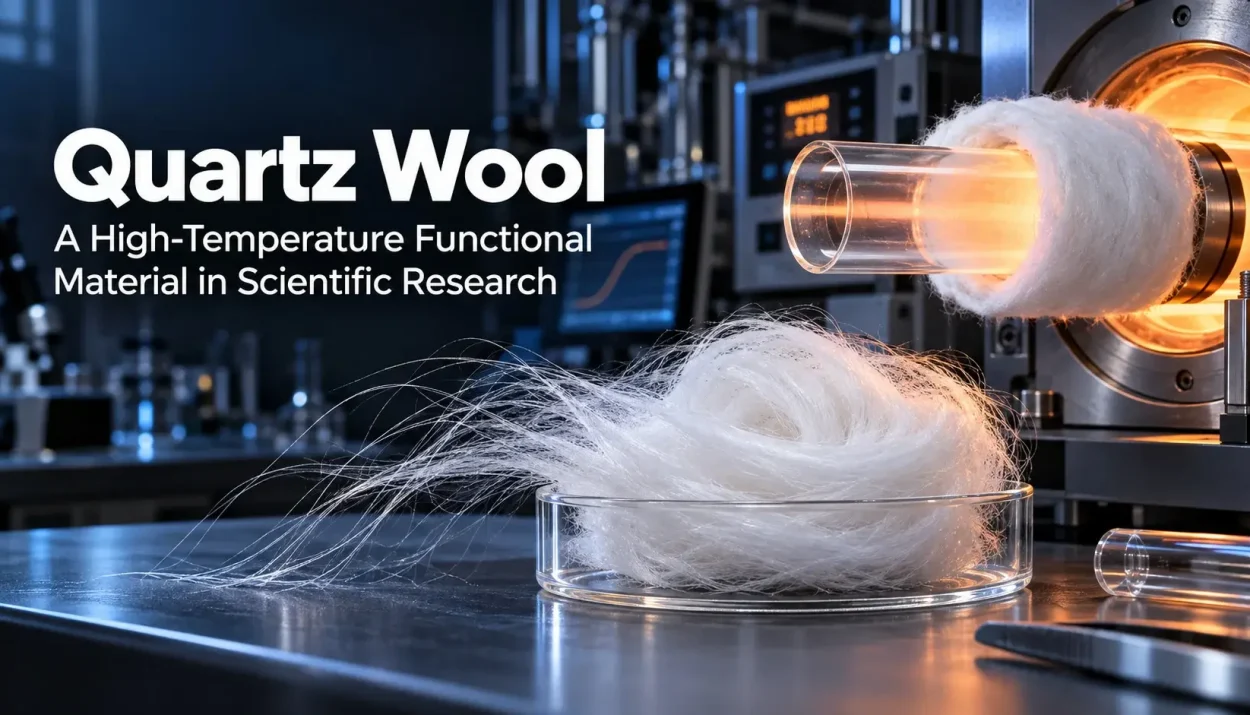
Quartz wool is a specialized fibrous material used in scientific and industrial research where high-temperature stability, chemical resistance, filtration, and controlled material handling are important. Its distinctive combination of a lightweight fibrous structure and quartz’s inherent stability makes it particularly useful in experimental systems that operate under demanding thermal conditions.
Unlike conventional insulation materials, quartz wool can serve several functions within a single experimental setup. It can provide thermal separation, retain particulate samples, support granular materials, and assist with filtration while maintaining its structural integrity at elevated temperatures. These characteristics have established quartz wool as a valuable material for laboratory-scale research and experimental engineering.
Understanding the Structure of Quartz Wool
Quartz wool consists of extremely fine quartz fibers arranged into a loose, interconnected network. The spaces between the fibers create a porous structure through which gases can move while solid particles can be physically retained.
Quartz wool performance depends strongly on characteristics such as fiber diameter, density, packing arrangement, purity, and overall thickness. Researchers can select different grades or packing configurations according to the requirements of a particular experimental system.
Fibrous architecture is especially important because it lets quartz wool combine low weight with useful mechanical and thermal performance. Instead of forming a dense solid barrier, it creates a three-dimensional network that interacts with heat, gases, and particulate materials.
High-Temperature Performance
One of the most important characteristics of quartz wool is its ability to function in elevated-temperature environments. This makes it suitable for experimental systems involving furnaces, heated tubes, thermal treatment assemblies, and controlled-atmosphere reactors.
During high-temperature experiments, materials used inside the reaction or heating zone must remain stable enough not to become an unwanted source of contamination or structural failure. Quartz wool provides a practical solution for applications that require a thermally stable fibrous material.
Its low thermal mass can also benefit laboratory systems. Because it requires relatively little material to provide a physical barrier or support structure, researchers can design compact experimental assemblies without adding unnecessary bulk.
Thermal Management in Experimental Systems
Temperature control is fundamental to many areas of scientific research. Even relatively small variations in the thermal environment can affect experimental observations. You can position quartz wool around selected areas of a laboratory setup to provide localized thermal insulation. In tube-based systems, it can help separate different thermal regions and reduce unwanted heat transfer.
Its fibrous structure also provides numerous small spaces that can influence heat movement through the material. As a result, quartz wool can contribute to more controlled thermal environments around samples and reaction zones.This makes it useful when researchers need to maintain a stable temperature distribution without substantially increasing the size or complexity of an experimental apparatus.
Quartz Wool in Filtration Research
The interconnected fibers of quartz wool provide a natural physical filtration structure. When a gas stream passes through the material, suspended particles can become trapped within the fiber network.This property has applications in laboratory filtration and experimental sampling systems, particularly when filtration must occur under elevated-temperature conditions.
Quartz wool can therefore serve as a collection medium in experiments involving particulate matter, aerosols, and thermally processed materials. Its ability to combine filtration with thermal stability distinguishes it from many conventional laboratory filter materials.
Sample Retention and Material Support
In laboratory reactors and heated tubes, loose powders or small particulate samples may need to remain within a defined region. Researchers can place quartz wool at selected positions to physically retain these materials while allowing gases to move through the experimental zone.
This approach is particularly useful for research involving granular materials, catalyst beds, powders, and other particulate samples. The amount and arrangement of quartz wool can be adjusted according to the experimental design. Researchers may use a small plug for simple retention or a carefully packed section when greater filtration or support is required.
Chemical Resistance
High-purity quartz resists many chemical environments encountered during laboratory experimentation. This is important when researchers want to minimize interactions between the support material and the experimental system.Material selection can influence experimental results through contamination, surface interactions, or unwanted reactions.
The relative chemical stability of quartz wool makes it attractive for applications where maintaining experimental cleanliness is important.However, always evaluate compatibility based on the specific chemicals, temperatures, atmospheric conditions, and exposure duration of an experiment.
Applications in Materials Research
Quartz wool is particularly relevant to materials research because many experimental processes require simultaneous control of temperature, atmosphere, and sample positioning. It can be incorporated into experimental systems used for thermal treatment, material synthesis, powder processing, surface studies, gas-flow experiments, and high-temperature characterization.
for researchers working with small quantities of experimental material, quartz wool offers a convenient way to position and retain samples without complex mechanical structures.
Use in Tube Furnace Experiments
Tube furnaces are widely used for controlled heating experiments. In these systems, quartz wool can hold experimental materials at a desired position inside the heated region. It can also separate different components of the experimental assembly.
For example, a quartz wool plug can prevent particulate material from moving into downstream sections of a tube while still allowing gases to pass through. This makes quartz wool particularly useful in experiments where you need to control solid particles without significantly restricting gas flow.
Importance of Purity
Purity is important when using quartz wool in research. Trace contaminants introduced by a supporting or insulating material can interfere with analytical measurements or alter experimental observations. High-purity quartz wool is therefore preferred for applications where contamination control is critical.
Select the appropriate grade based on the experiment’s sensitivity and the operating environment.Researchers should also consider how the material has been manufactured, cleaned, packaged, and handled before use.
Fiber Diameter and Packing Density
Not all quartz wool behaves in the same way. Fiber dimensions and packing density can significantly influence filtration, permeability, thermal behavior, and sample retention.A loosely arranged structure generally allows greater gas movement, whereas a more densely packed structure can provide greater particle retention.
Similarly, finer fibers can produce a more interconnected network.These characteristics allow researchers to adapt quartz wool to different experimental requirements rather than treating it as a single standardized material.
Advantages for Scientific Research
Quartz wool provides several useful characteristics within experimental environments:
- High-temperature stability
- Low thermal mass
- Lightweight fibrous construction
- Useful thermal insulation
- Physical particle retention
- Filtration capability
- High-purity material options
- Resistance to many chemical environments
- Easy integration into laboratory assemblies
- Compatibility with many quartz-based experimental systems
These characteristics make quartz wool a versatile material for laboratory research.
Considerations When Using Quartz Wool
Although quartz wool is highly useful, select it based on the experiment’s specific requirements. Researchers should consider operating temperature, atmosphere, chemical exposure, fiber dimensions, packing density, required filtration performance, and purity.
Handle it carefully, as fine fibers can become airborne when the material is cut, pulled apart, or aggressively manipulated. Therefore, follow appropriate laboratory handling and personal protective practices.
Future Research Opportunities
The scientific potential of quartz wool extends beyond conventional filtration and insulation. Researchers can investigate how fiber geometry, packing density, surface characteristics, and thermal conditions influence its behavior within complex experimental systems. Researchers can also design customized quartz-wool structures for specific applications.
Researchers could investigate controlled fiber arrangements to improve thermal management, particle retention, gas-flow distribution, and sample positioning. Such studies could help transform quartz wool from a conventional laboratory consumable into a more deliberately engineered functional component for advanced experimental systems.
Conclusion
Quartz wool represents a simple yet highly versatile material for high-temperature scientific research. Its fibrous architecture enables it to perform multiple functions, including thermal insulation, sample retention, filtration, and material support. Its value lies not in a single property but in the combination of thermal stability, chemical resistance, porosity, low mass, and flexible physical structure.
These characteristics allow researchers to incorporate quartz wool into a wide range of laboratory systems while maintaining relatively simple experimental configurations. As scientific research continues to demand greater control over temperature, gas flow, particulate movement, and material purity, quartz wool remains an important functional material for designing reliable and controlled high-temperature experimental environments.