
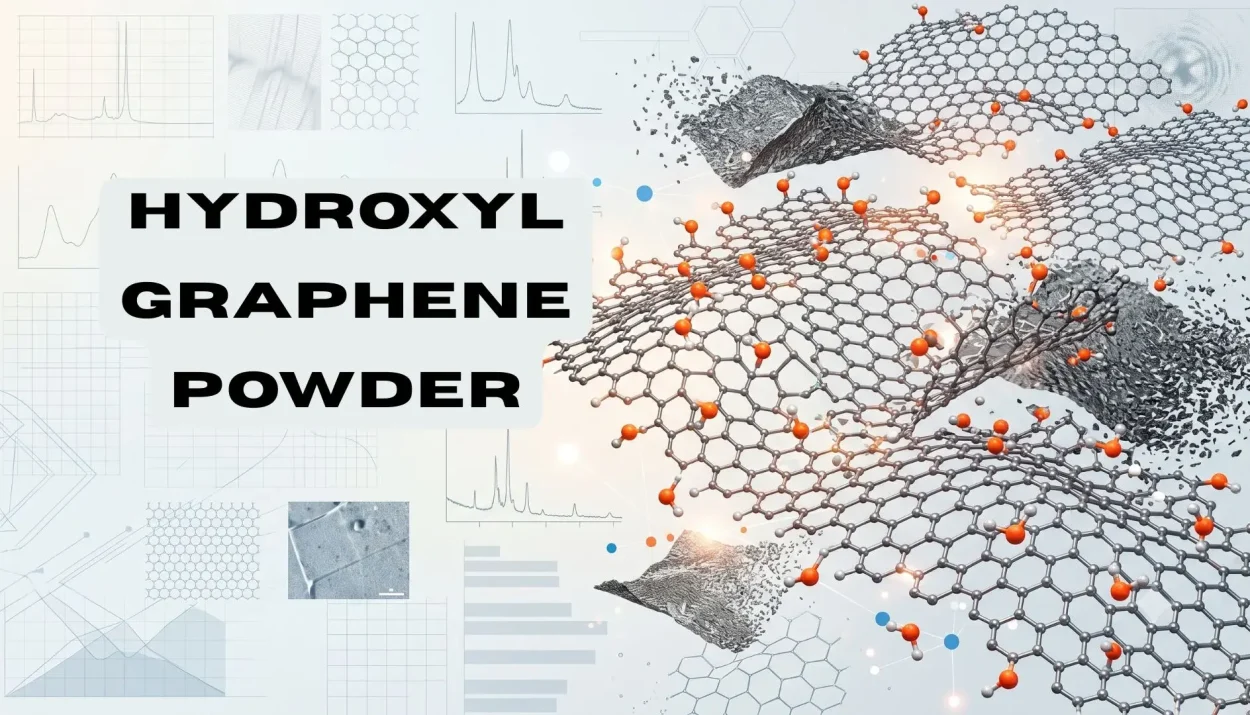
Hydroxyl graphene powder is a functionalized graphene-based nanomaterial containing hydroxyl (–OH) groups on or around the graphene surface. Introducing oxygen-containing functional groups can modify graphene’s surface chemistry and its interactions with other materials. As a result, hydroxyl-functionalized graphene has attracted interest in materials science, nanotechnology, surface engineering, energy research, sensors, coatings, and advanced composite development.
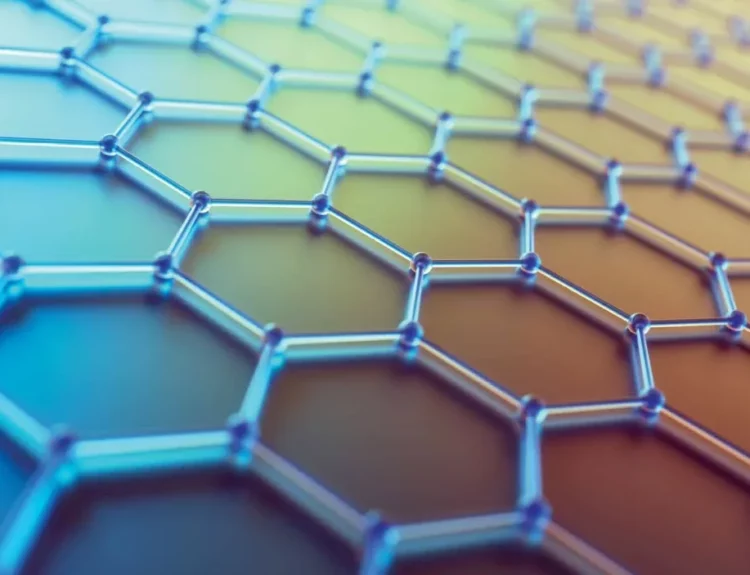
Graphene consists of a two-dimensional carbon structure arranged in a hexagonal lattice. While pristine graphene offers excellent electrical, thermal, mechanical, and surface properties, its relatively low surface reactivity and limited compatibility with some surrounding materials can restrict certain applications. Surface functionalization offers a way to tailor these characteristics.
Hydroxyl functionalization is particularly interesting because –OH groups can increase surface polarity and provide additional sites for interaction with solvents, polymers, nanoparticles, and other functional materials.
What Is Hydroxyl Graphene Powder?
Hydroxyl graphene powder refers to graphene material that contains hydroxyl groups introduced through controlled surface modification or functionalization. Depending on the preparation method and degree of functionalization, the material can exhibit different chemical compositions, defect concentrations, surface areas, layer structures, and electrical characteristics.
The properties of hydroxyl graphene depend on several parameters, including:
- Number of graphene layers
- Lateral sheet dimensions
- Hydroxyl-group concentration
- Defect density
- Carbon-to-oxygen ratio
- Surface area
- Purity
- Bulk density
- Preparation method
- Degree of exfoliation
Because these parameters can vary significantly, characterization is an important part of evaluating hydroxyl graphene powder for research applications.
Surface Functionalization of Graphene
Surface functionalization involves modifying the graphene surface to introduce specific chemical groups or improve its interaction with other materials. Researchers can introduce hydroxyl groups through various chemical or physical approaches.
Chemical Functionalization
Chemical methods can introduce oxygen-containing groups onto graphene surfaces through controlled reactions. The reaction conditions, reagent concentration, temperature, and processing time can influence the final degree of functionalization.
Oxidation-Based Approaches
Controlled oxidation can generate oxygen-containing groups, including hydroxyl, carbonyl, and epoxy functionalities. Further processing can adjust the chemical composition and structural characteristics of the resulting graphene material.
Mechanical and Sonochemical Methods
Mechanical processing and sonication can assist in exfoliation, dispersion, and surface modification. These techniques can influence particle size, layer distribution, and the accessibility of functional groups.
The choice of functionalization method depends on the desired surface chemistry and the intended research application.
Important Properties of Hydroxyl Graphene Powder
- Surface Chemistry
Hydroxyl groups change the chemical environment of the graphene surface. These groups provide additional sites for intermolecular interactions and can influence the material’s compatibility with polar solvents and other functional materials.
- Surface Wettability
Pristine graphene generally exhibits relatively low surface wettability toward polar environments. Hydroxyl functionalization can increase surface polarity and improve interaction with polar liquids. This characteristic can be useful when incorporating graphene into water-based systems, polymer matrices, coatings, and composite materials.
- Dispersion Behavior
Functional groups can influence the dispersion of graphene sheets within selected solvents or matrices. Improved surface interaction may help reduce aggregation under suitable processing conditions. However, dispersion stability depends on several factors, including functional-group concentration, solvent chemistry, concentration, particle size, and processing conditions.
- Electrical Properties
Graphene is known for its high electrical conductivity. Functionalization can modify the electronic structure by introducing defects or changing the bonding environment of carbon atoms.
Therefore, the electrical conductivity of hydroxyl-functionalized graphene may differ from that of pristine graphene. The final electrical behavior depends strongly on the degree and type of functionalization.
- Thermal Properties
Graphene materials generally exhibit excellent thermal characteristics. Surface functionalization can influence thermal stability because additional chemical groups may alter the surface structure and decomposition behavior.
Thermal analysis can therefore evaluate the stability of hydroxyl graphene under controlled heating conditions.
- Mechanical Characteristics
Graphene has exceptional mechanical strength and stiffness. When incorporated into a suitable matrix, functionalized graphene can influence interfacial bonding and stress transfer.
The resulting mechanical performance depends on graphene concentration, dispersion quality, functionalization level, matrix chemistry, and processing conditions.
- High Specific Surface Area
Graphene’s two-dimensional structure provides a large accessible surface area. The actual measured surface area depends on layer number, aggregation, porosity, drying conditions, and measurement methodology.
Characterization Techniques
Comprehensive characterization is essential for understanding hydroxyl graphene powder.
Raman Spectroscopy
Raman spectroscopy is widely used to investigate the structural characteristics of graphene materials.
Important features include:
- D band: associated with structural disorder and defects
- G band: associated with the graphitic carbon framework
- 2D band: provides information related to graphene layer structure
The ratio between characteristic Raman bands can indicate structural changes after functionalization.
Fourier Transform Infrared Spectroscopy (FTIR)
FTIR can identify chemical bonds and functional groups in the material.
For hydroxyl-functionalized graphene, FTIR analysis may provide evidence of:
- O–H stretching
- C–O bonding
- C=C-related structures
- Other oxygen-containing functionalities
FTIR is particularly useful for investigating changes in surface chemistry after functionalization.
X-Ray Photoelectron Spectroscopy (XPS)
XPS provides information about elemental composition and chemical bonding at the material surface. Carbon and oxygen signals can be analyzed to estimate surface composition and identify different chemical states of carbon and oxygen.
Scanning Electron Microscopy (SEM)
SEM provides information about surface morphology, particle structure, aggregation, and general sheet morphology. It is useful for examining the physical appearance and distribution of graphene-based material.
Transmission Electron Microscopy (TEM)
TEM can provide higher-resolution information about graphene sheets, layer structures, edges, and nanoscale morphology.
Atomic Force Microscopy (AFM)
AFM can investigate sheet thickness, surface topography, lateral dimensions, and nanoscale morphology. This technique is particularly useful for studying exfoliated graphene sheets deposited onto suitable substrates.
Thermogravimetric Analysis (TGA)
TGA measures changes in material mass as a function of temperature. It provides information on thermal stability and the presence of volatile or decomposing surface functionalities.
BET Surface-Area Analysis
BET analysis can determine specific surface area through gas adsorption measurements. It provides useful information for comparing different graphene powders and evaluating the effects of aggregation and processing.
Hydroxyl Graphene in Advanced Material Research
Researchers are investigating hydroxyl graphene as a functional building block for advanced materials because its surface chemistry can be tailored to interact with different matrices and compounds.
Polymer Nanocomposites
Functionalized graphene can be incorporated into polymer systems to investigate changes in mechanical strength, electrical properties, thermal stability, barrier characteristics, and interfacial bonding. Hydroxyl groups may improve interaction between graphene and selected polar polymer matrices.
Conductive Materials
Graphene-based materials are widely studied for conductive coatings, composite structures, electrodes, and other research systems requiring controlled electrical properties. Functionalization helps balance surface compatibility with electrical performance.
Energy-Material Research
Researchers investigate functionalized graphene as a component of electrodes, conductive networks, and other advanced material systems used in energy-related research. Its high surface area, tunable surface chemistry, and electrical properties make it an interesting platform for developing composite structures.
Sensors and Surface Interfaces
Chemically active surface groups can provide additional interaction sites for selected molecules and materials. This makes functionalized graphene useful for research into sensing platforms and engineered interfaces.
Coatings and Surface Engineering
Hydroxyl graphene can be investigated as an additive in functional coatings where surface interaction, conductivity, mechanical performance, or barrier characteristics are important.
Factors Affecting Material Performance
The performance of hydroxyl graphene powder is strongly dependent on its material parameters. Important factors include:
- Degree of hydroxyl functionalization
- Graphene layer number
- Sheet size
- Surface area
- Defect concentration
- Carbon-to-oxygen ratio
- Purity
- Dispersion quality
- Processing conditions
- Compatibility with the selected matrix
Two hydroxyl graphene products with similar names can therefore demonstrate different properties if their structural and chemical characteristics differ.
Importance of Material Characterization
For research and industrial development, consider characterization data alongside product specifications. A typical technical characterization package may include:
TEM
Sheet
| Parameter | Typical Characterization Method |
| Functional groups | FTIR |
| Elemental composition | XPS / elemental analysis |
| Structural defects | Raman spectroscopy |
| Morphology | |
| SEM / | |
| thickness | AFM |
| Surface area | BET |
| Thermal stability | TGA |
| Dispersion behavior | Optical analysis / particle characterization |
| Electrical properties | Four-point probe or suitable conductivity measurement |
ParameterTypical Characterization MethodFunctional groupsFTIRElemental compositionXPS / elemental analysisStructural defectsRaman spectroscopyMorphologySEM / TEMSheet thicknessAFMSurface areaBETThermal stabilityTGADispersion behaviorOptical analysis / particle characterizationElectrical propertiesFour-point probe or suitable conductivity measuremen.
Determine actual values experimentally for each material batch rather than assuming them from general graphene specifications.
Research Opportunities
Hydroxyl-functionalized graphene continues to provide opportunities for research into surface chemistry and advanced material design. Future studies can focus on controlling functional-group concentration, improving dispersion, understanding structure-property relationships, and developing reproducible functionalization methods.
Researchers can also investigate combinations of hydroxyl graphene with polymers, metals, ceramics, carbon-based materials, and other nanostructures to develop multifunctional composites. An important research direction is establishing a clear relationship between functionalization level → structural changes → surface properties → material performance. Such studies can help researchers optimize graphene-based materials for specific experimental requirements.
Conclusion
Hydroxyl graphene powder is a versatile functionalized carbon nanomaterial whose properties can be modified through controlled surface chemistry. Introducing hydroxyl groups can influence wettability, dispersion, interfacial interaction, electrical characteristics, thermal behavior, and compatibility with other materials.
Advanced characterization techniques such as Raman spectroscopy, FTIR, XPS, SEM, TEM, AFM, TGA, and BET analysis provide complementary information on the material’s structure and properties. With its tunable surface chemistry and combination of nanoscale structure with graphene’s intrinsic properties, hydroxyl graphene remains an important research material for advanced composites, conductive systems, surface engineering, sensors, and energy-material research.