
Indium Tin Oxide (ITO)-coated PET film is an important material in scientific research involving flexible electronics, transparent electrodes, and optoelectronic devices. It combines ITO’s electrical conductivity and optical transparency with the lightweight, flexible properties of polyethylene terephthalate (PET).
The performance of ITO-coated PET films depends on several fabrication parameters, including deposition temperature, coating thickness, working pressure, oxygen concentration, and deposition time. Among these factors, deposition temperature can influence the microstructure, surface morphology, electrical resistance, and optical transmittance of the ITO layer.
Understanding the relationship between deposition temperature and film properties is essential for developing transparent conductive substrates with consistent performance while maintaining the polymer substrate’s dimensional stability.
Material Structure of ITO-Coated PET Films
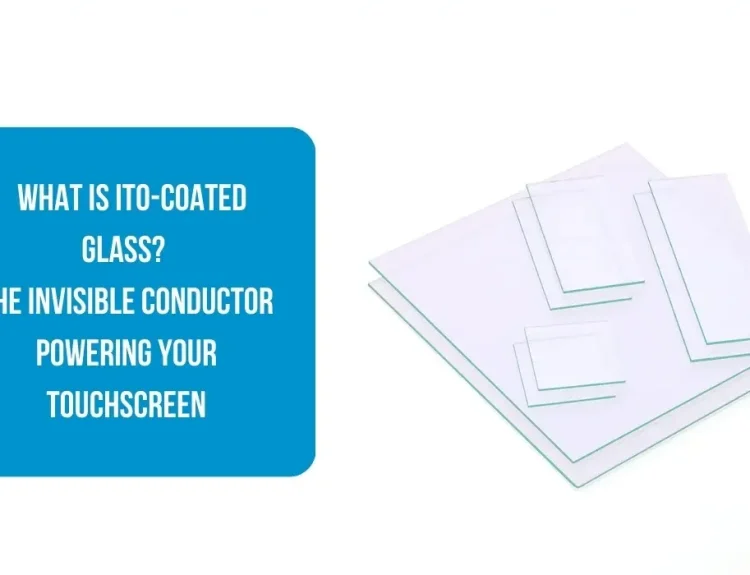
ITO-coated PET film consists of a thin indium tin oxide layer deposited on a PET polymer substrate. ITO is a transparent conducting oxide commonly composed of indium oxide doped with tin oxide. Its material structure supports electrical conduction while allowing visible light to pass through.
PET provides a lightweight and flexible support suitable for thin-film applications. However, its thermal properties differ from those of rigid glass substrates, making temperature control important during deposition.
The primary characteristics of ITO-coated PET films include:
- conductivity and sheet resistance.
- Visible-light transmittance.
- Coating thickness and uniformity.
- Surface roughness and morphology.
- Adhesion between ITO and PET.
- Resistance to repeated bending.
- Dimensional stability during thermal processing.
These characteristics are interrelated, and their optimization requires careful control of deposition conditions.
Role of Deposition Temperature in Film Formation
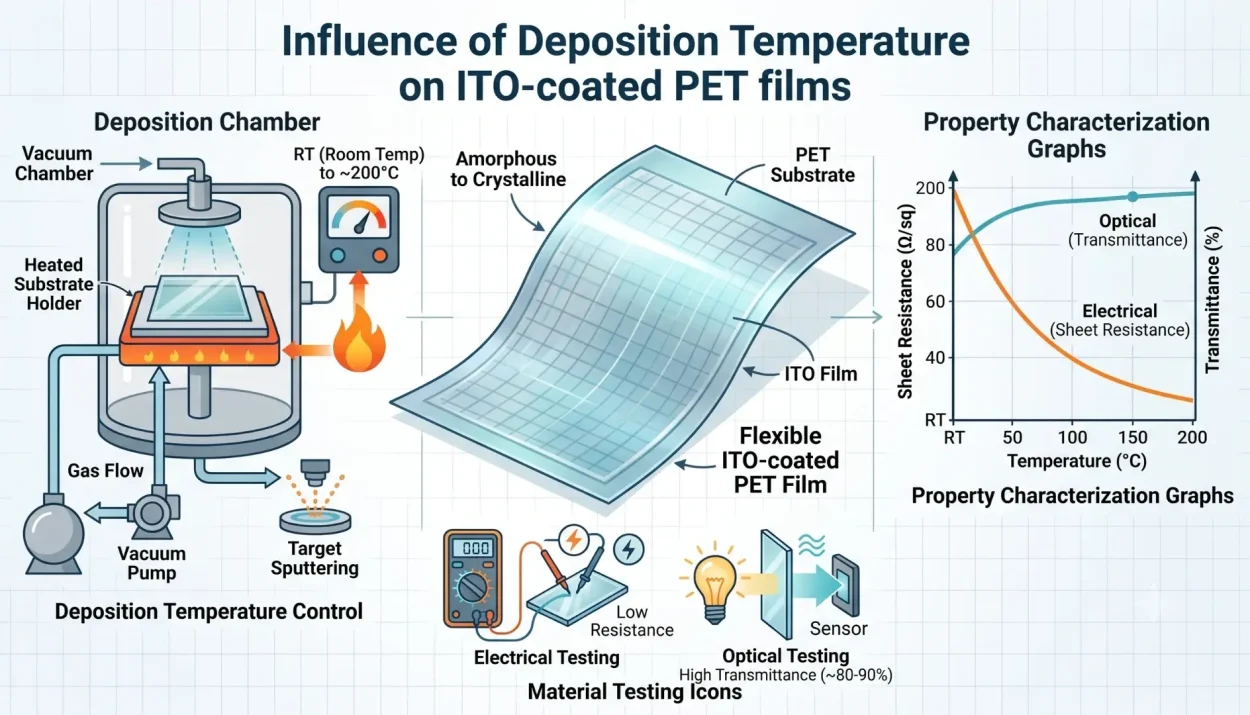
Deposition temperature influences atomic movement and arrangement during ITO coating formation. Depending on the deposition method, temperature can affect surface diffusion, grain development, crystallinity, and the formation of structural defects.
At relatively low deposition temperatures, the deposited layer may exhibit limited atomic mobility and a less-developed crystalline structure. These characteristics can influence electrical transport and surface uniformity.
Increasing the deposition temperature may change film density, crystallinity, and grain structure. Under suitable conditions, these changes can improve electrical performance. However, the relationship is not always linear because the final properties also depend on oxygen concentration, deposition rate, coating thickness, and the characteristics of the deposition system.
For PET-supported films, excessive thermal exposure can cause shrinkage, warping, or other dimensional changes. Therefore, the appropriate temperature range must support ITO film formation without compromising the polymer substrate.
Researchers should also distinguish between substrate temperature during deposition and temperature used for subsequent thermal treatment, as both can influence the final film differently.
Influence of Deposition Temperature on Electrical Properties
Electrical performance is one of the most important evaluation criteria for ITO-coated PET films. Sheet resistance is commonly used to assess the conductive layer’s ability to carry electrical current.
Deposition temperature can influence electrical properties by changing carrier concentration, carrier mobility, oxygen-related defects, and the coating microstructure.
Charge Transport
Charge transport depends on the ITO layer’s quality and the presence of structural imperfections. Changes in deposition temperature can affect defect distribution and the arrangement of the deposited material, potentially altering electrical resistance.
Grain Structure
The crystalline structure and grain boundaries of ITO can influence charge transport. Temperature-dependent changes in grain size and grain-boundary characteristics may affect the coating’s resistance.
Sheet Resistance Uniformity
A coating with uniform thickness and consistent microstructure generally supports more reproducible electrical measurements. Researchers can measure sheet resistance at multiple locations to determine whether deposition temperature affects electrical uniformity.
When comparing samples, also measure coating thickness. Otherwise, changes in sheet resistance may reflect thickness variations rather than temperature-related changes in the intrinsic electrical properties.
Influence of Deposition Temperature on Optical Properties
Optical transmittance is a critical property of transparent conductive films. ITO-coated PET is designed to provide electrical conduction while maintaining useful visible-light transmission.
Deposition temperature can influence optical behavior by affecting the coating’s thickness, density, surface roughness, defect concentration, and crystalline structure.
Visible-Light Transmittance
Visible-light transmittance describes how effectively the complete film allows visible light to pass through. It is commonly measured using a UV–visible spectrophotometer.
The measured value depends on both the ITO coating and the PET substrate, as well as reflection, absorption, and scattering within the material.
Optical Absorption
Changes in ITO’s electronic structure and defect characteristics may influence optical absorption. Researchers can examine the transmission spectrum over a defined wavelength range to identify temperature-related changes.
Surface Roughness
Surface irregularities can scatter light and affect optical consistency. Deposition temperature may influence the coating’s surface morphology, making surface analysis useful when interpreting transmittance changes.
The goal is to identify processing conditions that provide suitable optical transparency alongside the required electrical performance.
Deposition Techniques and Temperature Control
Several techniques deposit ITO onto PET films. Each method has specific process requirements and can produce different film characteristics.
Magnetron Sputtering
Magnetron sputtering is widely used for depositing transparent conductive oxide coatings. The process transfers material from an ITO target to the substrate through plasma-assisted physical deposition.
Important parameters include sputtering power, working pressure, oxygen concentration, deposition duration, and substrate temperature. These variables influence coating thickness, microstructure, electrical resistance, and optical transmittance.
Because PET is temperature-sensitive, the deposition conditions must be selected to limit thermal deformation while achieving the desired coating quality.
Roll-to-Roll Deposition
Roll-to-roll processing enables continuous coating of flexible films. It is relevant to large-area production because the polymer substrate moves through the deposition system during coating.
Maintaining consistent temperature and deposition conditions is important for obtaining uniform electrical and optical properties across the film.
Temperature-Controlled Processing
A controlled experimental setup lets researchers investigate different substrate temperatures while keeping other deposition parameters as consistent as possible.
Important controls include substrate preparation, coating duration, working pressure, deposition power, gas composition, and cooling conditions. Documenting these parameters improves reproducibility and helps isolate the effect of deposition temperature.
Experimental Methodology
A systematic experimental approach can investigate the relationship between deposition temperature and ITO-coated PET film performance.
Step 1: Substrate preparation
Select PET films with consistent dimensions, thickness, and surface quality. Clean the substrates using a method compatible with the polymer and deposition process.
Step 2: Controlled deposition
Prepare several samples using different substrate temperatures within the permitted processing range. Keep other deposition parameters consistent wherever possible.
Step 3: Thickness measurement
Measure the ITO coating thickness using a suitable technique. This provides important context for comparing electrical and optical properties.
Step 4: Electrical characterization
Measure sheet resistance at multiple locations on each sample. Record the average value and variation to evaluate conductivity and coating uniformity.
Step 5: Optical characterization
Measure visible-light transmittance using a UV–visible spectrophotometer. Record the measurement wavelength and specify whether the reported result represents the complete coated film or the ITO layer alone.
Step 6: Structural analysis
Use appropriate techniques such as X-ray diffraction, scanning electron microscopy, or atomic force microscopy to examine crystallinity, surface morphology, and roughness.
Step 7: Comparative evaluation
Compare electrical, optical, and structural results to identify temperature conditions associated with the desired film properties. Include repeated measurements to assess experimental variability.
Characterization Techniques
A combination of analytical methods provides a more complete understanding of the relationship between deposition temperature and film performance.
| Technique | Property Evaluated | Research Purpose |
| Four-point probe | Sheet resistance | Evaluates electrical performance |
| UV–visible spectroscopy | Optical transmittance | Measures visible-light transmission |
| X-ray diffraction | Crystalline structure | Investigates structural changes |
| Scanning electron microscopy | Surface morphology | Identifies defects and coating features |
| Atomic force microscopy | Surface roughness | Examines nanoscale surface characteristics |
| Thickness measurement | Coating thickness | Supports electrical and optical comparisons |
| Bending tests | Resistance stability | Evaluates performance under mechanical deformation |
Combining these techniques helps researchers determine whether changes in electrical or optical behavior correspond to variations in film structure, thickness, or surface quality.
Relationship Between Optical and Electrical Performance
Developing transparent conductive films requires balancing electrical conductivity and optical transparency.
Increasing the ITO coating thickness may reduce sheet resistance, but it can also affect visible-light transmission. Deposition temperature may further influence this relationship by changing the coating’s microstructure and defect characteristics.
Under suitable conditions, adjusting the temperature may improve electrical performance while maintaining acceptable optical transparency. However, the result depends on the deposition method, material composition, oxygen conditions, and PET substrate properties.
Researchers should therefore identify a suitable processing window rather than assume that the highest possible deposition temperature will produce the best results.
A comparative study should consider sheet resistance, visible-light transmittance, coating thickness, surface roughness, and substrate dimensional stability together.
Mechanical Stability of ITO-Coated PET Films
ITO is an inorganic conductive coating that can crack under repeated bending. Although PET provides flexibility, the conductive layer may not tolerate the same deformation without changes in electrical performance.
Deposition temperature can indirectly influence mechanical stability by affecting film density, microstructure, residual stress, and adhesion to the substrate.
Researchers can investigate mechanical stability by measuring resistance before and after controlled bending tests. Document the bending radius, number of cycles, bending direction, and measurement conditions.
Surface inspection can help identify cracks, delamination, or other defects associated with changes in electrical resistance.
This analysis is particularly relevant when selecting ITO-coated PET films for flexible electronic structures.
Research Challenges and Future Directions
A main challenge in ITO-coated PET research is improving electrical conductivity without compromising transparency or the polymer’s dimensional stability.
Higher deposition temperatures may support favorable changes in the ITO layer, but excessive thermal exposure can deform PET. Lower-temperature deposition methods and optimized process conditions are therefore important areas for research.
Future investigations may focus on improving coating adhesion, controlling oxygen concentration, optimizing deposition power, and reducing variations in sheet resistance across large areas.
Additional research can evaluate long-term electrical stability, resistance changes during repeated bending, and how coating thickness affects optical and electrical performance.
Standardized reporting of deposition conditions, actual substrate temperature, film thickness, sheet resistance, optical transmittance, and testing methods will improve reproducibility and facilitate comparisons between research studies.
Conclusion
Deposition temperature is a key fabrication parameter that affects the optical and electrical properties of ITO-coated PET films. It can influence the microstructure, crystallinity, surface morphology, defect characteristics, and electrical transport behavior of the ITO coating.
Although suitable deposition conditions can improve electrical performance, results depend on the deposition technique, coating thickness, oxygen concentration, and the PET substrate’s thermal limitations. Excessive temperature can compromise dimensional stability and reduce the reliability of the complete film.
A systematic approach combining electrical measurements, optical spectroscopy, structural analysis, and thickness characterization can help researchers identify suitable processing conditions. Such investigations support the development of transparent conductive substrates for flexible electronics, thin-film research, and advanced optoelectronic applications.