

Transparent conductive glass combines two properties that are normally difficult to achieve together: electrical conductivity and optical transparency. This makes it useful in displays, touch panels, solar cells, sensors, electrochemical devices, and other optoelectronic systems.
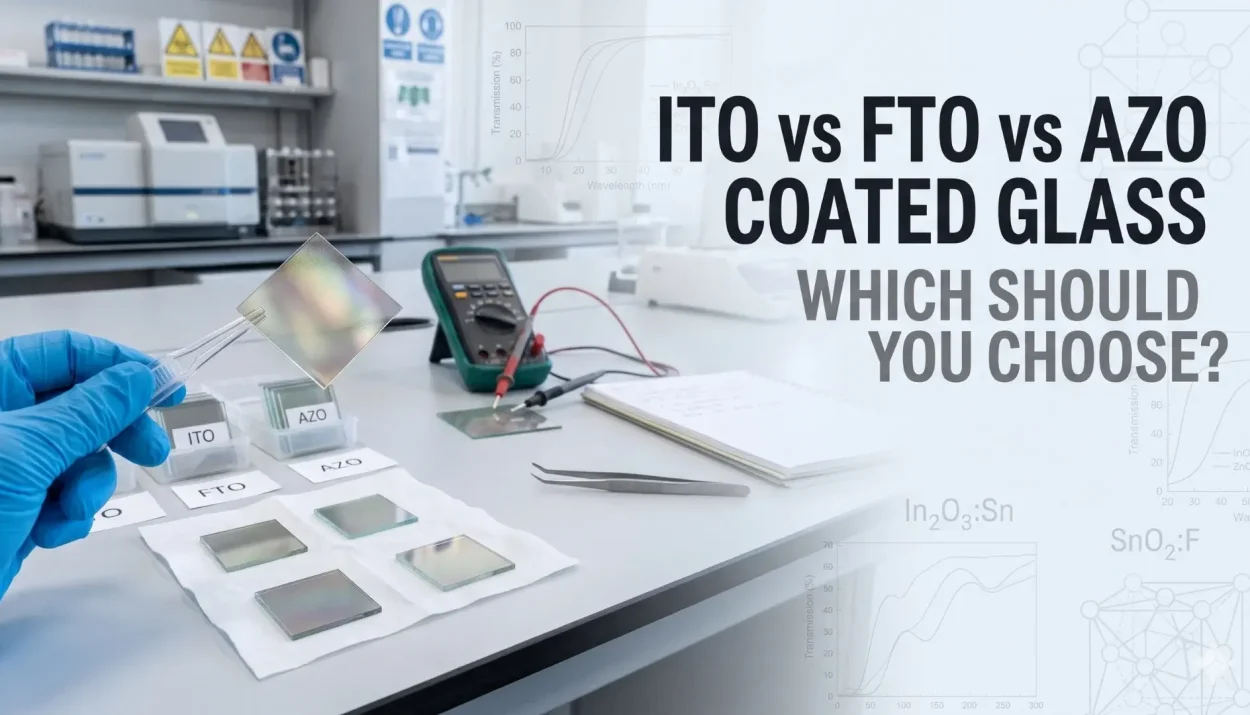
Shipment includes ITO-, FTO-, and AZO-coated glass. Each product meets different technical requirements, with variations in electrical conductivity, optical transparency, thermal stability, chemical resistance, processing needs, and cost. The right choice depends on what the glass needs to do and the conditions it will face during manufacturing and operation.
ITO Coated Glass
ITO-coated glass has a thin, clear layer of indium tin oxide on its surface. The layer conducts electricity, yet light can still pass through it. That is why it is used in touchscreens, displays, optical devices, and transparent electrodes. The coating is usually applied by sputtering and can be patterned to fit a specific design. If it stays at high temperatures for too long, its conductivity can drop.
Buy ITO Coated Glass: Techinstro | Shilpent
FTO Coated Glass
FTO-coated glass has a thin layer of fluorine-doped tin oxide. It conducts electricity and stays transparent. It withstands heat and chemicals well and is quite durable. Because of this, it works well in solar cells, electrochemical systems, and sensors. FTO handles high temperatures better than ITO, but it usually has higher electrical resistance.
Buy FTO Coated Glass: Techinstro | Shilpent
AZO Coated Glass
AZO-coated glass has a transparent conductive layer made of aluminum-doped zinc oxide. It offers a good mix of conductivity and light transmission and does not require indium. This makes it a handy choice when cost matters, such as in solar cells, displays, and sensors. Performance depends on the coating method, layer thickness, and the type of glass used.
Buy Azo Coated Glass: Techinstro | Shilpent
Shared Similarities between ITO, FTO, and AZO Glass
Although their compositions differ, ITO, FTO, and AZO belong to the same broad family of transparent conductive oxides. Their main similarities include:
- They combine electrical conductivity with high visible-light transmission.
- Glass substrates can be coated with a thin layer of these materials to create conductive surfaces.
- They are widely used as transparent electrodes in various applications.
- Coating thickness and deposition conditions affect their optical and electrical performance.
- These coatings are used in electronics, optics, photovoltaics, and sensor technologies.
- Modifying the coating structure and production process can control their properties.
ITO vs FTO vs AZO: Head-to-Head Comparison
| Feature | ITO Glass | FTO Glass | AZO Glass |
| Conductivity | Very high | Moderate to high | Moderate to high |
| Visible transparency | High | High | High |
| Thermal stability | Moderate | Excellent | Good to high |
| Chemical stability | Good | Excellent | Application-dependent |
| Material availability | Limited by indium | Good | Good |
| Relative cost | High | Moderate | Low |
| Common strength | Low resistance | Heat and chemical stability | Cost and material availability |
| Uses | Displays, touchscreens, electronics | Solar cells, sensors, high-temperature systems | Solar technology, electronics, transparent electrodes |
Conductive Glass Applications
ITO Applications
- Touchscreens: ITO forms a transparent conductive layer that senses touch while maintaining good light transmission.
- Flat-Panel Displays: It serves as a transparent electrode in LCD, OLED, and other types of display panels.
- Transparent Electrodes: ITO carries electrical current while allowing most visible light to pass through the coated surface.
- Optical Devices: Used in devices that require both electrical conductivity and optical transparency.
- Smart Glass: Enables electrically controlled glass transparency.
- Laboratory Devices: Used in experimental devices and testing systems that require transparent conductive surfaces.
FTO Applications
- Dye-Sensitized Solar Cells: Provides a transparent conductive surface for collecting and transferring electrical charges within the solar cell.
- Photovoltaic Systems: Used as a transparent conductive layer to support photovoltaic materials.
- Electrochemical Devices: Provide a conductive, stable surface for electrochemical reactions and testing.
- Chemical Sensors: Supports sensing layers while allowing electrical signals to be measured through the conductive coating.
- High-Temperature Electrode Systems: FTO offers good thermal stability, making it suitable for applications that operate at elevated temperatures.
- Electrochromic Devices: Functions as a transparent electrode for devices that change color or transparency when an electrical voltage is applied.
AZO Applications
- Solar Cells: Acts as a transparent conductive layer that allows light to enter while providing electrical conductivity.
- Transparent Electrodes: Provide conductivity while maintaining high light transmission.
- Optoelectronic Devices: Used in devices that combine electrical and optical functions, including light-emitting and light-detecting technologies.
- Sensors: Provide a conductive substrate for sensor systems that detect chemical, environmental, or physical changes.
- Display Technologies: Can be used as a transparent electrode material in certain display and electronic applications.
- Alternatives to Indium-Based Coatings: Provide a transparent conductive option without using indium.
Selection Guide: When and How to Choose the Right Coated Glass
No single coating is best for every application. Start by identifying the most important performance requirement.
Choose ITO when:
- Very low electrical resistance is important.
- The glass will be used in touch or display technology.
- Precise transparent electrodes are required.
- Optical and electrical performance need to be closely balanced.
Choose FTO when:
- The process involves high temperatures.
- You need strong resistance to chemicals and environmental conditions.
- The glass is intended for photovoltaic or electrochemical applications.
- The coating must remain stable and durable over a long period.
Choose AZO when:
- You want an indium-free alternative.
- Material cost and availability are important.
- The application requires good optical transparency and electrical conductivity.
- The application can work within AZO’s electrical and environmental limitations.
Conclusion
ITO, FTO, and AZO-coated glass all provide the same basic advantage: a transparent surface that can conduct electricity. Their differences become important when the application demands a specific combination of conductivity, transparency, durability, temperature resistance, and cost.
ITO is a good option for electronic and display applications that need low electrical resistance. FTO is used where the material must withstand high temperatures and chemicals, such as in solar and electrochemical systems. AZO can be a practical alternative to indium-based materials when lower cost, easy availability, and reduced indium use are important.
Instead of choosing based only on conductivity or price, evaluate the complete operating environment. The right coated glass should match the final product’s requirements.